Tag Archives: Iran

We need furious peacemakers: And they appear to be out there.

Ben Rhodes, who was Assistant to the President and Deputy National Security Advisor for Strategic Communications and Speechwriting (whew!) from 2009 to 2017, was a close confidant to President Obama and a key foreign policy advisor. In his NY Times opinion piece last week, he regretted a lot of what he did.

He looked at Trump’s latest expenditure of bombs and laid part of the blame for it on the tepid and toothless response of Democrats. He imagines some Congressional logic for why they were generally feckless:

[W]hat if Mr. Trump bombs Iran, and the regime collapses and is replaced by something better? You could feel this calculation within the Democratic Party as the war began — a hedging that only dissipated when the war’s brutality and insanity became clear. Behind it is a perverse logic: Both Iranian strength and Iranian weakness can justify war.

To be fair, the blame for this dynamic extends far beyond elected officials, to commentators who are at turns jingoistic, credulous of fearmongering and inclined to cover any harm done to Americans or our interests around the world as a political crisis; to think tanks that cast events particularly in the Middle East as problems that can be solved by U.S. intervention; to an entertainment industry that often valorizes American military and intelligence operations; and to people like me who have filled the ranks of Democratic administrations.

We’ve all been in a world of “what if” since Covid, so we can probably relate to the skittish Dems. Anxiety rules.

But “what if” is not the only rule that leads the opponents of Trump to be less than furious — like I wish they would be. You can see those rules in Rhodes’ writing: “calculation…hedging…perverse logic…our interests…problems that can be solved…entertainment industry…intelligence operation.” When we host the 250th anniversary of the Declaration this year, those words could be the key words to describe the new American experiment – put them on a banner over a background of a Minuteman, perhaps, to achieve the appropriate irony. I suppose we could include “brutality” and “insanity,” too. That’s what the country has perfected and who knows what it might do next?

Where are the peacemakers?

I know there are a lot of Christians who are out on the front lines boldly harassing ICE and telling the truth about the world and Jesus.  The aging clergy in Philly (and I can still be included in that group) have been out and getting arrested for their actions. At the end of March, twelve of them got in good trouble for blocking the ICE driveway at 8th and Cherry [Inquirer].
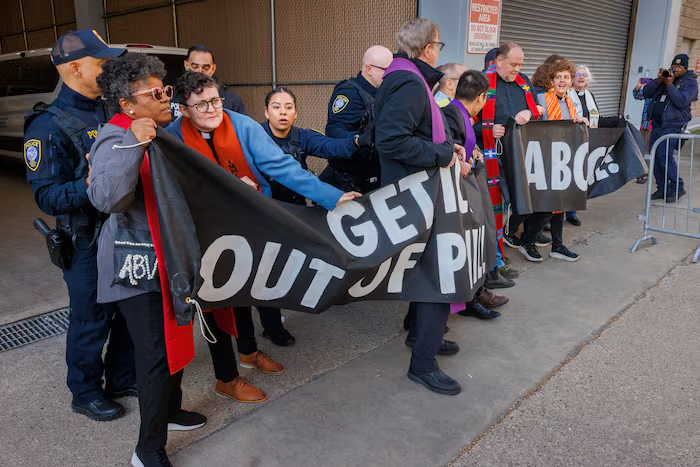
They are so loving, the officers smile at them when they help them get up off the street. Love will win if anything good wins.

But we could use some more furious love. Over 225 million people in the U.S. identify as Christians. That percentage used to be declining but apparently isn’t anymore. You’d think at least 100 million or so would actually be like Jesus. What if they were? That would be potent.

Paul says Jesus in our peace. That peacemaking got him killed. But a lot of people just make his peace an inner sense of peace with God and only as outer as getting along with others in whatever church they can manage to stay in.

Jesus is quite a bit more furious than that. Just read Matthew 23, where he tags people who preserve their own power with a perverted reading of the scripture as a “brood of vipers.” A bit later, he contrasts himself as a mother hen longing to brood over Jerusalem, to protect her children. There is nothing more furious than a mother separated from her children.

Or go back a few pages in Matthew to chapter 18, where Jesus says, 

If any of you cause one of these little ones who believe in me to sin, it would be better for you if a great millstone were fastened around your neck and you were drowned in the depth of the sea. Woe to the world because of things that cause sin! Such things are bound to come, but woe to the one through whom they come!

That is furious stuff. He must be especially inflamed right now. How in the world could any Christian support the brutality and insanity of the Iran War and defend the sociopath president undermining the whole world with it?  Jesus knows that sins are going to come, but his followers should do their best not to cause or cooperate with  them! They certainly won’t be praying for them to occur with Pete Hegseth and his nationalist pastor/mentor!

Furious peacemakers are out there

I hope the Christians are catching up. Maybe they will be out in force for May Day Strong. In the meantime, other prophets are doing their duty. Here are two of my favorites, in case you don’t know them, yet.

Briefly, start with Matthew Cooke. Cooke is not a Christian; he’s more of a Star Trek, Jesus-adjacent humanist. But he still gives some of the best sermons I have heard about what needs to happen in the world today. He is a furious, filmmaking, philosophizing peacemaker. I don’t sign up for a lot, but I don’t want to miss what he comes up with [Survivor’s guide]. Take a minute to listen as he preaches about taking back the future.

An even better example of what a furious Christian peacemaker should probably sound like is the politician Ben Rhodes was writing about in the Times: Graham Platner of Maine. He’s lightly Jewish if anything more than atheist. But his morality is spot on.

As a 20 year old, Platner had his first epiphany when he was constructing a patrol base near Falluja. A mortar round fired by Iraqi opponents killed the families of the troop’s local co-workers. He said, “There’s this thing I often think about. Those kids were killed because we were spending money to build this base that probably doesn’t exist anymore. [I thought] ‘How horrifically wasteful this is.’”

I agree. Since Sep. 11, 2001 the U.S. has spent more than $6 trillion fighting wars that killed over 7,000 Americans and hundreds of thousands of civilians, inflicting trauma on innumerable people. The country is responsible for destruction which has displaced tens of millions of people. The refugees who sought safety in the Eurocentric countries fueled a right-wing backlash to democracy. And what was built in Afghanistan, Iraq, Yemen, Somalia, Libya and now Iran? What could have  been built at home with those trillions of dollars? Just writing that burns me up.

Platner is with me. Visceral outrage infuses his opposition to the war in Iran: “Nobody is going to be able to convince me that what I did in Iraq and Afghanistan did anything for the people of Sullivan, Maine.”…“I don’t want other young Americans to go through what I’ve been through. And I don’t want to send other young Americans to inflict the horror that I had to inflict on people.”…“I don’t know a single guy I served with who thinks this thing in Iran is a good idea.”…[The reason] they were big Trump supporters — he was the antiwar or ‘America first’ candidate.”

Credit…Mark Peterson for The New York Times

“Here in the real world, most people get it,” Platner says of his campaign events. “Do you think this country should spend more on schools and hospitals and less on bombs? A lot of people are like, yeah, that’s pretty obvious.”

And yet the wars keep happening. The money keeps flowing to defense contractors. Traders, even in Congress, keep profiting from bets on the rise and fall of oil prices while the working class can’t afford to pay for a tank of gas [more here]. Insiders make ghoulish bets about the war on prediction markets while children are killed by American weapons in Iran and Lebanon.

Platner says, “We are so broken emotionally when it comes to our politics that we’ve literally created this story that it’s inherent in being a competent political leader to kill civilians. If you’re not willing to do some hard things and drop some bombs, then you’re not up to the task of power. I think it’s the opposite. You’re not up to the task of being in power if you do not think about the cost of violence. If that’s not at the front of your mind, then I don’t think you are morally in the right place to be in positions of power.”

Most of us know the forever war started by Bush has been destroying America from within, like an organism that must keep growing to survive. It fills the citizens with fear of outsiders and contempt for one another. War does the worst to societies. Once you normalize obliterating people abroad, people don’t value others at home, or even themselves.

They sound like Jesus

Cooke and Platner sound an awful lot like Jesus to me. They are rightly furious. Go back to Matthew 23. Isn’t the  blindness and delusion of American leaders just what Jesus is talking about?

“Woe to you, scribes and Pharisees, hypocrites! For you clean the outside of the cup and of the plate, but inside they are full of greed and self-indulgence. You blind Pharisee! First clean the inside of the cup and of the plate, so that the outside also may become clean.”

Just remember, Trump took the slavery placards off of Washington’s House on Philadelphia’s Independence Mall.

“Woe to you, scribes and Pharisees, hypocrites! For you are like whitewashed tombs, which on the outside look beautiful but inside are full of the bones of the dead and of all kinds of uncleanness. So you also on the outside look righteous to others, but inside you are full of hypocrisy and lawlessness.”

I would not say Jesus sounded like Graham Platner when he was facing off with the radical Pharisees who dominated the Sanhedrin. But I’m pretty sure Jesus would have called him out of the crowd to be a disciple. He’s kind of there already.

Moneyland: What does a Jesus-follower do in the era of that dark power?

People are writing such wonderful things these days! But it seems so few people are paying attention! This post has that spirit of hope and lament running through it.

It happened again.  I couldn’t resist starting my new book before I finished the one I was reading. The first one was The Warmth of Other Suns: The Epic Story of America’s Great Migration — an old entry on our Kindle bookshelf about how African Americans finally fled Jim Crow in the South. It is so well written, I keep going back to it. But it is so painful I can’t talk about it yet. [NPR interviewed the author in 2010]

I think I heard about the new one, Moneyland: The Inside Story of the Crooks and Kleptocrats Who Rule the World by chance on NPR. I need to talk about that one since Gwen is about ready to head for Ukraine in June and that is where an unusual door opened into the secret world of the kleptocrats who saw a weakness in capitalist democracies and have exploited it to the fullest. Not only are they rich, they have an extraordinary control over the countries they exploit and generally live above the law. Paul Manafort, who opened the Ukrainian door to us here in the U.S. was just inept enough at his exploitation to end up in jail. His boss, Donald Trump, also seems rather inept, but he has no lack of brazen self-interest as he attempts to propel himself into the head of the plutocracy. The next proposed boss, Joe Biden, has a son, Hunter, who has also been in and out of the weird Ukrainian door to Moneyland, so we’ll see where all this ends up.

News from a Moneylander family: Treasury Secretary Minuchen’s father bought Jeff Koon’s “Rabbit” for $91.1 MILLION last week, setting a record for a piece by a living artist.

Meanwhile, the little people, like you and me are totally in the dark about the flow of money in “moneyland.” The author, Oliver Bullough, does his best unravel it for us. For example, if you give to a non-profit supporting a hospital in Kiev the administrator may have a bank account in St. Kitts, like Paul Manafort, or she may have to pay someone who has one or risk the lives of her children. If you want to spread your goodwill to another city in Ukraine, you will have to ride the neglected roads (budget lines pillaged by insiders) and get through countless checkpoints at which the armed forces/police ask for their cut (rule of law is undermined). We experienced this in Zimbabwe, personally, when we were there, Robert Mugabe being the head kleptocrat.

Bullough writes in his revealing introduction:

“It’s no wonder most sensible people ignore what the superrich get up to. You follow a white rabbit down a hole, the tunnel dips suddenly and, before you know it, you find yourself falling down a very deep well into a new world. It’s a beautiful place, if you’re rich enough to enjoy it. If you’re not, it’s inaccessible.

This is the place I called Moneyland — Maltese passports, English libel, American privacy, Panamanian shell companies, Jersey trusts, Liechtenstein foundations, all added together to create a virtual space that is far greater than the sum of its parts. The laws of Moneyland are whichever laws anywhere are most suited to those wealthy enough to afford them at any moment in time. If a country somewhere changes the law to restrict Moneylanders in any way, they shift themselves or their assets to countries with more generous laws. If a country passes a law that offers new possibilities for enrichment, then the assets shift likewise….

If we wish to preserve democracy…we must confront Moneyland’s nomad citizens, and must find a way to dismantle the offshore structures that make it so easy for them to hide their money from democratic oversight. They are at least as significant a threat to the rules-based order that we’ve created to make the world safe as the terrorists and dictators we read about every day.”

What do Christians’ do in response to all this?

Christian Archives - Page 2 of 6 - The Domestic Hermit

Get our heads out of the sand

I hope this isn’t overly critical. But aren’t Christians generally known for keeping their heads in the the sand, even though they should feel safer to look around than people living without Jesus? I think I can sympathize with the temptation to perfect avoidance. For most of us, we are happy if we feel relatively safe and we hope nothing changes. These days, the world makes many of us so anxious, we are even more likely to turn a blind eye to what evil is up to as long as we are not on its radar. But that is not the call from our teachers:

Have nothing to do with the fruitless deeds of darkness, but rather expose them. It is shameful even to mention what the disobedient do in secret. But everything exposed by the light becomes visible—and everything that is illuminated becomes a light. This is why it is said:

“Wake up, sleeper,
rise from the dead,
and Christ will shine on you.”

Be very careful, then, how you live—not as unwise but as wise, making the most of every opportunity, because the days are evil. (Ephesians 5:11-16)

We are not to acquiesce to or collude with the darkness, we are supposed to expose it!

I am distressed there are enough blind Christians in the United States to support the smokescreen from the Trump administration that promises protection from the infidels in Iran and an abortion-free society in exchange for spending all our treasure on warfare and indebting the country for generations, while the rich hide their money offshore and the rest of us suckers pay the taxes for it all. If you have a job and don’t feel too hard-pressed right now, at least care about the poor, the most defenseless who bear the regressive weight of the schemes of Moneyland. The Ryan tax cut for the rich and Trump’s incarceration of immigrant children should provide a graphic enough picture of what is in store for the poorest. Surely no Jesus follower wants to collude with that! We should expose it.

Tell the truth

Bullough accuses most of us of not even knowing the truth. But he is sympathetic, since the truth about Moneyland is a well-guarded secret. I appreciate how he offers his book as an antidote. I’m glad he had the freedom of speech to write it. I’d say most of my readers also trust in freedom of speech to change the world. If we do anything to protest, it mostly has to do with speaking, or writing, or chanting in the streets.

It’s when we don’t feel the freedom that things get rough. Here’s an example from the Bible. When King Herod heard about what Jesus was saying, he was a bit terrified (see Mark 6:14-29). Jesus reminded the king of John the Baptist so much, he was afraid John had risen from the dead! He had just killed the Lord’s cousin for daring to speak up about his unholy marriage, among other things. Jesus soon followed in his cousin’s footsteps for telling the truth to the Jewish and Roman rulers who sent him to the cross. As usual, the rule of law was about the rulers. When that is the case, truth tellers need to hold on to their eternal life — they are going to need it.

I think I notice a subtle change in our truth-telling church over the last ten years. As the post 9/11 babies come into leadership, there is less conflict, less truth telling, more ghosting and more cutting off. Jesus tells them, “In fact, the reason I was born and came into the world is to testify to the truth. Everyone on the side of truth listens to me.” They tend to reply with Pilate, “What is truth?” (John 18:37-8).

I don’t know if that applies to you, personally, but the world seems to be conforming to the spirit of the age and truth-tellers could get killed, and do. I think our fear of death is shutting our mouths. We may not fear getting killed, but we think our money will be stolen and our jobs eliminated if we don’t keep quiet. We know education does not guarantee security. We see how the whims of the president can destroy a family’s farm in Iowa in a matter of months. People are thinking, “Who knows what might happen if I make myself a target?”

Jesus’ ultimate answer to Pilate wasn’t, “I tell the truth and that is what changes the world.” Jesus is the truth, the way, the truth and the life. When we relate to him, we relate to his Father. Our reconciliation saves us and changes the world, which brings me to the main thing we do in the face of Moneyland.

Build an alternative community

Some scholars call Ephesians “Paul’s book of the church.” I think it is his book about following Jesus, which never happens outside the church. Jesus followers live a reconciled life as closely connected and interdependent as members of a body. This makes us an alternative to the “fruitless deeds of darkness” mentioned above. If we are Christian in principle but not practice, mostly law and not love, we are sitting ducks for the ways of the dying world or just more ideologues in a power struggle.

Paul teaches:

Speaking the truth in love, we will grow to become in every respect the mature body of him who is the head, that is, Christ. From him the whole body, joined and held together by every supporting ligament, grows and builds itself up in love, as each part does its work.

So I tell you this, and insist on it in the Lord, that you must no longer live as the Gentiles do, in the futility of their thinking. They are darkened in their understanding and separated from the life of God because of the ignorance that is in them due to the hardening of their hearts (4:15-18)…

Our struggle is not against flesh and blood, but against the rulers, against the authorities, against the powers of this dark world and against the spiritual forces of evil in the heavenly realms (6:12).

Oliver Bullough might wish his book was so influential people would be talking about it 2000 years from now. May you write something that profound!

We rely on you to be profoundly yourself in Christ and to dare to make an alternative community with us. The resistance we perfect and the transformation we effect depends on being the body of Christ. We are like Jesus before Pilate — we are who we are; we are the truth. We aren’t there to argue, we are there because the world is struggling against God and its true self and we aren’t struggling with them.

Is Moneyland a real place? It is if evil can blind us, if the powers can keep us in the dark with them. Regardless, it is not as real as the kingdom of God where we live with Jesus and one another. Every time we turn toward home and turn away from the deceptions all around us, we are strengthening our true selves, and just that small action speaks the truth in love to a world desperately in need of it.