Category Archives: A life in the Spirit

Do not be afraid: Your container will be filled with content

I am surrounded by twenty and thirtysomethings. It is a blessing. Serving these people has been the joy of most of my life. I think the spiritual life that follows adolescence and precedes the second half of life might be the most interesting but also the most frustrating and dangerous time of life. So I often feel like I am in the thick of it. We often think of babies as the most vulnerable of creatures. Twenty and thirtysomethings spend a great deal of their energy creating a container in which these dear little beings can survive.  But what about the parents? They are vulnerable, too, and quite often their true selves die before they even get recognized!

maslow's hierarchy of needs five stage pyramid
Clearly what will be called personality problems depends on who is doing the calling. The slave owner? The dictator? The patriarchal father? The husband who wants his wife to remain a child? It seems quite clear that personality problems may sometimes be loud protests against the crushing of one’s psychological bones, of one’s true inner nature. — Maslow, 1956

Build a container for content

The noble actions of first-half adults are focused on finding one’s place in the world, often as a mate, a parent, an income supplier and a social system builder. The whole era of first half development is a crucial time for growing into our fullness as humans and as spiritual people. But a big danger comes with our development. Our container building can become the only thing we know how to do and we never move on to receive the content to fill up the container! Success, security, some sense of power – looking good to ourselves and others, can almost be our only considerations. We can become containers with little content.

As we often say, U.S. society promotes such emptiness, since our rulers are preoccupied with adolescent pursuits. For instance, they are obsessed with security needs, among other things. Neither Republicans nor Democrats seriously question the enormously high military budget. But that budget is all about the container. The developmentally-arrested president wants to build a wall to contain the whole country and protect it from “shithole” nations!  At the same time, appropriations that reflect needs that are deeper than Maslow’s first two stages on the hierarchy of needs are neglected: education, health care for the poor and everyone else, community-building and the arts. The leaders neglect the need for content in the container. Is often the first cut in the budget, if it is considered at all.

The U.S. is basically an adolescent society and our religious expressions look like it, too. Liberals criticize the church if it is not preoccupied with food and housing [Maslow’s first level]. Conservatives criticize the church if it is not filled with certainty [second level, isn’t it?]. Circle of Hope can get it from both sides as people come to Jesus and his people looking for the basic needs they lost when their lives fractured in this fracturing world. We help them build a container. It is tempting to stay stuck in it and miss the content for which it is intended.

Richard Rohr says, “We all want and need various certitudes, constants, and insurance policies at every stage of life. But we have to be careful, or they totally take over and become all-controlling needs, keeping us from further growth.” Receiving the content of resurrection life takes faith and trust, which are not that useful if one is anxiously maintaining a container. Thus the most common one-liner in the Bible (365 times) is “Do not be afraid.” We we need to move beyond our early motivations of personal security, reproduction and identity. But it is scary to do so.

Do you think we commiserate more with what people fear than we help them not be afraid? How many people are driven from your cell because they can’t compute life beyond their container-building religious ideas? Consider how often you don’t help them figure out how to move deeper. Maybe your cell is stuck at the third step up Maslow’s pyramid up above and does not have an eternal outlook.

Be afraid of the right thing

Being preoccupied with morality, control, safety, pleasure and certitude comes to a bad end. A high percentage of people never get to the content of their own lives! Sometimes you can see the trouble creeping up on us. Areas of our leadership team silo off and don’t talk to other teams. Whole congregations get a sense of their “otherness.” People demand that we make policies about identities. We have to keep saying, “Human life is about more than building boundaries, protecting identities, creating tribes and teaching impulse control.”

Like Jesus said in Luke 12, “Why do you ask, what am I to eat? What am I to wear?” He asks the container-builders who ask such questions, “Is life not so much more than food? Is life not so much more than clothing?” Repeatedly he asks, “What will it profit you if you gain the whole world, and lose your very soul?” (Matthew 16:26). And I add, what will happen to your children if all you teach them is fear and practical faithlessness? What will happen to the church if you persist in never getting the content you need to share? What will happen to the world when your adolescent faith burns up in the heat of adulthood?

A thirty-year-old in our church was 13 when the 9/11 attack turned the country even more into a security state. When they were 19 the Great Recession hit and fear and anger skyrocketed. Since the 80’s, a philosophy-shift resulted in the top 20% of the population securing 76% of the wealth. Now, Oxfam says, worldwide, 8 men own as much wealth as the 3.6 billion who make up the poorest people in the world! Everyday life has encouraged a whole generation to be anxious and fearful. Now Trump is president and each day looks like the foundations in society are being upended. It is no wonder we try to build a wall around ourselves . But our vessels of clay are meant to to hold glory.

Take heart, you were made for this


Window by Douglas Strachan in the church of St Andrew’s and St George’s in Edinburgh.

Jesus tells us to “Take heart! I have overcome the world” (John 16:33). It is hard to hear him when we are feverishly trying to keep ahead of the eroding foundations under our feet, as if that were top priority. Jesus was less concerned about his impending death (!), about his life-container, than he was about the content of his life. He was less interested in the consequences of his actions than he was interested in revealing to his fearful, controlling, unfaithful followers what a container is for. Life is more than finding one’s own bliss or balance, disciplining and making the most of one’s time, and fighting for one’s rights — all that is for beginners! The bulk of an eternal life is lived in trust and hope. Dying to mere self-awareness, self-aggrandizement, and self-centeredness is the first task of gaining content for the container.

Barack Obama displayed some of this wisdom when he was shown talking to David Letterman the other night. He said, “One of the things that Michelle figured out, in some ways faster than I did—was part of your ability to lead the country doesn’t have to do with legislation, doesn’t have to do with regulations [making a container], it has to do with shaping attitudes, shaping culture, increasing awareness [being and receiving content].” He is a hopeful guy and he inspires me to be the same, even when I feel I am in the thick of it. Our containers (egos, churches, and what not)  have holes in them, so we need Jesus to overcome our world and keep filling us with eternal life. But as  long as we are co-workers with the Lord instead of container protectors, we have a chance to become the kind of content that makes the world take heart.

Subscribe to Development! Hit the “follow” button after you type in your email. Thanks for reading!
Pursue it with a hobble; that’s OK.

I have been pretty much hobbled this week, so I decided to replay a very old blog post that just a few of you read a long time ago. It seems appropriate, as I have spent much of the week with Gwen in the hospital; I had to miss the funeral of my dear friend’s mother; I endured a cyclone bomb of snow and cold; and I did not manage to get all the important work done for our important cause. Yet, as I was writing this, that wonderful old feeling of peace was again given by God. I hope you can enjoy it with me.

Now may the God of peace make you holy in every way, and may your whole spirit and soul and body be kept blameless until our Lord Jesus Christ comes again. God will make this happen, for he who calls you is faithful.  — 1 Thess. 5:23-4 , New Living Translation

Yesterday I woke up and my back felt a little better. I am slowly getting over my bidecadal back thing. So I felt a little foolish as I hobbled across the street, looking like some old dwarf from Middle Earth, to drop off my keys at my mechanic’s house — he had graciously offered to take my car in himself. Only I had not been to his house in so long that the wrong address I wrote down seemed plausible and I put the keys through the neighbor’s mail slot! We discerned this via cell phone when my trolley was about to descend underground.

So yesterday my body was not working so well and my inner workings seemed a tad whacked, too! So what is Paul telling me in the scripture above?

For in thing, he is reminding me that my trials are rather insignificant compared to those of others. My friends have chronic illnesses. They can’t get their weight down. They are locked in immoral sexual relationships. They have been betrayed or abused by people they love. They can’t find a job. Their dreams have been overrun by faithless comrades. Their cells aren’t as vibrant as they’d hoped. They’ve been sent into war. They can’t get along. Their refrigerator died and their Bubba Burgers spoiled.

Whatever Paul might be saying, they are having a hard time hearing anything but the alarm system in their mind going off.

I don’t know what God might be saying to them, for sure, or whether my friends will be listening at all. But I am hearing two further, important things from what Paul is saying:

1) The first is about God. God is the God of peace. God is our Lord, Jesus. God is faithful. God can and will make me holy and whole, Jesus will come again. God is taking a lot of initiative.

2) The second is about my situation. Peace is a possibility. I am set apart for something good. All of me, inside and out, has a destiny because of what Jesus did and does and will do, not because I work that well. I can trust him in the middle of the mess.

And there is just a lot of mess. The leaders of the church felt knee-deep in it last night. It was interesting. I think that the more we talked about what a mess we were and everyone else, too, the better we felt. At the end of the conversation, I think we all realized that our backs were aching and our keys were locked up in the neighbor’s foyer — either God saves us, or we’re dead.

That’s realistic. And you know what? The more realistic we got the more courageous we felt, the more truth we told, and the more our laughter was freed up.

My body and mind feel a little better this morning. But I’m not sure that is the point. God will make what needs to happen happen. If I have to pursue it with a hobble; that’s OK.

Subscribe to Development! Hit the “follow” button after you type in your email. Thanks for reading!

We mostly have opponents because they oppose us, not because we are bad.

A few years ago, some of us were reading Psalm 109 together during our noon prayer time.  It may not be on your top-ten psalms list, so give it a try.

When we read it, we had a groupthink moment and ALL got the wrong impression about what was going on. When we heard verses 6-19, we thought the psalmist was pronouncing a long curse on someone! We suspected something like that was in the Bible, and here it was! It was hard to take thirteen verses of curse! We are nice, of course, and we at least keep our curses short.

Sometimes the Psalms feel a little rough to us, since we’ve all been taught to keep our emotions subject to our theories and politics. What’s more, a lot of us just don’t trust anyone, so we never share what we really think or feel. So all that angry, vulnerable poetry in the Psalms jars our sensibilities a little. This one seemed VERY jarring:

“May his children become orphans

            and his wife a widow.” (v.9)

Who would say such a thing!! We were uncomfortable reading it. How did THIS prayer get in the Psalms?

Oh, it is SOMEONE ELSE talking

The prayer had started off in a way we could relate to more easily:

 “In return for my love, they accuse me,

            though my prayer is for them.

And they offer me evil in return for good

            and hatred in return for my love: (Psalm 109:4-5)

That we could pray. We’ve all been abused and misunderstood. I’m not very good at seeing it — but I am sometimes hated. I’m usually shocked when I find out about what someone feels about me or says about me, but sometimes I do find out that I have an opponent who doesn’t mind taking me out behind my back. In return for my love, they hate me.

We thought what came next was the Psalmist pronouncing a long curse on the people who returned hate for love:

“Appoint a wicked man over him,

            let an accuser stand at his right…

Let his days be few,

            may another man take his post….

May his offspring be cut off,

            in the next generation his name wiped out”

It was going on and on. One of us finally said, “Whew!” Because we usually think – “If it is in the Bible, then it is an example for us.” If the Psalms are a prayer book, this is a wild prayer! But we were more than a little hesitant to say the prayer.

We didn’t understand that vv. 6-19 is a quote of what someone else is saying about the psalmist, not what he is saying about them. The prayer is about being taken out, being hated, being attacked by an evil person. He ends up crying out for mercy:

“And You, O Lord, Master,

            act on my behalf for the sake of Your name,

                        for Your kindness is good. O save me!

For poor and needy am I,

            and my heart is pierced within me.”

My realization after using this Psalm and studying what it really says is this: I can get surprisingly out of touch with the forces that are coming against me! Evil and its allies want me destroyed. You may have the opposite problem and think I am kind of nutty, since you’re effectively paranoid all day — so have some mercy. I had such a resistance to pronouncing a curse that I didn’t see the curse coming at me — even in the safety of my own prayer book!

Poor, needy, opposed — admit it

In Celtic Daily Prayer it says “Our society teaches us to be suspicious of what is good, and to listen passively to whatever is evil.” We are even getting used to Trump’s daily lies! We may not even be aware that evil is coming at us! Look at how so many have sacrificed children to screen domination and allowed porn to provide a generation’s sex education. When evil does come at us, we may invite it in for a drink because we are committed to being nice, or at least committed to appearing nice — “Who am I to judge whether any screens or sexual practices are unhealthy?”

I want to love and trust first, but I don’t want to be nice to evil. Even worse, I don’t want to impassively stew in what’s wrong until it cooks me.

So I recommend some appropriate drama today. Let’s pray it together: “I am surrounded! I am needy! Save me!” 2018 could be 2017 doubled, Lord!

Let’s be appropriately concerned that we might be mean to someone. But for those of you who are like me, let’s be appropriately aware that we have opponents. We’re doing good things and they will be opposed — so opposed that our opponents might wear us down or throw us into defensive apathy. Lord knows that if we keep harping on mass incarceration there is a domestic army willing to defend itself! We are made good in Jesus and we, because of that good at work within us, are dangerous, as far as the Lord’s opponents are concerned. They just might try to take us out. We just might need a Savior!

Subscribe to Development! Hit the “follow” button after you type in your email. Thanks for reading!

Basic ways to work with all that anxiety

I was at a conference two weeks ago and one of the common maladies being considered was the “panic attack.” They are more common than ever, it seems. You may have experienced your heart racing and your mind filling with doomsday visions as you worry about everything around you, including whether you’ll have more panic attacks or not be able to stop them.

About 40 million people eighteen or older in the United States, that’s 18% of the population, will suffer from an anxiety disorder this year. David Rosmarin, the director of the Center for Anxiety at Harvard says, “We’ve seen a massive increase in services in New York City in the last six months. From North Korea to hurricanes, we live with a greater degree of uncertainty. What it boils down to is: How much can people tolerate it when they don’t know what’s going to happen next?”

To make matters more anxiety-provoking, there’s an overwhelming number of methods to which you might turn to help you manage life in these uncertain times. (Coping might not be  a DIY situation for you, so you might need to contact Circle Counseling).

Check your thinking: just because you are anxious does not mean you’re disordered

There’s an important distinction between anxiety and an anxiety disorder. Anxiety is a natural reaction to stress — it’s not necessarily pathological or dangerous. There’s the point where it becomes a “condition.” It depends on the level of persistence, the severity, sense of distress, and if it’s impacting day-to-day function.

So, for example, if you feel anxiety while watching the news, you probably don’t need to do anything about that (except maybe turn off the TV, go for a walk or take some deep breaths). But if your anxiety is interfering with your concentration, ability to focus or sleep (or, as the DSM-5 says, if you have worry for more days than not for at least six months) — those things point toward disorder and you should find a counselor. But for anyone who has some nervousness, anxiety or stress, there are many coping strategies you can try on your own.

Even at extreme levels, anxiety is uncomfortable but generally does not result in death. (Even if it doesn’t feel like that at the time.)

Get out of control

Anxiety is an excessive focus on something that might happen in the future. It is always related to a perceived lack of control.

Jesus followers started following Jesus because they saw the truth that they were not supposed to be in control and could not manage the authority of being so, so they returned to a proper relationship of trust in God.

When things feel “out of control” we can do very practical things to put ourselves back in an appropriate track. Rather than focusing on what we can’t control, we can focus on what we are given to manage. Think about how you can contribute, do things, make progress. Just walk outside — even that does wonders. Talk therapy is rarely a bad thing.

You might think about “editing” your life to help bring back a sense of empowerment. This means giving up things that contribute to anxiety.

Medication can have its place

Many doctors urge caution, however, with regard to prescriptions, as well as indulging too heavily in “self-medicating” with beers or rosé with friends. Keep in mind, however, that there’s an increased association between anxiety and alcohol and other substance abuse. And drinking too much can ultimately make you feel even more anxious. So turn to rosé cautiously.

Meds do have a role for some people either short or long term as they are generally safe under the care of a doctor. A person should use them only so far as they help deal with the problem, Ultimately, people have to face their fear. To get a person to that place, that’s the art of therapy.

Meditate

Even people who don’t care about God think praying is great. It doesn’t have to be scary. Begin  with a very simple daily practice in the beginning of the day. Keep it to five minutes, or do five breath cycles if five minutes causes anxiety. For example, breathe out anxiety, breathe in goodness, strength, or whatever you’re trying to cultivate, all in the safe presence of the Holy Spirit.

If you sit down and enter a space you’ve decided is safe and healthy and healing, it sends a message to the rest of your system that you are not just at the whim of all the other things that are going on.

This is also where you might work in gratitude, or the practice of being grateful for what you have. I have a friend who keeps a list of things on her iPhone that make her feel good (reading a few of them made me feel good, too!). Others write in journals or think of a positive thing — or several — before going to sleep at night.

Go into more natural settings and attend to the trees, the weather or the ocean. It will refocus your attention away from the worries and toward God. Going to the cell and the Sunday meeting, getting out to help somebody else or protest, provides ways to be among good human nature.

Control the phone

Lots of people sleep with their phone, or right next to it. It’s generally the first thing they look at in the morning, and the last thing they look at before they go to bed. That’s asking for anxiety. Try turning off your ringer and all alerts so you don’t immediately respond to texts or calls. The Moment app might help you, since it tracks how much time you are looking at apps on your phone. Get off the devices and try to spend time with people you care about and restrict how much you interact with anxiety-provoking topics.

Get sweaty

The exercise, dance, sports are not guilty pleasures or luxuries, they are ways to take care of oneself so you can engage more meaningfully. Even if you don’t feel that great when you are there, plod to the gym. The endorphins are nice, and the process gives you a sense of mastery over your situation and your body. That reduces anxiety.

Say no

Packing our schedules with activities and obligations takes a toll, no matter how much we want to do them. Maybe you need to get over your “FOMO issues” — Fear of Missing Out. Anxiety creeps up when we let demands — even fun distractions — from the outside have their way with us When we say no it feels like we’re reshuffling the decks so we are a priority and not “the things.”

Try working backward. What do you want your life to look like? What do you want your day to look like? Whenever you come up against the feeling of dread, instead of saying “I have to do this,” say ‘I GET to do this, what will this GET me?’ If what you are asked to do does not align, then stop doing that.

… But say yes to the right things

“Self care” has become a suspicious phrase because it’s often a marketing strategy for things that feel frivolous. But we should not throw the baby out with the scented bath water.

Need some ideas? I collected some the other week. But here are some more:

  • Do a sheet mask (it requires you to lie down motionless);
  • adopt an anti-inflammatory diet;
  • sleep at least eight hours a night;
  • read poetry or fiction and don’t read all the latest articles;
  • watch the best TV, including escapist favorites like 30 Rock, or The Great British Baking Show;
  • ride a roller coaster every few weeks. North Korea may be beyond your comprehension. But being upside down at 60 miles per hour is not is a fear you can handle.
  • Spend quality time with friends, both furry and human;
  • Be with kids, yours or borrowed. They can really help put things in perspective.

Ask for help

Panic often leads to isolation. The shame of not feeling completely, personally capable is part of our original sin. If you need to press the numbers through tears, that’s OK. Call someone. Spending time with people who you find supportive, professional or otherwise, is one of the most protective things.

Suggested by Jen Doll NY Times

Subscribe to Development! Hit the “follow” button after you type in your email. Thanks for reading!


What to do with rage: Healthy strategies after an awful year

In my neck of the woods (and the Facebookwoods) people have had a hard week after a gobsmacking year! It goes on and on: the 1% tax grab, Trump stirring up the Middle East and begging nuclear war with North Korea, then firing back at abused women in the divisive Pensacola rally; meanwhile Mueller painstakingly exposing and following the lies and more lies. It was a tough week.

One of my old friends on Facebook asked, “Today, I found myself weeping in the car out of rage about the on-going state of the world. Our society is not super comfortable with folks processing anger and rage out loud. Many of us suffer in the silence of depression due to the weight of carrying our unprocessed anger. We need to lift each other up and  make our common journey through this broken world livable. WHAT ARE SOME HEALTHY STRATEGIES YOU USE FOR PROCESSING ANGER/RAGE?”

Another old friend immediately exclaimed: “This is like the fifth post like this I’ve seen! Meanwhile my mom and I are over here yelling about everything that’s going on. The rage is intense.”

It has been a tough week after a tough year. but people are not giving up! A few people responded to my friend’s tears in funny ways (it was on Facebook after all!), but most were serious. Some suggested drinking, it’s true. And one said, “I usually just bury it deep inside until I’m full of rage and then lash out at something irrelevant.” You might relate. But a lot of people had some great ideas to suggest. So I am relaying them to you in their honor.

My mind went to Galatians 4:21-5:1, especially this part: “For freedom Christ has set us free. Stand firm, therefore, and do not submit again to a yoke of slavery.” I go to my faith when rage tries to tie me up. I don’t see how we can stand against the wind of slavery and deny false gods the attention and honor they demand unless we are free. We are children of the “free woman,” not the “slave woman,” Paul says. Some responses to the present national disaster strike me as “children of the slave woman” responses, as if we can get the “master” to set us free if we reason well, shout enough or organize better. The government is not my master. And being “in power” or “out of power” is not all that matters. Let’s tell the truth and be the truth and bring the liars down. But let’s do it as people who come from God, not just more powermongers or victims.

That being said, the FB users had some good answers to the question: WHAT ARE SOME HEALTHY STRATEGIES YOU USE FOR PROCESSING ANGER/RAGE?” If we are free, what keeps our minds and hearts in freedom while we are getting blown away by the latest thing the powers-that-be are perpetrating?

These are not all direct quotes, but I hope they honor the gifters.

Express your anger

There’s no perfect solution. Allowing yourself to start sobbing in your car is more productive than people think. I repress so much out of habit. I imagine others do too. So if it comes out in big tearful moments, then that’s fine. Cry! And be okay with it. Pray! Ask Jesus to comfort you. Sometimes it’s just saying “Jesus” in the midst of the cry.

Cry over unrelated things — Inside Out is usually good for some solid sobbing.

Primal Scream Therapy is still suggested. My dad often came back from work, changed into work out gear, silently wheeled his Nordic Trac exercise machine out to our deck and then screamed out into the woods.

Some people conflate “processing” with “avoidance.” An immediate reaction to anger might be “turn off the internet for a day.” A lot of us avoid feeling our rage so it gets tamped down and turned into depression. Many of us aren’t comfortable with rage because we fear it taking over. But either expressing or suppressing rage could lead to depression, since the outcome in both cases is likely to be still feeling powerless, negatively impacted by a bunch of stuff nearly completely out of our control. If we are free in Christ, rage doesn’t kill us and might fuel us, since we are done with being in control or merely reacting to people supposedly in control.

Stop drinking and start exercising

One person got back to the dialogue to say, “I just got back from a solid run/walk interval session. I run without earbuds or music so I am forced to focus and listen more deeply to my body — from my foot falls to concentrated deep breaths to my heart-headspace.

Another person also started running again, but they like boxing even more. Another agreed, “I’m not very strong so if I punch my punching bag for like 7 minutes I feel amazing and exhausted.”

There are a lot of options: kickboxing, “beating the shit out of a bike in spin class,” lifting weights and yoga. They all help us put our focus on training in a discipline and channeling energy into something constructive. Maybe this is not the year for a passive quiet Advent, but an angry, active one!

Stay awake

You are angry because evil powers are doing evil. Keep in mind that making the oppressed depressed is a strategy for them, not a mistake. They are making the chaos and despair. It is an industry, not mere self-expression — boycott their “products.” Don’t give in! Try, if possible, not to let them get to your emotion. They are counting on us to completely lose hope. Don’t let them steal your freedom and joy. Those treasures are gifts from God. They don’t need to be earned or approved.

Another person started a daily action email blast. He made it super simple and stripped down to make it easy to know what to say and what to do. He sends letters to his congress people everyday via ResistBot.

One person summed it up with, “just watch this video:

Get spiritual again

One person said, “I have started meditating but that is more just to focus.”

Many people use music to meditate. They find it powerful for helping them process the full range of their emotions (one person said, “Most of those I express through crying”). For the past few years, one friend has been educated, inspired, and released to cry by Praise 107.9.

Another friend offered the Daughters of the King Devotional for December 8: “You Are Not Alone”

Stand firm against him, and be strong in your faith. Remember that your Christian brothers and sisters all over the world are going through the same kind of suffering you are” — 1 Peter 5:9, NLT

You are not the only one whom God has chosen.
You are not the only one who loves the Lord deeply.
You are not the only one who has said yes to Him.
You are not the only one fighting on the front-line.
You are not the only one He is pruning.
You are not the only one being used by Him.
You are not the only one who is sacrificing in order to obey Him.

The enemy loves to make us feel alone. If we’re doing good, he’ll say you’re the only one. If we’re doing terribly, he’ll say you’re the only one.”

Get on your music and art

This may not be something most of us have tried when we are angry: “The focus of creating has been a good way for me to process through shit. For me, it’s comix, particularly the inking, where my marker traces over penciled lines. There’s something autopilot about the motion and my mind becomes incredibly focused on each line (and whatever music I’m playing in the background).” Just go away from everyone for a bit so you can reflect, or play guitar or music.

Draw (even if you think you can’t) and see if it helps. Also, look into Danny Gregory’s Everyday Matters. He teaches about how sketching ordinary items allows us space to slow down, process, and recover.

Play drums!!!!!!

Sing! One friend says, “We’ve been making up songs, channeling emotions into melodies and loops and chants and prayers. I’m often surprised how quickly a song can come through when I have something I have to get out of my body.”

Such great ideas!

We are free to try them all: “For freedom Christ has set us free. Stand firm, therefore, and do not submit again to a yoke of slavery.” Don’t let anyone steal your joy! We can stand against the oppressors because we come from a place of freedom when we are in Christ. The beloved of God know to whom they belong and the heart of their homeland is truth and love.

Subscribe to Development! Hit the “follow” button after you type in your email. Thanks for reading!

Intensity: How to be in a movement, not a moment

So how was the meeting of the church yesterday? Was it about as exciting as the Eagles’ rout of the Bears? Did you skip it because you thought it might not be worth driving to? Are you out of the habit?

Maybe prayer has even slipped out of your schedule and you replaced it with caustic remarks about people who “drank the Kool-aid” and keep acting excited about things you “got over” a long time ago. Maybe you chalk up your boredom to your “meeting fatigue” or “lack of bandwidth.”

I don’t mean to shame you if any of this is true about you. I just want to be honest. Christianity is intense – all the time. It is a life and death matter – all the time. Most of us have a moment of that intensity here and there, or we would desert Jesus altogether. But we need a movement, not a moment. And if we expect to reveal Jesus to the world and work with the Spirit as God transforms it, we certainly can’t do it with a few moments of intensity.

Earnest expectation

In Philippians 1:20 Paul says, “I eagerly expect and hope that I will in no way be ashamed, but will have sufficient courage so that now as always Christ will be exalted in my body, whether by life or by death.” Many translations  says he has “earnest expectation” and hope.  He is intense. The Greek word has the idea of a head that is outstretched, as if waiting in suspense, eyes peeled, ears open.

We can all relate to this sense of expectation. My grandchildren were afraid and delighted to be going to race go-carts the other day. You may have a job interview lined up. The baby might be due. For Paul, he is writing while awaiting trial before a Roman court. It could be that the delusional Nero will give him a death sentence. What was Paul’s expectation? That Christ’s glory would be seen in his body whether he lived or died. That was his EARNEST expectation.

Paul’s intense desire was that Jesus, in whom he lived and who lived in him, would have free rein of him so he would prove to be the best vehicle of transformation he could be. If dying proved to be a better strategy, then so be it. Really! He wrote that to the church in Philippi, “For to me, to live is Christ, and to die is gain.” That’s intense.

Paul did not come equipped with his courage or will. We humans have those capacities, but they are mostly moments, not movements. His courage came from the Spirit of Christ who made him alive, even if he died. He was not talking about achieving an ongoing integration of Christ “into his life.” This was not post-therapy, post-intellectualizing Paul telling us how he ended up enlightened. Jesus is his light and he is confident Jesus will shine through what he is and does whether he lives or dies.  That is basic Christianity. It feels intense to us.

If the Sunday meeting does not provide us a moment, we might feel like we have no movement. If a person feels like they are too intense, we might want to put the brakes on their movement, since it feels like we are getting run over. I supposed we are getting run over — meanwhile, Paul appears to like getting run over. Being a vehicle for God’s glory is his definition of wonder-ful.

How do we get into the movement and stop living off the “crumbs” of the spiritual moments that don’t add up to enough?

1) We need to pray

Pray for yourself. Pray for others. Pray for the Congo. Intercession is crucial if anything is going to happen. If things seem flat, maybe we are not praying! But even before you get to interceding, practice the turn into the movement of God’s Spirit.  Work on the meditation that gets you out of thinking your courage and capacity makes it all happen.

2) We need to relate rightly

If you are talking about people instead of to them; if you’ve decided you can’t talk to them so you are just avoiding everyone, you are starving for connection and it is wrecking you. The moments of love you get may hurt, since they just point out how much more you need. Those moments might make you mad, since they seem to be depriving you or demanding of you. You need to be in the movement.

I wish our leaders told us every week that the Sunday meeting is not just about the speech or the songs; it is about the relating, the being together in the Spirit, the relationships built and the plans being made. What happens before and after the scheduled events should be just as important as what happens during them.

3) We need to do something. Trump is president.

The fact that the populace (or at least the system) elected a liar who would rather have a strong-man government like Russia’s demonstrates that the world needs saved. What are you going to do about it? Get depressed? Be resentful? Withdraw? Join in and make as much money as possible while the doors are open to exploitation? Get as mean and divided as the powers are promoting? Conform to an even more debased way of thinking? I wish I did not have to even list those things, but people are doing all those things.

Many people are doing just the opposite, of course, but temptation is everywhere. Black Friday background checks for gun purchases soared last week while we were calling for “buy nothing” day. While we are calling each other to Turn Up to Bail Out, the Ku Klux Klan claimed a surge in new members. Some of us are overwhelmed. We would never have done anything to get into prison like Paul did and if we did get there we might have gone crazy instead of converting the Praetorian Guard.

The main thing Paul does is demonstrate the glory of God in his body whether he lives or dies. He does not have a plan to save democracy or depose Nero. He is part of a movement of God’s Spirit that is way more than the present moment. He trusts in it. He is confident in it.  He is not waiting for a moment or disappointed because he missed it. He lives in an eternal now with Jesus.

The main thing Paul expects the followers of Jesus to do is demonstrate the presence of the risen Lord as the body of Christ. How we do that is discerned moment by moment, but we are always in the movement. If the powers that be try to kill us, that will make Jesus even more obvious.

I, for one, would not be a Jesus follower if Christianity were not intense. That’s why it is hard, sometimes, when I think the meetings feel a little dead, or I run into loved ones who are more resistant than resplendent with glory. But then, like today, I often remember Paul’s letter to the Philippians and note the contours of my cell — and maybe even pen my own letter, of sorts. Jesus is with me.

Subscribe to DevelopmentHit the “follow” button after you type in your email. Thanks for reading!

Hope: The quality of aliveness right under our noses

Last Saturday, I kept running into hope and it made me cry.

  • As I rolled in to the Good Business Oversight Team summit, Pie Jesus came on my player right when I was thinking about the epidemic of heroin-induced deaths in our city and country. My grief over the loss of hope among the victims (and now their families!) made me a dangerous, vision-impaired driver!
  • Then I went to the Love Feast and felt the worship team and the covenant-makers stoking our hope as they expressed theirs – we were, in fact, a Circle of Hope. It made me weep with joy.
  • Before we went to bed, we tuned into Netflix and watched the last episode of season six of the most Christian TV show ever: Call the Midwife. The sweetness of their hope in the middle of a changing world and troubling family situations unleashed my own hope – and the tears.
hope
Click the pic if you want to see the scene

What a wonder it is that so many of us are drawn away and turn away from the death-dealing world and find God “right under our noses” so to speak. We’re often like Dorothy waking up from her vision and realizing her heart’s desire was in her own backyard all the time and among those who love her.

As Cynthia Bourgeault ends her book Mystical Hope she tries to sum up her profound teaching about finding hope right under our noses, while rolling down Washington Ave, and especially in the moments of love we give and receive. She is teaching us to find hope in a new way, not as an object of desire, but as the subject who is as near as a turn of heart. I am going to quote quite a bit of it for you:

“I have tried to suggest a new way of picturing hope. In this new positioning, the underlying sense of corporateness is physically real, the that ‘electromagnetic field of love’ is the Mercy – and the Mercy is the body of Christ. Through this body hope circulates as a lifeblood. It warms, it fills, it connects, it directs. It is the heart of our own life and the heart of all that lives.

Hope’s home is the innermost point in us, and in all things. It is a quality of aliveness. It does not come at the end, as the feeling that results from a happy outcome. Rather, it lies at the beginning, as a pulse of truth that sends us forth. When our innermost being is attuned to this pulse it will send us forth in hope, regardless of the physical circumstances of our lives. Hope fills us with the strength to stay present, to abide in the flow of the Mercy no matter what outer storms assail us. It is entered always and only through surrender; that is through the willingness to let go of everything we are presently clinging to. And yet when we enter it, it enters us and fills us with its own life – a quiet strength beyond anything we have ever known.

And since that strength is, in fact, a piece of God’s purposiveness coursing like sap through our own being, it will lead us in the right way. It sweeps us along in the greater flow of divine life as God moves – and in the western religions, God does move – toward the fulfillment of divine purpose which is the deeper, more intense, more subtle, more intimate revelation of the heart of God.”

Nature tree autumn river moss wallpaper | 2048x1365 | 166584 | WallpaperUPLong before we know Jesus, we have had experiences of being swept up in the flow of God’s good purpose. This “quality of aliveness” was called “righteousness” in the Old Testament, as in Psalm 23: “He restores my soul; he guides me in the paths of righteousness.” Unlike how many people read that couplet, the psalmist did not mean we should stay within the lines of a moral template so we will succeed at building an ideal replica of God’s kingdom and be justified by it. The poet was reminding us we live in a Spirit-charged “force field” (as we might picture it), a force field in which everything we do must move in order to come to fruit. The inner and outer need to sync up: our souls are restored and our feet are guided; as Jesus says, we become good trees that bear good fruit; as Psalm 1 says, we are good trees planted by flowing streams of righteousness.

In the New Testament, Paul calls this territory “in Christ.” In Christ we find that quality of aliveness we need.

To [his saints] God chose to make known how great among the Gentiles are the riches of the glory of this mystery, which is Christ in you, the hope of glory. It is he whom we proclaim, warning everyone and teaching everyone in all wisdom, so that we may present everyone mature in Christ….I want their hearts to be encouraged and united in love, so that they may have all the riches of assured understanding and have the knowledge of God’s mystery, that is, Christ himself, in whom are hidden all the treasures of wisdom and knowledge…As you therefore have received Christ Jesus the Lord, continue to live your lives in him, rooted and built up in him and established in the faith, just as you were taught, abounding in thanksgiving…For in him the whole fullness of deity dwells bodily, and you have come to fullness in him, who is the head of every ruler and authority. – Colossians 1:27-2:10

“Christ in us” and “us in Christ” is the Mercy, that place of assured understanding, that mystery that continues to unfold as we experience it in our hearts “encouraged and united in love.” Christ in us is the “hope of glory.” In Christ we come to “fullness.”

Paul sounds a lot like Cynthia Bourgeault as she piles up metaphors and viewpoints, circling in on the mystical hope she can feel better than describe. Her everyday way to “in Christ” is meditation that turns her in toward that golden kernel of her true self, protected and saved by God. In a somewhat seamless movement, that everyday prayer then turned her out to write her book, knowing that no self-giving love is wasted in the world, not on her and not on us, either. Our prayer, especially the prayer of meditation, is not only what saves us from the world, it is also the key thing we do to save the world. It is our way to hope, our way to become a circle of hope, and our way toward encircling others with hope.

I have enjoyed sharing these five posts inspired by Bourgeault’s book. I’d love to hear how your own prayer was encouraged or developed as a result. Let me know. If you missed one, I think you can find them all by searching for “Cynthia Bourgeault” with the search bar.

More on Mystical Hope
Previous: Mystical hope in a deteriorating world
Swimming in the Mercy: The experience of hope
Anxious and tired: Prayer that turns us toward hope
There is hope: But you’ll need to die to enjoy it

Subscribe to Development! Hit the “follow” button after you type in your email. Thanks for reading!

There is hope: But you’ll need to die to enjoy it

I’m still savoring the memory of Cynthia Bourgeault’s book, Mystical Hope, laying in my lap, a tear trickling down my cheek and a smile broadening across my face in deep relief and joy. I had just reached the part in which she quoted a little piece of a Thomas Merton cassette (!) speaking to his novices.  As I read it, I laughed out loud, since he used an image that was very similar to one I had received in prayer during a rich period of my thirties — an image that has sustained me ever since.

“God is near to us at the point that is just before final destruction. Take away everything else down to that point of final destruction, and the last little bit that’s left before destruction, a little kernel of gold which is the essence of you–and there is God protecting it…And this is something terrific. …[We] don’t normally get into that center unless we’re brought to the edge of what looks like destruction. In other words, we have to be facing the possibility of the destruction of everything else to know this will not be destroyed.”

Merton sounds a bit like he is inviting his novices to jump off a cliff, doesn’t he?! And I suppose he is. I suppose I jumped. But he is also inviting relative beginners into a life of prayer, like my three previous posts have been doing. It is a life that leads to the place of surrender and revelation he describes in the quote above.

Meditation “puts us immediately in touch with that ‘little kernel of gold which is the essence of’ us and allows us to begin to recognize it and trust it.” So much religion these days relies on a “good offense” or a “good defense.” On the one hand we are taught to release our preoccupation with death and suffering in order to experience blissful, mindless oneness with all life. Then on the other hand, many Christians offer something equally deficient when they promise an overcoming hope that seems hollow in the cancer ward, or when the baby is born with disabilities, or when the house is destroyed and a lifetime of memories seems washed away. Deeper than having a good defense or good offense  and more in line with the Lord’s example, on the other side of suffering is hope. Bourgeault says, “Only if we are still hanging on…only in the measure that we fail to yield completely into the mercy of God, will hope fail us. If we are willing to take it all the way, it will take us all the way.”

Jesus went beyond destruction to hope.

Isn’t this the journey Jesus took all the way? When he was arrested he told his disciples to put away their swords because he, like us, needed to pass through his own powerlessness and hopelessness. He was not going to hope in some nuclear arsenal of angels or call on a victory-making God. When he was in the garden praying and meditating (as the disciples fainted), he found that “protecting nearness” at the center of reality. How he went “to the edge of what looks like destruction” is an example for us. It is the Lord’s death as well as his resurrection that is our salvation.

In the wonderful old movie Babette’s Feast, the wonder centers around a sumptuous meal that reveals many secrets. It is like another last supper, only this one is full of old Danish people facing death, gathered full of faith and full of their regrets. The General gets up and names the wonder that is happening among them, the same wonder that is seen when Jesus, the living truth, yields himself faithfully into the Mercy. The General says, “Mercy and faithfulness have met; justice and peace have embraced.” And all the joys and regrets become one in love as the Alpha and Omega is present in fullness.

There is hope

On All Saints Day, we look toward the people who have gone before us for the assurance that this wild thought is true: if I move over the edge of destruction, God will still protect the golden kernel of the true me. If I dare to meet the living God, my fallen, scarred, angry, abandoned, intolerably vulnerable self, my old self might die, but I will live. We get this assurance not only from our ultimate example, Jesus, but last week we celebrated Rosa Parks, who could have quoted Albert Camus: “In the middle of winter I discovered in myself an invincible summer.”

There is hope.

Or look much closer; look at Mike Escott’s covenant blog from the love feast last Saturday. He has gone through so much and is going through much right into life, right now:  “There had always been an emptiness inside me and after my mom passed, I fell into the grips of addiction. When I moved to Philadelphia to get sober, I was fortunate enough to meet Jimmy , in what will always be a “God shot” to me….I was immediately drawn to Circle of Hope and I now realize I was also being called to Christ. This journey brings me joy and deep connection. At times Circle Of Hope is all I felt I had, but the fellowship, my Cell, and my growing relationship with Christ have filled me and helped me to thrive again.”

There is hope.

God is protecting that golden true self at the heart of each of us, calling us to meet in that Spirit-open place where life moves us and draws us. The everyday way to living comfortably and securely outside our present-oriented injuries and fears and into our eternal now with God is the listening, feeling and releasing prayer of meditation. It is a new way, as Bourgeault says, “beyond linear, discursive thinking” into “inspired visionary knowing where Christianity finally becomes fully congruent with its own highest truth and its mystical treasures can be received into an awakened heart.”

If all that beautiful teaching from Merton and Bourgeault seem a bit much to you, just listen to Jesus and see where he leads. Or meditate on Rosa Parks when you pray. Or appreciate the love that guards Mike, even when he has just been called back from far away.

There is hope.

More on Mystical Hope
Previous: Mystical hope in a deteriorating world
Swimming in the Mercy: The experience of hope
Anxious and tired: Prayer that turns us toward hope
Next: Hope: The quality of aliveness right under our noses

Subscribe to Development! Hit the “follow” button after you type in your email. Thanks for reading!

Anxious and tired: Prayer that turns us toward hope

The notion that God is absent is the
fundamental illusion of the human condition.
Thomas Keating

If Cynthia Bourgeault is right (and my own experience says she is), then the way beyond egoic thinking is the way of meditation. She says, “Meditation, more than any other spiritual practice, nurtures the latent capacities within us that can perceive and respond to divine hope. In the classic language of our tradition, these capacities are known as the ‘spiritual senses.'”

That little paragraph might have seemed so weird it drove you right back into you egoic thinking! So hang on. All “egoic thinking” means is we humans have the capacity to stand outside ourselves and look at ourselves. As far as we know, we are the only species who can do this. Tigers don’t think, “I have a quick temper.” And whales don’t say, “I am really glad to be going north; I’m a cold-water kind of whale.” And tigers and whales don’t write children’s books where tigers  and whales seem cute when they reflect. Humans can imagine these different realities, looking back and forward, dreaming and visioning. It is a great thing about us.

we are drawn to meditation

Egoic thinking is great…until it’s not

The downside of this reflexive capacity, Bourgeault says, “is the tendency to experience one’s personal identity as separate — composed of distinct qualities, defined by what holds one apart from the whole.” So we all have an anxiety streak running through us because we really need and want to be together, not separate. The ego can’t get enough: praise, security, accomplishment, etc. to overcome that dreadful sense of being left out or thrown out and failing at being a full self. You can see how quickly we have all been driven into sin by this innate anxiety. And you can see why Jesus calls us to see our true selves, look at ravens and lilies, stop worrying and “strive first for the kingdom of God and his righteousness” as the means of becoming free of what is depriving us of joy.

Art often captures the turning of meditation
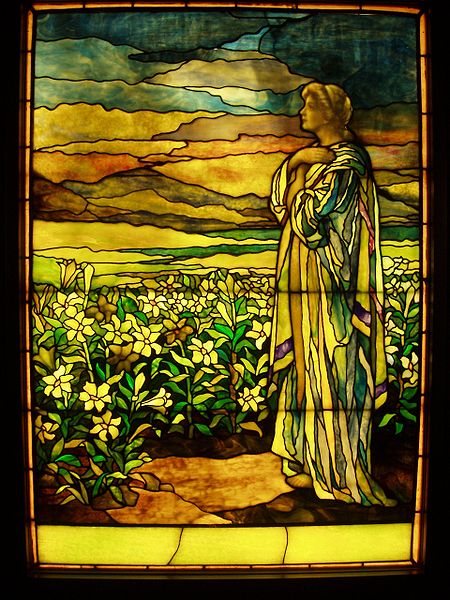
Field of Lilies – Tiffany Studios, c. 1910.

Meditative prayer is a way of discovering and nurturing the latent capacities within us that can perceive and respond to “the Mercy” I talked about last week. It is a primary way to experience the “mystical hope”I talked about the week before, the hope which is near and not the outcome of all our striving.  The centering prayer that Bourgeault teaches is “a basic, no-nonsense method of self-emptying — simply letting go of thoughts as they arise — to help practitioners break out of their compulsive attachment to thinking and entrust themselves to the deeper stillness of God.” [Here is Martin Laird’s take on it.] The essence of this kind of meditation is not keeping a perfectly clear mind. The essence is recognizing the moment when one is distracted and willingly turning back into the stillness of the Mercy, toward hope; turning toward the meeting place we have inside as an act of faith and honor; letting go of our own stuff and holding a space open for all God gives and all God is.

We need to get beyond self-awareness and its evil twin: self-centeredness

We have a “self” awareness that is beyond the egoic capacity that makes us human — we also have spiritual awareness. Meditation leads us out of ego-centered consciousness and into a space where we meet God. And so many of us know almost every feeling better than the feeling of communion with God! Someone has said we can also get to this meeting place by having a near-death experience or by falling deeply in love. I do not wish you the first short cut and do wish for you the latter. Meditation is the everyday path. It is the discipline that helps us “die daily” as Paul says he does, and helps us be one in love as he hopes we will be. The prayer of meditation puts a stick in the spokes of our outer awareness and leads us into the warmth and abundance of our inner awareness and into hope in the Mercy.

It is a hard world right now. Maybe you are pretty numb like a newscaster was saying she was after she was confronted with Donald Trump’s and General Kelly’s icky relationship with the family of La David Johnson. Or maybe you are feeling like the pastor who wrote to Christianity Today to voice how tired he is of trying to get into the white man’s church and how determined to separate into a black world until someone approaches him for once. If it were not a hard world, we’d probably make it one. So it is time to pray.

Have you listened to Jesus saying this to you lately?

“Come to me, all you that are weary and are carrying heavy burdens,
and I will give you rest. 
Take my yoke upon you, and learn from me;
for I am gentle and humble in heart,
and you will find rest for your souls.”

Basic to that easy yoke is the prayer of meditation. We keep turning to it in our anxiety and fatigue and it keeps turning us toward hope.

More on Mystical Hope
Previous: Mystical hope in a deteriorating world
Swimming in the Mercy: The experience of hope
Next: There is hope: But you’ll need to die to enjoy it
Hope: The quality of aliveness right under our noses

Subscribe to DevelopmentHit the “follow” button after you type in your email. Thanks for reading!


Faith over forty, with some help from dear friends

fortysomething

For many people who have not arrived yet, “forty years old” is a phrase with almost no “juice” to it. It sounds like that great, somewhat boring, arid territory between 36 and retirement, when all you do is work, maybe raise children, and hopefully don’t get divorced, since you don’t want to find someone new at that age. (At least I have heard such things and more). For many who have arrived, fortysomething feels like broken dreams and broken promises piled up, a time of lost friends and difficulties with making new ones. (That can happen).

For others, the forties are a time of freedom (finally!), a time of new confidence to be one’s true self and a time to build something great on the foundation laid and the wisdom gained. If you are building a church (like we are!), the fortysomethings (and older) are often golden. They contain crucial gravity — deep and magnetic; they hold us together. When they offer themselves and often their leadership, they make a movement possible. Of course, if they sink into self-centeredness and merely survive, they are kind of a lead weight. (That happens too).

When I was 41, I moved to Philadelphia to put everything I had gained in service to the inspiration God gave me, and Circle of Hope was generated. I don’t regret a minute. The forties were great! Now I am watching a whole new collection of fortysomethings finding themselves as “elders” in our ever-young church. And many of them are inspired, just as I was.

I asked a random collection of Circle of Hope fortysomethings to give me some of their personal thoughts on this question: What is the best thing about being a Christian in my forties? Maybe you’d like to add your own response in the comments section below (I did not ask everyone I could have asked to share, so please add some more). I’ve organized their thoughts in some categories about what the forties are like for everyone, and for Jesus followers, in particular.

A decade for reckoning

The 40’s is a time of reckoning with life as it really is, in all its beauty and difficulty. The idealized dreams and expectations of the 20’s and 30’s are tempered by responsibility. We learn to bear the necessary losses.

The responses from my friends are in italics

The best thing about being a Christian…is the intimacy with Jesus!  Once God began healing what feels like ancient wounds, then came the arrival of my innocence and ability to rest with Jesus and the Father as well as listen for the many ways they might communicate. The mystery and creativity are exciting and the journey is never-ending.

 Faith in my forties has lead to a re-examination of the “rules” of believing and a greater dependence on grace. At this point many disappointments have occurred (many joys too) and questions have come up that can’t be answered (at least not in the way I want them to be). Grace is the only thing I can rely on. Legalism doesn’t work…and everyone tries to make it work, left, right and center. That grace I depend on for myself translates into trying to be more generous and less judgmental than I used to be when everything was black and white. 
            I also have a community of believers made up of people I probably would not be this close to otherwise…and it’s been great to shut up and listen to what they have to say.

A decade for settling into your true self

The 40’s can be a time of feeling settled about who you are and who you are not. We often have more confidence in the gifts and abilities we have. We are probably ready for contemplative prayer at a deeper level than we have been and it allows for a deeper sense of being beloved and being able to discern the spirits.

I’ve transitioned from worrying about fixing myself (to be the right kind of Christian) to doing the best I can with what I’ve been given–it’s helped me immensely in thinking about giftedness and what my gifts really are rather than chasing the gifts that I think I’m supposed to have or that others want me to have. This means that I’m much more able to say “no” to things than I used to be able to while at the same time saying “yes” to those things that fit my skills–and I can do that with very little guilt or angst or worry that I’m disappointing others (even if they are disappointed) or God. The 40s have also brought for me a new sense of peace with my own struggles, my thorns of the flesh, and a recognition that they likely are with me for life even as I struggle.  I’m surprised at how this recognition has brought me grace and freedom.

A decade for honest reassessment

While there’s a sense of growing confidence, the 40’s can usher in a new crisis moment too: a time of reassessment and perhaps a mid-course correction. We have often learned to ask the right questions and live into them without needing all the answers.

In my forties, I’ve found that having my faith is like seeing the trail markers along a hiking path; I know that the path is marked, the paint lines are there even when they are somewhat obscured by wear, distance or confusing maps. I trust that the guideposts are there leading me through thick forests and up onto glorious vistas. I face many uncertainties, so many losses and changes but I find peace knowing that I will find the white mark on the tree — God is with me.

My life prior to 40 was a roller-coaster ride of education, marriage, career, parenting, moving, charitable work, and continuously trying to be the best person I could be. Life was always changing and required my full attention.  But as 40 approached I realized I was completely, spiritually, physically, and mentally exhausted. I stepped back and it occurred to me that I no longer liked myself. 
            Fortunately, my husband and children are supportive, loving, and understanding and supportive souls who were patient with my crankiness. They let me rest when I needed rest. I exercised, picked up indulgent hobbies, and took time to be alone. But most importantly, I’ve stopped listening to the voices in my head that told me I was doing the wrong thing, or the bad thing, or the ‘socially inappropriate’ or ‘selfish’ thing. 
            It’s taken some time, but I’m turning 45 next year and I no longer care whether others approve of my clothing or my life choices. I know that my ‘chosen family’ is my husband, my sons, and my brothers and sisters in Christ, and I love you all deeply. Finally, I firmly believe that I am a beautiful and wonderful person known and loved by God, and from the center of that grace and peace, it’s much easier to consider all the rest of life’s stuff as JOY. 

My immediate thoughts:

  • experience (good and bad)
  • sense of time and place
  • sense of purpose / place in the world / mission / needs
  • deep, long term relationships, local and long distance
  • spiritual sense of scripture, not academic 
  • so much sin, so much forgiveness

“A man can accomplish anything when he realizes he is a part of something bigger – a team of people who share that conviction can change the world.”

A decade for contribution and opportunity

While the 40’s can be a time of difficult reassessment and crisis, the encouraging note is that they can be a time of hitting your “sweet spot.” You’ve had enough experience to develop your talents and abilities, and have lived enough life to offer wisdom to others. We often awaken to surprising newness that feels like we are following God, maybe for the first time.

Maybe you can have an actual sense of vocation when you’re forty not before, not realistically. More than aspiration, more than aptitude test printouts, not some perceived potential to measure up to. Not something that just “worked out.” Instead: you have an actual track record (if you showed up along the way) skills (if you ventured out into difficulty at all) probably those skills are developed and useful for achieving the purposes of self and loved ones. If you survived to 40 and are reading Rods blog, you probably have loved ones. You might know your own limitations too, for self and loved ones, since you’ve had a long time to try hard at whatever.  Probably by now you’re in a particular place and not looking for somewhere to go — so you can know yourself by being known over time. Probably by 40 you’ve needed real saving from some crisis or another. Salvation is known and made real in the emotional work of acceptance, that’s a 40s state of mind right there. Good to show up to a cell as a somebody knowing a little something, with a living gospel story not just a curious conversationalist. If you are paying attention you might even knowingly and joyfully exercise all this as opportunities present. All this makes 40somethings who’ve maintained faith over years really valuable to the community here. Hope we can get vocationed.

May you get to the ripe old age of forty in faith! It is not that easy. If you have lost your faith, then these people probably encourage you to look deeper and farther than the losses and heart-hardening influences that have taken you another direction. We are forming a community that has enough gravity to be sustainable in the harsh spiritual environment the world is creating right now. Maybe you should be a part. If you are in your teens, twenties or thirties, maybe you should get ready for what you will face on the journey ahead. As you can see, it can be full of real faith…and beautiful.