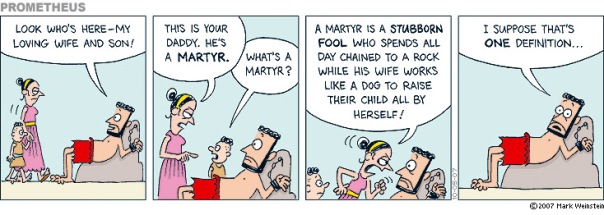
Being a “martyr” is not like when your mom has to drive you to band practice and she makes everyone notice what a wonderful sacrifice she is making. At least that is not what being a martyr meant to the Bible writers and the early Christians. It is not the same as a martyr complex.
The word martyr derives from the Greek word for witness. When Jesus says to his disciples – “You will be my witnesses,” he could have been translated, “You will be my martyrs.” When governments and mobs started killing Jesus-followers for witnessing to what they had seen, heard and were experiencing, the dying part of being a martyr got attached to the word. Now all we think about martyrs is that they are dying for a cause.
Dying for a cause appeals to many people, like Islamic radicals driving a truck load of explosives into something or a band of marines saving their brothers. Dying for the cause can seem pretty exciting. When Paul was teaching the Corinthian church about spiritual gifts he confronted a group of people he had to correct about such enthusiasm. They were similar to the anti-disciples, here:
The church at Corinth had a faction in it which tended to care more about the gifts they received from God than they did about the intended recipients. They liked being radical for the sake of it. They were sort of like teenagers who are so thrilled to drive the car fast they don’t mind who dies in the process.
Some of the Christians in Corinth cared more about receiving the powerful gifts of the Spirit than they cared for the Giver of the gifts. It was like you might have reacted last Christmas when you had opened your sixth present and forgot to look at the tag that said who gave it to you. When it came to the exciting new possibilities of exercising the power of the Holy Spirit, some in the Corinthian church loved the expression of power. And some of them didn’t mind bearing witness to how great they were – even greater than Paul who brought them the news of God’s great gift in Jesus!
Paul’s corrective to those seeking power
In between chapters 12 and 14 of the first letter to the Corinthian church, right in the middle of his teaching on the gifts of the Spirit, Paul inserts a beautiful chapter about love. At the beginning he writes: If I…surrender my body to the flames, but have not love, I gain nothing.
Surrendering one’s body to the flames might be considered another spiritual gift: the gift of martyrdom [link to Bible studies about them all]. Since Paul is talking about spiritual gifts, that’s always sounded right to me – and I know of people with that gift. Some of the Corinthians probably liked that idea of facing danger for their faith. They liked to be the ones to look like powerful witnesses of God’s work in the world. They wouldn’t mind going out in a firefight.
But those bold members of the church would most likely have expected to win a firefight. That kind of lust for power, competition to be the best, to be the most spiritual, to be the best looking Christian is still a problem in the church as a whole. At least I think it is a problem to see the church in competition with the Muslims for market share, or something, as if life were a mall and we want to be Nordstroms not the Dollar Store. In some famous cases, like the notorious Buddhist Thich Quang Duc, one might leap into the flames to burn away the dross and to etherialize one’s spirit, making a powerful point in the process. People do such things.
This lust for surrendering one’s body to the flames, for being a spectacular witness, is probably less a problem in Circle of Hope than it was in the Corinthian Church. In Circle of Hope most of us love love, and we are good at it. I think we are more likely to read the love chapter and de-emphasize chapters 12 and 14 as being “a bit much.” We will sacrifice almost anything to get love and we feel terrible if anyone says we are not giving enough. We’ll even sacrifice the truth to be seen as loving; we might even sacrifice Jesus if he got too scary looking.
We don’t fight, we don’t even want to have strong opinions, because we know that people won’t think we love them, worse yet, they won’t like us. So Paul would probably change chapter 13 for us: “Wait a minute, God may give it to you to surrender yourself to the flames some day as a witness for the truth. You may need to get into trouble with people who don’t like Jesus.” He might re-write the line for us: If I say I have love but never surrender my body to the flames, what kind of love is it?”
Our transhistorical body blog often pinches this general spirit among us. I hope we never forget how to say “Ouch!” We try to honor the martyrs who showed us how to keep faith in confusing, oppressive times so we can remember how to do it. To name three recent examples: March 24 — Oscar Romero, April 4 – Martin Luther King Jr., April 9 – Dietrich Bonhoeffer
These disciples were loving and well loved. But they certainly got themselves into trouble, didn’t they? They were martyrs for witnessing to the inconvenient truths of the gospel. Just like Jesus did, they got into trouble when they crossed the boundaries of class, ethnicity, tradition, politics and power. They insisted that Christ is all and there is no life unless he is in all and powerful people felt threatened and responded as powerful people often do. I am pondering whether we have a such a vision worth dying for or at least worth dying trying for, like our great ancestors in the faith. Will we share our revelation with love or will we let it be corrupted as we succumb to the constant drumbeat to support the powermongers or at least maintain as much personal power as we can?
In preparation for dinner Saturday, I turned on the Pandora “Hymns” channel. Soon we were listening to American Idol runner-up David Archuleta singing “Be Still My Soul” (complete with his Mariah Careyesque trill on various long notes). He sings it sincerely. It has been a comforting song since the 1850’s and I was comforted.
Be still, my soul: the hour is hast’ning on
when we shall be forever with the Lord,
when disappointment, grief, and fear are gone,
sorrow forgot, love’s purest joys restored.
Be still, my soul: when change and tears are past,
all safe and blessed we shall meet at last.
David is 26 now. He’s got a little more depth since he’s returned from his Mormon mission in Chile. He’s already had a long career. He started singing since at ten when he was inspired by a recording of Les Miserables (he later sang some of it for soldiers in Afghanistan). He was runner up for American Idol ten years ago — Utah was disappointed he did not win. His father was banned from the Idol backstage, then he was caught in a prostitution sting and then he was divorced. So David has faced some Utah-sized disappointment of his own. Spending most of your life in a Disneyfied atmosphere would be difficult enough.
He’s popular in the Philippines and other Asian countries. An interviewer there says “Helping and inspiring others, particularly those who are undergoing depression, has become a big part of David’s purpose in life. He admits that he himself went through a phase when he was depressed due to being bullied in school.” He told her, “Even when I was little, I’ve always had self-confidence issues. I got bullied and I was known as the quiet kid. I sat by myself during lunch and I would be made fun of. I was socially awkward. I think feeling good enough was something I always wondered.” Sometimes he gets on stage and looks like he is being bullied — most of the time, not so much.
We’re all disappointed sometimes
So even though he can sing like an angel, David Archuleta carries some disappointment with him and fears more of it, just like us. And like Mormons, Buddhists, Muslims, and us he’s looking forward to a time “when disappointment, grief, and fear are gone, sorrow forgot, love’s purest joys restored.”
Jesus followers look forward to a time when God
“will wipe every tear from their eyes. There will be no more deathor mourning or crying or pain, for the old order of things has passed away” (Rev. 21:4).
Some of us were ten-year-olds who become entranced by Les Mis and grew up to become talented optimists — most of us didn’t. We need God to save us from disappointment. We need to find some exultation, like Peter expressed when he wrote,
“In his great mercy [God] has given us new birth into a living hope through the resurrection of Jesus Christ from the dead, and into an inheritance that can never perish, spoil or fade” (1 Peter 1:3-4).
One day, the joy we have experienced in flashes will be the light in which we live. But even now we know our hope is not in vain because Jesus has delivered the first fruit of our future by rising from the dead, as we will.
I was inspired by the great hymn, by David, by John and Peter (and a little by Les Mis). So I am reminding us to hope. We have all experienced disappointment. Some of it has been severe, lately. Divorces depress more people than just the partners divorcing. Being cut off by former friends hurts. People have resigned their covenant with the church. Some people refuse to reconcile. We have not succeeded in all our goals. No amount of Disney-like happy talk or Archuleta pop confection will overcome what we feel for long. For the long–haul of difficult lives, we need Jesus.
Feeling better is not all up to you
When I say that we need Jesus, many Christians interpret that to mean, “I need a trust upgrade.” They have been taught that if they feel something or suffer something it denotes a lack of faith. They must want something more than Jesus. The idea is: Jesus is our treasure and if we want something else, we are setting ourselves up for disappointment. It is no wonder so many church people are so controlling, they are supposed to control their behavior so they will feel good! They need to get some treasure and protect it! There is something to be said for that strategy, but not much. It is true that if we keep doing dumb stuff, things won’t work out well. If we never get mentally and spiritually healthy, life will be difficult. If we are self centered, we will get ourselves and that’s it. But we’ll never be smart enough or healthy enough to avoid our share of disappointment, failure and grief. Stuff has already happened and more is coming.
If all you want is to be the American Idol and you don’t win you’ll lose hope. (99.99% of singers beware). You might even blame God for not giving you the desires of your heart, as supposedly promised. If you are responsible for making Utah feel better because you win the contest, you might even feel responsible for a great deal of disappointment in the world. In Circle of Hope, this can be translated: people got divorced, people left the church, people were fighting, I/we/God must suck.
I am so taken with the Lord’s vision for the world, I face disappointment every day. I am working with Jesus for transformation and it hasn’t happened just liked I wanted, has it? I keep allowing myself to be flabbergasted by the sin and death at work in the world, even though another load of it will be delivered in the news tomorrow, fake news or not. What do we do when the sorrow hits? When friends desert us? When we are not so smart? When our plans don’t work out?
I don’t think we should get smaller until we think we can keep things under control better. I think we should be as big as we are in the Spirit and start again right now, in resurrection hope. It is an everyday thing.
Six ways to deal with disappointment
Here are some things I collected for my journey after I bumped into David Archuleta on Pandora. If you are disappointed, there are some things you can try.
Sing
Singing is a perfect way to pray. It reorients body, mind, heart and soul in a common direction toward our source of hope. Try David’s hymn. Sing along, or just be still and know God is with you.
Talk to someone.
That’s what David Archuleta tells depressed Malaysian teenagers to do. He’s right. If you are 35-50 and you think you should know better, have lost the friends you used to talk to, are feeling marriage strains, you must not stay alone. Take a risk and talk about how you feel. A psychotherapist could help.
Visit the Bible again.
You might just be on the endless loop of yourself inside. Just meditating on the two portions of the Bible quoted above might throw a wrench in the works and put you on a different track. If your spiritual disciplines seem to have failed, they might just need some deepening. Try something else. Take a day off and ask some deeper questions than you usually have time for. When you’re done reading this, blank out the screen and turn your face towards God.
Listen to your suffering.
My experience has taught me that disappointment is a great teacher. If we are going through a seasonal (not chronic) depression, resisting it or anesthetizing it with something won’t get me anywhere. If you are blaming someone (or something, like injustice or Trump) you’d better reel that in and meditate on your own development in the safe place you have with God.
5. Let the past go and start from here.
This is the exciting news Peter was so happy about when he wrote his letter. He has a famous role in the story of the last days of Jesus. He was disappointed and distraught by the Lord’s death. He was disappointing, too, because he did not have the stuff to face his fears. But he got restarted after the resurrection.
We don’t know exactly what is going to happen. The future is always foggy. But we have the risen Savior with us, and that is our security. No matter what we have done, or what has happened to us, today is a beginning with Jesus. It will always feel like things are in the way, but there is no good reason, at least, not to take a first step again.
6. Bless the people who leave you on their way.
As a church, we prize our community and we let people into our love. So we get hurt — a lot. Some people get hurt and solve the problem of feeling bad by restricting or shutting off their love. We try not to do that, even when it is tempting. We hope we can suffer with Jesus and gain a resilient heart that can keep following in his way until the end. Even though our numbers are growing, people are always leaving, and it never feels good. We get connected. It is tempting to shut our doors, so we never have to feel left.
I think Jesus is an open door/open tomb kind of person. He blesses those who curse him. I think we should always keep the back door open to anyone we have loved. They might return. Besides, getting even or cutting off is not what we do. (I’m not talking about unrepentant people who have abused us, or people on whom we are unhealthily dependent). Slamming the door in self-protection is not what Jesus does to us, even though we aren’t the best of friends for Him.
But even more than managing our back door, we should turn toward the front door. There are six million people in the metro, a few of them, no doubt, would love to be invited into your life. We are never just our past, we are always looking with confidence into the future. The past is gone, the new has come, and is coming. Look for the people who are new to you with the wisdom you are carrying now, as the person you have become, and move into the next phase of your life.
Making six points about something makes it look easy or predictable! Our future and our feelings are not going to be easy and they are seldom predictable. But the love of God in Jesus is evident and permanent. And the promise in the old song, sung by a young man, and often heard in our meetings is consistent:
Be quiet and listen for the assurance.
It won’t be long until we receive in full what we know in part.
One day disappointment, grief, and fear will be gone;
the tears will be wiped away and our living hope will be kissed by joy.
Be quiet and listen for the assurance.
Change and sorrow will be part of the journey
but we will arrive home safe and blessed.
It was a wonderful day yesterday. Tons of people ascended to Lemon Hill at sunrise, many biking over in the frigid air – including Peter, who purportedly is the youngest ever to accomplish the feat. Crosses burst into bloom at several of our sites, people told resurrection stories, we worshiped with joy, we feasted together – it was a day to remember.
Now what?
It is so great to get to resurrection, why spoil it by asking what happens next? The main reason to move into what is next is: it spoils the Resurrection to turn it into a mere holiday! We celebrate the resurrection of Jesus because it is a beginning point for us, too, not just a memory. For the first disciples, what happened next after the Lord’s resurrection was totally transforming! Before long they were missionaries, martyrs and leaders of expanding networks of Jesus-followers.
Quite the opposite for for many of us, after Easter there is a glutted sigh of relief that another holiday season is over and we can get back to concentrating on work, baseball season, school, and the addictions we gave up for Lent. In other words, we get to resurrection but never get on with resurrection life. What’s worse for many of us, we’ve heard of this tendency many times before and are adept at ignoring the problem!
But today is another beginning. We are not our past. The promise of resurrection is we are our future. It can all start from right here: our lives, our church, even our society.
Paul teaches us this in Colossians 3 and collects one of the best lists in the Bible about what resurrection life means. It is so brief, and yet so profound! I was so moved by it, I can’t resist offering it to everyone as a great starting point for our response to the new life we have received, right now.
Here is how he starts:
So if you have been raised with Christ, seek the things that are above, where Christ is, seated at the right hand of God.
Then he lists five big responses:
1. Meditate on God, not yourself
Set your minds on things that are above, not on things that are on earth, for you have died, and your life is hidden with Christ in God. When Christ who is your life is revealed, then you also will be revealed with him in glory.
If you managed to exercise spiritual disciplines during Lent, great. Hopefully, they tipped you over into everyday habits for the rest of your life. But maybe you need to keep trying. If you just keep thinking about yourself: your ambitions, relationships, problems and failures, that will be deadly. I estimate that 60% of us don’t even pray in any deliberate fashion every day. That’s why our spiritual lives get anemic and why many people fell away from Christ last year.
2. Put to death your fallen self, not others
Put to death, therefore, whatever in you is earthly: fornication, impurity, passion, evil desire, and greed (which is idolatry). On account of these the wrath of God is coming on those who are disobedient.These are the ways you also once followed, when you were living that life. But now you must get rid of all such things—anger, wrath, malice, slander, and abusive language from your mouth.
“Put to death” sounds dramatic, doesn’t it? But Paul is talking about a response to the resurrection of Jesus which begins the recreation of the world! It deserves a large response, not a begrudging addition to our lifestyle! He is pointing out the common things that quench the new light that just got lit in our lives. Leaving the ways we used to follow before we were raised with Jesus takes lifelong devotion, especially these days. Even feeling a tinge of guilt about fornication or greed in the United States is practically illegal now! People express their anger as if it were liberating and can’t stop abusing people on Twitter, just like the president. We’re in a difficult environment for what Paul is talking about. It is hard to even hear what he thinks is an obvious response to new life. He’s not talking about mere morality, he’s talking about supernatural goodness flooding into our lives!
3. Clothe yourselves with resurrection life, not lies
Do not lie to one another, seeing that you have stripped off the old self with its practices and have clothed yourselves with the new self, which is being renewed in knowledge according to the image of its creator. In that renewal there is no longer Greek and Jew, circumcised and uncircumcised, barbarian, Scythian, slave and free; but Christ is all and in all!
It would be so sad if we woke up today into the promise of new life and put on the same old lies: I am alone. I have to make it on my own. Nobody will care for me. I have to be the best. If I don’t succeed I will die. I need to stay safe from others. Add you own — which lies torment you? There are so many self-destructive scripts from our pre-Jesus lives running in our brains that it is hard to shut down the liars – and now we have a massive media machine in our hands all day to reinforce them!
4. Clothe yourself with reconciliation, not judgment
As God’s chosen ones, holy and beloved, clothe yourselves with compassion, kindness, humility, meekness, and patience. Bear with one another and, if anyone has a complaint against another, forgive each other; just as the Lord has forgiven you, so you also must forgive.
Life is too short to blame someone else or ourselves. Criticism is easy, forgiveness and reconciliation is revolutionary. During Lent our congregations were awash in new revelation and love. It was beautiful. But they were also attacked with divorce, division and the disease of scorn. The clothing Paul is talking about is like the armor Jesus wore to the cross to overcome the world in his upside-down way.
The Good Samaritan, after Delacroix — Van Gogh, 1890
5. Clothe yourself with love, not division
Above all, clothe yourselves with love, which binds everything together in perfect harmony.
Paul’s new love released him from his roots in Tarsus and moved him all over the Roman Empire planting churches as he spread the news about the resurrection of Jesus and all it means. He’s not just talking about fulfilling our dreams of having a nice family and friendship circle. God wants us to live in harmony just like we want, but what God really wants is comrades who will bind things back together with Jesus. Paul closes up with a few things such rebinding means:
It means proactive peacemaking
And let the peace of Christ rule in your hearts, to which indeed you were called in the one body.
It means being persistently thankful
And be thankful.
It means speaking the truth from Jesus in love
Let the word of Christ dwell in you richly; teach and admonish one another in all wisdom;
It means a life of public worship
and with gratitude in your hearts sing psalms, hymns, and spiritual songs to God.And whatever you do, in word or deed, do everything in the name of the Lord Jesus, giving thanks to God the Father through him.
Jesus is risen, now what? You can see that I am afraid we will have a personal response to Jesus that is just personal and next Easter we will have to decide again if we even believe this stuff. If our faith doesn’t transform our everyday lives, is it really following Jesus? I don’t think Paul was telling us to spend all our time thinking about what we think about Christianity! Like he responded to the resurrection, I think he hopes we will feel life in a new way and find joy in letting resurrection make us new — and the world with us.
I’m not sure anyone cares about a “lent.” I wish everyone did for a variety of reasons I have mentioned elsewhere [here][here] and [here]. So let’s not talk about Lent. Let’s just talk about how hard it is to have a live relationship with God as our true selves.
It is dawn. You’ll get there. Help us, Jesus.
One way to get over our usual blockades to deeper faith and spiritual transformation is to ask the questions we often ignore. Or maybe to listen to God’s questions, since we can strangely ignore Jesus.
Last night Katie gave us a nice litany spread out over the evening at South Broad. Each movement begged an important question. Asking the question, living with it, even living into it, can help us keep moving along our own way, along our group’s way into something really good.
What do you lean on? Can it support you?
We often lean on our family and friends, our income, and our accomplishments to remind us that we are safe and lovable. When those anchors fail us — we feel unmoored and that we are beyond help. We confess this to you, Help of the Helpless, You who do not change.
Help us to pay attention, Jesus
What is the script of your inner dialogue? Can it be disrupted?
Oh God, sometimes our doubt feels nearer to us than you do. Sometimes our guilt feels nearer to us than you do. We want to know you closer than our doubts, closer than our guilt. You stay with us, Lord, even in our darkest places.
Help us to pay attention, Jesus
What do you fear? Is there any way to redirect your anxiety?
Our hearts are near to breaking over the state of our world and how powerless we feel to change it. We’re at capacity already with the demands made of us at home and at work. Even now, we’d rather be distracted than sit in a cave considering the way we feel overwhelmed by our pilgrim journey.
Help us to pay attention, Jesus
Are you just surviving? Isn’t there somewhere to turn instead of you?
I’m recalling all those times this past week when I felt needy or lonely and despaired. We confess that most of the time we go into survival mode instead of turning to you in those moments. Both joy and sorrow belong to you, Lord, and we bring them to you.
Help us to pay attention, Jesus
Do you see the dawn coming? Isn’t every day a new opportunity?
We have a deep feeling, even in the middle of this darkness, that we were made for the light. That we are moving towards it with you Jesus, as you moved through death to your resurrection.
Tim Geoffrion (a spiritual director/coach) interviewed Buddhist monks a decade ago while he was teaching Christian theology in Thailand and briefly in Myanmar. As a result, he became aware of helpful contributions Buddhist philosophy and practices offer, not only to Buddhists but also to Christians. (See “What I learned from the Buddhists.” )
Dalai Lama lays a wreath where MLK was assassinated.
Many of us are in regular contact with adherents of both Buddhism and its cousin, Hinduism, primarily through yoga. We see Buddhist monks on the street all the time, and many of us are fond of Richard Gere. In the U.S., .07% of the people are Buddhist, 1% in Philly. 1% in the U.S. are Hindus, 7% in Philly. I mention Hinduism because Siddhartha Gautama, founder of Buddhism, was a Hindu, and though the religions are clearly distinct, they have similarities. Many Catholics and Evangelicals find Buddhism attractive, as a philosophy, because of it’s demanding, principle based, self-denying, personally-responsible practice. Without looking too closely, apart from its god-less center, Buddhist-like Christianity is common. So many of us have many connections.
Helpful tools from Buddhists
Intellectually, Christianity and Buddhism are largely incompatible, but just as Christians have something most Buddhists do not, Buddhists have something Christians often do not, or need more of. For instance, Christians need to know how to effectively practice deep breathing in order to relax the body, reduce anxiety and open up to spiritual experience. Buddhists specialize in this. Buddhists develop capacity to comfortably and confidently access their inner wisdom. They develop their ability to detach themselves from the desires and preoccupations that bring them suffering. They value humility, patience, and mutual respect, in ways that actually lead to kinder, more peaceful relationships. Of course, it is true that many Buddhists do not regularly practice such things or possess such qualities. They may keep incense burning before a statue of Buddha just like other people might keep a candle burning in front of Mary, and that’s about it. But as a well developed, psychologically oriented, practical philosophy, Buddhism offers many helpful tools that are still mysteries to many Christians.
Tim Geoffrion being schooled by a Thai friend.
Looking to the East is nothing new for Western thinkers and seekers alike, though a concerted effort by Christian theologians to look to Eastern culture and religion for new insights into God and how God works is relatively recent. Yet, for many Christians, just the suggestion that we might have something to learn from Buddhism makes them feel uneasy, or outright furious. The notion flies in the face of traditional mission philosophy, not to mention (conscious or unconscious, stated or unstated) assumptions about Western cultural, intellectual, or religious superiority. So let’s talk about the issues.
A first question is: How can devoted Christians beneficially draw on the wisdom, insights, and practices of Buddhism (or any other religion)? I’m not trying to write about what specific benefits you should seek from Buddhism. Many of you are probably doing just fine without thinking about that subject at all, as am I, for the most part. I am being more general. How should Christians think about encountering another faith? What are the options? What are the issues? How do we keep faith with a spirit of generosity?
Among those who are truly curious, open, and willing to listen to those whose culture and religion are different than theirs, I see three different kinds of reactions.
Blenders
Blenders are eclectic syncretists, who consciously try to wrap their arms around both Buddhism and Christianity, thus creating a hybrid religion of sorts. Such individuals may call themselves Buddhist-Christians (or Christian-Buddhists), believing that, in spite of contradictions and tensions that exist between the religions, their spiritual experience is best explained or best advanced by embracing them both side by side, or some hybridization of the two.
I think it matters which path one takes in seeking to benefit from Buddhism and other religions. What postmodernists call syncretism is probably a reality for many people: the media mashes up cultures and beliefs for us all day every day. For true seekers, I think it is possible that they are faithful to Jesus long before they know it, just like a Tibetan monk called Merton a “rangjung, a naturally arisen Buddha.” Regardless of all the connections humanity has in our spiritual searching, Jesus-followers need to reflect on what they believe, why they believe, and where they are going to look for spiritual truth, wisdom, and power. Our view of God and view of self are basic to how we live. How we know God and relate to God, and how we receive God’s work in our lives, affect all our beliefs, thoughts, feelings and actions. I am not talking just about intellectual reflection, we all need to integrate reason and experience in community to find our true self on the true path.
We are relating to Jesus, the Son of God. Jesus said,
“Can you say that the one whom the Father has sanctified and sent into the world is blaspheming because I said, ‘I am God’s Son’? If I am not doing the works of my Father, then do not believe me. But if I do them, even though you do not believe me, believe the works, so that you may know and understandthat the Father is in me and I am in the Father” (John 10:36-8).
The incarnation of God in Jesus begins our exploration.
In his book God in the Dock, C.S. Lewis is quoted as saying,
“If you had gone to Buddha and asked him ‘Are you the son of Brahma?’ he would have said, ‘My son, you are still in the vale of illusion.’ If you had gone to Socrates and asked, ‘Are you Zeus?’ he would have laughed at you. If you had gone to Mohammad and asked, ‘Are you Allah?’ he would first have rent his clothes then cut your head off. If you had asked Confucius, ‘Are you Heaven?’ I think he would have probably replied, ‘Remarks which are not in accordance with nature are in bad taste.’ The idea of a great moral teacher saying what Christ said is out of the question. In my opinion, the only person who can say that sort of thing is either God or a complete lunatic suffering from that form of delusion which undermines the whole mind of man.”
From our secure base, reattached to our Parent through the work of Jesus, we can explore all sorts of beneficial goodness built into creation and imagined by humanity. But every attempt to blend religions as a means to provide this base falls short of providing a spiritual foundation upon which to build. I think I have learned a lot from the wisdom and cultures found in “the East.” But Christian-Buddhist syncretistic blends tend to be so subjective that they resemble a host of individual, self-made religions. A Blender’s faith will likely depend mostly on his or her personal feelings and experiences in a vacuum, betraying fidelity to Jesus Christ in some way, and divorcing the Christian community’s reflection over the centuries that provides thoughtful examination of the implications of the competing worldviews, and a balanced interpretation of the revelation in the Bible.
Borrowers
Many Christians in the West have been exposed to Eastern thought through the media and popular literature, and wind up mixing and matching various beliefs, whether or not they realize they are doing so. They do not significantly alter their basic Christian world-view or faith, but they freely borrow from Buddhism whatever they think might be helpful to their life. They may embrace various insights (e.g., the power of attachments to produce suffering in human lives) or adopt helpful practices (e.g., meditation) as “add-ons” to their faith and spirituality. Often such borrowing is done without much theological reflection, and thus Borrowers are often unconscious syncretists. Post-modern scholars generally argue that all religious people, including Christians, are syncretistic. They just don’t know it. So they may have that thinking in the mix, too.
The second reaction is less radical and seems fairly popular in some circles. Open to benefit from whatever might enhance their lives, borrowers embrace meditation, yoga, ancient rituals, or anything else that they find helpful or meaningful in some other religion, but which is unavailable in their own tradition. Unconcerned about, or simply oblivious to, whatever underlying beliefs may be at odds with their Christian faith, they focus more on the immediate benefits of the borrowed ideas and practices that they are enjoying.
I wonder, though, how often these “add ons” wind up being a distraction from spending time and energy seeking a more dynamic relationship with Christ and from learning how to live by the Holy Spirit. I feel more relaxed when I meditate, and my body feels better after exercise, but the most life-changing spiritual experiences I have ever had involve being consciously inspired and led by God as I wait in the silence; involve heart-felt, honest prayer and worship; or involve hearing God speak to me through the Bible and my brother and sisters in Christ.
Inspired
Then there are those for whom an encounter with Buddhism or another religion becomes a catalyst to look more deeply into their own faith tradition. They are inspired to see if they have missed something that may have always been there but has been lacking in their experience. Spiritual growth for the Inspired, stemming from the encounter with Buddhism, will still look, sound, and be very Christian, in the best sense of the term. Yet, at the same time, if you listen carefully, you will notice that the Inspired develop a larger, more inclusive view of Creation. They are more compassionate, sympathetic, and understanding. They care less about adherence to rules and traditions, and more about being “the real deal,” someone who genuinely loves God from their hearts and want to be an effective, fruitful servant of Jesus Christ. Maybe Thomas Merton would be in this category.
Most of the time, my journey looks like the third path. I’m inspired. I’m on a quest for greater understanding about God, myself, and how human beings function and best flourish psychologically, socially, and spiritually. I am open to learn from any good source, and freely and respectfully borrow insights and practices from other religions (just like I am borrowing many thoughts from Tim Geoffrion today), as long as they genuinely cohere with how the Lord speaks to me through the Holy Spirit, the body of Christ and the Bible. I have a relationship with God in Christ that guides my explorations.
I value dialogue but I do not journey as a lost soul. All along the way, I understand my way is laid out by my faith in and relationship with Jesus Christ. My quest is part obedience and part longing to better know, love, and serve God. I want to experience more and more of the abundant life Jesus offered to his followers. It seems inevitable that part of my experience will be encounters with different cultures and religions; they will help me open my eyes and mind. I respect fellow seekers and I welcome the opportunities.
As you consider your own journey, here is a prayer Tim Geoffrion suggests:
“Loving God, sometimes I feel overwhelmed and confused by all that I do not know or understand, and I want so much more for my life and relationships. Please help me to see what I need to see; give me courage to face truth wherever it may be found; and fill me with wisdom to know how to best learn from those whose beliefs do not fit neatly into my way of thinking or being in the world. I want to know you as you truly are, and to experience more of the abundant life Jesus came to give his followers. Please continue to lead me deeper into this life. In Christ’s name… Amen.”
Aching loneliness, feeling detached, a broken sense of belonging or being able to connect — all these feelings are flourishing in the church right now. The Times is talking about it and so are we. The experience is not new or foreign to any of us. But we need to be reminded. We can forget that we all have a sense of aloneness we don’t like; it’s not just them and it’s not just me.
Let’s be careful
We should be careful with each other!
“love” by Ukrainian sculptor Alexander Milov , at Burning Man 2015
Maybe you should stop what you are thinking most of the time and picture an adorable baby in front of you instead of a threatening or threatened loved one. Stuff is happening inside!
Maybe you should let the first thing someone says go right by — that thing that hurt you or disturbed you. Let it go by and let the person have another chance. They might not be clear on why they say what they say: why make it worse by holding them to their first try?
Under it all they might feel detached and trying not to feel that, or they want to be attached and they are really trying to feel that. We are complex. And the church is an ideal, God-given setting to sort things out. But quite often it is the place where things get messed up. [Bonnie Poon Zahl on Christians and attachment theory].
Things can get hurtful
This is hypothetical, but it will probably sound familiar. Let’s say you are a worship leader and you overhear someone telling one of your friends that she feels you have an annoying singing voice. You feel so hurt you go find your husband and make him take you home immediately. You feel so defensive you tell your husband the whole story and that you want to quit singing. You start listing why the person who talked about you is terrible, even worse than you.
When your husband tries to talk you out of it, you are furious that he is not on your side. He tries to get the other person, who he knows, off the hook. That makes you feel like he is leaving you alone in your distress. You even say, “Just like my father never took my side and then he deserted me.” You refuse to talk about it anymore and just look mad and sulk the rest of the day.
The next day you go and talk to your women’s group about it. They are upset and they tell you to call the pastor. So far you have not talked to the person you overheard or your friend to whom they were talking. But at least fifteen people are having your attachment issues. Their own loneliness, detachment, broken senses of belonging and connection are triggered. Vicariously, they are all mad at your father for abandoning you. You can’t stand to feel that aloneness from way back, so you pile the feeling on everyone else and blame them, from your father to the person who talked about you. Now your listeners are invited to do the same.
Some dangerous-feeling relationships are also places to heal
A woman recently told me about feeling things like this in church and asked me why she went to meetings! Who knows what could happen? It has been hard for her and she expects people to keep hurting her! She always sits in the back, when she goes to the meeting, so she can slip out easily, without risking the connection she wants for fear of the hurt she dreads.
I felt for her. Her past is full of the worst kind of hurts. So I suggested her strategy might be OK for the time being, as God eased her way into love. The church is great for easing into love, if we let people move into it at their own pace, and help them keep moving. I also suggested that, in the long run, God is going to keep after us until we are securely attached to Love, until our security breeds security and alleviates conflict rather than creating or perpetuating it.
Someone you know, or maybe you, are emotionally unable to tolerate being part of the church where their attachment issues were triggered and repair was not made. I know you can’t just “let the feelings go by.” But whatever it was that triggered your exit might not be as bad as you think it is. After all, the woman who who was hurt in my example had not even talked to the woman who hurt her or the friend who was listening to the criticism she overheard. God is with you if you want to try to get back into the community and do the repair work that not only wins a friend back, but provides an opportunity for your wounds to be healed. God touches our aloneness and is present in it to sustain and even help us be born again.
Subscribe to Development(and receive untimely editions of posts! :)) There is a place to enter your email address in the right column.
[{I think a draft of this may have gone to subscribers by mistake. It was almost done, so no great harm. But sorry.]
I am not sure how it happened. But I realized early on that loneliness and my sense of isolation as a Christian had a lot to do with my infantile sense of being the center of the universe and unattended by those upon whom I was dependent. Later on I met God through Jesus Christ and I realized I was mistaken. In him is life. When I am alone I am actually alone with God. This experience completely changed my life. But it did not change without a process, like Lent. Thank God the season will be here again, soon.
Lent is a fruitful wilderness
Lent grows people who know they are one with God in their isolation and can act out of that oneness, even when they feel lonely. We know about many examples of people with the spiritual capacity to listen in the wilderness and then and act out of the oneness with God they find there, especially to speak what needs to be said to people who need to hear.
I offered a few stories about this to North Broad in December. Let me revisit two, starting with my own experience of the wind in the wilderness in my splendid and disturbing isolation one summer.
Palmdale without Palmdale
Back in the day, when I was in my early thirties, I spent a few retreat times alone in the Franciscan Spirituality Center outside Palmdale CA. Retreating made me a little strange, but I learned to love my wilderness experiences, especially in the desert. I love the desert. I have often met God there. The monks would give me the room of a visiting monk, which was pretty nice compared to the other rooms. I was often there all alone. It was a splendid kind of isolation.
One time I drove out to the center and I just felt terrible. I think I was having some kind of marriage issue. I think my close friendships were in a mess. And I was in a general thirtysomething angst fog. I got to my room and collapsed on my knees next to the bed. I felt blank. It felt like I needed to force myself to stay there on my knees, since I was on retreat and all. But I had no prayers. Not even “Help.”
After a few minutes I began to relax and felt so tired. I lay my head on the bed. Almost immediately I felt a little breeze. I looked over and the window was open a crack — for fresh air from some thoughtful Franciscan. I instinctively laid my head back down on my praying hands, and there was the wind. Dry desert wind gently blew over me until I began to feel it filling me and blowing through me, moving my feelings and reminding me that the Spirit of God was with me.
It was the beginning of a significant retreat. I went away with a marriage change to effect. And I went back with a direction: get beyond yourself and give my word to people. I experienced for myself a pattern often recounted in the Bible. The word of God comes to someone in the “wilderness.” Then the word of God comes through someone as they speak it with passion, authority and courage (although sometimes reluctantly). This all results in the person having a real relationship with the Word of God, Jesus, himself in a deeper and more satisfying, if often trying, way.
Over and over God meets people in their wilderness
Throughout the history of the church, we see again and again how God finds these out-of-place individuals, a bit wild like John the Baptist, nervous like Gideon, incapable feeling like Moses, scared like Peter. They are all thrust into the wilderness in one way or another, receive the word, bring it, and change their world in significant ways. We aspire to be those people. That’s why we remember them in our Celebrating Our Transhistorical Body blog.
On November 18 we admired Odo of Cluny (a French way to spell Otto). It is a high-minded name, usually for the upper classes. It means “possessor of wealth.” The Cluny region in France, where he ended up, has always been a little hotbed of edgy Christianity. Today Cluny is about twenty minutes from Taize (whose music we sing), not far from Citeaux (home of Bernard of Claivaux), and Lake Geneva (where John Calvin built his community).
When Odo, was a young priest in Tours, he read The Rule of St. Benedict for himself for the first time. He was stunned. He realized he was not much of a Christian. He decided to leave his home town and become a Benedictine monk. You can imagine how this made him a little strange. In 909 he went to Beaume, a monastery (unlike many) where the Benedictine rule was strictly observed, and Abbot Berno received him into the community.
That same year, Berno started a new monastery at Cluny in Burgundy. He established it on the pattern of Beaume, insisting on a rigorous application of the Benedictine rule, which, to be honest, is not that rigorous compared to other rules, so you can see how lax and lifeless communities can get (note to self). In 927, Odo succeeded Berno as Cluny’s abbot and spread its influence to monasteries all over Europe. It turned out to be a huge influence, probably one of the most amazing movements of the Spirit you have never heard about.
Odo went to existing monastic communities and talked them into returning to the original pattern of the Benedictine rule of prayer, manual labor, and community life under the direction of a spiritual father. Imagine how hard it is to get our congregations to change how they do stuff. He was a change agent when he came to visit. Under his influence, monasteries chose more worthy abbots, cultivated a more committed spiritual life, and restored the depth of their daily worship. Odo helped lay the foundation for a renewal movement that went on for 200 years and reformed more than a thousand monastic communities. Those communities transformed the religious and political life of Europe.
The word of God came to Odo in the wilderness of his nominal Christianity. Then the word of God came through Odo as he spoke it with passion, authority and courage — so much so that he started a revival and became a peacemaker between warring kings. All this because the word of God, himself, the risen Jesus came to him to get his mission started.
Where do you think the Spirit is leading now?
The same Spirit that moved thirtysomething me, Odo, and others brought us together as Circle of Hope. The word of God came to us in Philadelphia, in the wilderness of postmodernity and vacuous expressions of the church.
That Spirit also isolated us in ways. While we might seem normal to us, the reforms we instituted make us loved and resented in the BIC. A man is flying in from Kentucky to consult with us this month because he thinks he is as strange as us. But our bishops are never sure we are really team players. We don’t get along with Trump Christians, we deploy women pastors. We welcome gay people, accept cohabiting people as married. We listen instead of fighting and think reconciliation is more important than being right. We love psychotherapy. We believe black lives matter. We abhor war and suspect guns. We love immigrants. We talk about Jesus all the time to liberals and celebrate Lent with our spiritual ancestors. We practice contemplative prayer and don’t put men or anyone else at the top of a pyramidical structure. It goes on.
We are ambitious. We might go to your monastery tell you what God showed us. We might follow a radical rule of life together right in your backyard. So we might get as isolated like Moses, feared like Odo of Cluny. That might be Lent for many of us – receiving the wind of suffering, struggle, change, and reform that often isolates the reformers while they are bringing people together in Christ.
What is the word that Jesus wants to get out there now? — any new mouthpieces being grown up in the wilderness around here? I know there are. Do not let anyone shut you up. Tell the truth no matter what it costs. Love your hearers even if they don’t understand you right off. Give them what they need even if they throw it back in your face. The message is old. It came as a variation in the 900s and 1980s. But it always has a unique slant. What are you feeling? What does the wind of the Spirit blow into your mind and heart? Trust it!
During Lent we deliberately open ourselves to the disruption of death and resurrection. The discipline season leads us to the end of ourselves so we can rise again. We become isolated so we can be joined with God and others in a new way. As we have repeatedly experienced, through our times in the wilderness we end up being the vehicles for the Spirit, who come with a word from Jesus uniquely tailored to the needy world of today. What an honor! No matter where the wind of the Spirit blows me, I am always honored to feel it at all.
Subscribe to Development! Hit the “follow” button after you type in your email. Thanks for reading!
Our mission in Christ is like a long, endurance race (Hebrews 12:1). If you watch the Olympics, you have seen long distance runners race in a pack, gauging the capacity of the other runners until it is time to give it their all on the last leg. Living in the resurrection is like that. If you feel tired, if you resist the demand to race, or if you hate being part of the pack, this post is especially for you.
This past week several of us were talking about how hard it is for the present generation to hear something like “faith is like running a long race.” For one thing, they expect to make the demands, not meet them. Chris uncovered an interesting article by a college professor about how consumerism and identity politics make it impossible for him to teach people who never expect to run hard, stumble, or need to be in a race with others at all — unless that is what they choose to do, of course. He was too demanding. On a similar track, the pastors were talking about the surprising discovery at the last Imaginarium that some people feel a persistent resistance to an irritating “demand” from God and the church.
Is the Bible “too demanding?”
Do you think a lot of us have become unable to hear the Bible at all? Is it too demanding? Are more and more of us unable to listen to anyone correcting us or calling us to something beyond ourselves? — does that even seem illegal? Did the world effectively do away with sin by making nothing wrong, by making everything one feels their “right?” Maybe. At least I have not heard anyone quoting Hebrews 12 lately. The writer says:
Lift your drooping hands and strengthen your weak knees, and make straight paths for your feet, so that what is lame may not be put out of joint, but rather be healed. (Hebrews 12:12-13)
I can hear “Ugh. More demands!” And “Who are you to say what a straight path is — and why should I be on a straight path anyway?” And “Don’t label me ‘lame.’ Who gives you the right to tell me I need to be ‘healed’ instead of accepted as ‘out of joint’?” The generation excels at deconstruction, not at moving toward a preferable end. Is hope too demanding?
The writer to the “Hebrews” is talking to and about people in his or her day who have done their own version of deconstructing the message of Christ and are about ready to drop out of the race. The effects of persecution, theological confusion, relational strife and worldly temptation have taken their toll. Like exhausted runners who lack the energy to make it to the finish line, many seem close to collapsing on the sidelines. The writer draws on Proverbs 4:25-27 where Solomon exhorts his son, “Let your eyes look directly ahead and let your gaze be fixed straight in front of you. Watch the path of your feet and all your ways will be established. Do not turn to the right nor the left; turn your foot from evil.” He goes on to tell them: “Pursue peace with everyone, and the holiness without which no one will see the Lord. See to it that no one fails to obtain the grace of God; that no root of bitterness springs up and causes trouble, and through it many become defiled” (Hebrews 12:14-15).
I can hear, “Ugh. Personal holiness is a code word for colonialism. The bitterness is already there; I want justice for me and mine, not more demand to conform in order to be at peace. I want peace to be myself and I want the same for others.” I would never defend the various domination systems of the world, but it is ironic how being against them creates another kind of domination (as the professor was lamenting).
The writer of Hebrews is talking to people who have done their own version of delegitimizing the status quo of their church. Granted, they just experienced “status quo” in Christ, not long ago, but already they are entertaining many variations. The writer reminds them that the community Jesus makes runs in a pack. We are not really competing for first; we are all trying to get to the finish line. If one of us stumbles, it is likely we are all going down with them. The writer says, “See to it that no one becomes like Esau, an immoral and godless person, who sold his birthright for a single meal. You know that later, when he wanted to inherit the blessing, he was rejected, for he found no chance to repent, even though he sought the blessing with tears” (Hebrews 12:16-17).
I can hear, “Ugh.Patriarchy myths. My ‘birthright’ is in me. It does not come from my lineage and I should not need to beg to exercise it. Caitlyn Jenner is the story of the future.”
Keep running. The future is good.
The writer of Hebrews comes from a completely different sense of the future. He or she seems to be drawing from Isaiah 35. There Isaiah tells those awaiting Messiah’s arrival to “encourage the exhausted and strengthen the feeble. Say to those with anxious hearts, take courage, fear not. Behold your God will come with vengeance; the recompense of God will come; He will come and save you.” That’s the future! Miraculous transformation will take place when Messiah comes. He will bring “gladness and joy, and sorrow and sighing will flee away.” Keep running. Encourage one another. Receive strength from God. The future is amazing, if you remain faithful.
People want the future now. And scientists are valiantly trying to make that happen – even working on how we won’t have to die; we’ll either build new parts with our 3D printers or upload our minds into a machine. Just dealing with the onslaught of info causes people’s arms to droop and knee to fail! The writer’s exhortation to “pursue peace with all….” seems like the biggest demand of all! There is too much fighting and too much to fight! It is tempting to just leave people alone and let the law deal with them instead of having relationships.
Nevertheless, we are racing another way, unless we give up. Let’s focus on not allowing the bitter arguing (or the resolute avoidance of arguing) of this changing era make us stumble. The writer of Hebrews notes some of the issues he or she was confronting. We can only imagine what took place when some claimed that Jesus was not the divine Son of God (Heb. 1:5-14) or that He couldn’t be the Messiah because the true Messiah would never suffer and die (Heb. 2:9-18) or that returning to a Judaism without Jesus was perfectly acceptable to God (Heb. 2:1-4). In order to “pursue peace” the author wasn’t telling believers to passively allow such teachings to go unchallenged, but he didn’t want the debate to expel people from the race, either. We can have conflict kindly; we can be patient when we feel wronged; if we need to correct we can be gentle; and we can even approach perceived opponents with an eye on making peace. We can make love among us, not join the world’s wars.
There may be an “Ugh!” in response to that, too. Not being self-consumed, thinking outside the box of the latest domination system, and getting a heart that moves with Jesus is pretty demanding if you are still negotiating who is Lord. But if you are running with the Jesus followers it often feels like you could run forever.
Subscribe to Development! Hit the “follow” button after you type in your email. Thanks for reading!
The famous account in 1 Kings 3 about Solomon “splitting the baby” has worked its way into the memory of western culture. If a leader aspires to wisdom they often think of themselves dressed in red as in Poussin’s painting of the event: self assured, ruling as someone raised above the crowd. We seem to agree that a great leader is a hero, giving wise judgment that saves the day.
The Judgment of Solomon, Nicolas Poussin, 1649
Christians, in particular, are so steeped in their principles and holiness that they, in particular, put impossible demands on themselves and often do nothing unless they are qualified to sit on some idealized throne. They question their secret, mixed motives. They let heroes lead.
Is the leader always a “hero?”
The word “hero” is used a lot these days. They appear to be everywhere. You can be a hero if you do your homework! The Black Lives Matter movement ran headlong into the post-9/11 hero proliferation when they stated the obvious: not all policemen are heroes, especially when they don’t have enough wisdom to avoid shooting people.
Deserved or not, everyone is supposed to be a hero in some way. Or how else does one explain “The Real Life Super Hero Project?” (below). Or how does one explain the summer box office (aren’t all the top ten movies about heroism?) — not to mention Heroes Reborn(coming in three days!).
I don’t think you are a hero if you wear the costume. To be fair, some people are trying to undo the brute force the costume often implies. But no matter. The transformation of the world does not come because we’re multiplying heroes. Jesus doesn’t meet the usual definition for one, after all.
Nevertheless, Christian leaders often feel bad about themselves because they are not “up front;” they are not a perfect example, or on a throne somewhere. I think their ambition or sense of obligation comes from a misreading of the Bible (but not a misunderstanding of Poussin’s painting or Trump’s posturing!). The Bible is not calling anyone to be Captain America.
Think again about Solomon. When he was presented with two babies, the new king was presented with a test of his capacity. A lot of his authority and reputation would ride on a difficult decision. Plus he might forever separate a family if he were wrong. He could have flipped a coin about the she said/she said argument that was going on in front of him. He could have faked it by pretending he could decide based on fact or law. Flipping or faking, wiser heads in his court would have known, and he would have been undermined as well as the system.
Fortunately, Solomon cared. He did not hide behind a show of authority or look for some legal technicality to dismiss the case. He was honest about his situation, his responsibilities and his ignorance. Instead of going for either/or, he dug down beyond the legal and factual issues into the truth in the women and their relationship. He looked for the love. To do so he recast the whole situation as a psychological test. As a result, one woman revealed her bitterness and detachment, the other her self-giving love. Deep called to deep, the deadlock was broken, the decision was clear and doubts about the king and system were dispelled. It is such a successful moment it made it into the Bible!
The success makes it look like Solomon had it all planned or was not much like the rest of us. He was certainly specially gifted to lead with wisdom, but Solomon did not have a clear target for a smart bomb any more than drone operators in Nevada do. His motives were mixed. He needed to hesitate and come up with more than the usual. He was cautious. He had to consider the true mother, the baby, his own job security — and who knows what else is not implied by the short paragraph? It is the same for all of us, especially when we are given leadership positions, but always when we take the lead. Our motives are mixed and our situations are complex. Solomon was realistic and brilliantly pragmatic. I admire that.
Mixed motives make sense in a complex world
I think the Republican candidates I saw in debate last week might suspect I am wearing a t-shirt that says, “When all else fails, lower your standards” as I write. Because they uniformly said they could make America great by leading better than the unheroic Barack Obama. They seemed to think they would do everything right because that is just what they do. I doubt it. Men and women who want to do the right thing in turbulent times need more than a soundbite about their high standards to succeed. Especially if you are among the 99% who have little power and less money, your motives will be mixed:
how to survive — how to help;
how to give one’s best — how to make it into another round;
how to speak the truth — how to deal with people who don’t care about it.
In our complex circumstances, given our mixed motives, here are four things I recommend as approaches leaders need to consider:
Think more about what you need to do than about your motives (or someone else’s motives). The game is complex and so are you – take your best shot.
Don’t think you are disqualified from leading because your motives are mixed and complicated. Life is not on a straight path and many circumstances don’t fit into tidy, moralistic categories – do what you are moved to do.
Trust yourself – even when your motives pull you in different directions. Conflict is always instructive and often a key to opportunity. You don’t need to crank up or calm down – learn.
Before you lead in making things better, make sure you care. Your motives may not line up like you wish but, if you care, they are probably good enough and strong enough – get some skin in the game and make a difference. You are gifted by God, too.
Your mixed motives are probably appropriate for a complex world. Don’t count yourself out right when Jesus needs you! Even the “wisdom of Solomon” was acted out by a young, needy king who relied on God, not by a self-assured, narcissist determined to control the situation. You’ll do fine.
******************************************************************************************I like a book on this subject that is not about the church but, surprisingly, about middle managers leading business and government. It is worth a read: Leading Quietly by Joseph Badaracco.
Updated from 2015
Subscribe to Development! Hit the “follow” button after you type in your email. Thanks for reading!
I went for the beautiful. Stayed for the overlong, derivative, pig in lipstick movie. Del Toro snoro.
I suppose daring to put out negative reviews on Facebook invites conflict. I did it anyway, since I rarely leave a movie so irritated. Maybe I was just in a bad mood. But probably not, since I usually even like the bad ones (like Downsizing!). But I needed to say something lest everyone run out expectantly when it wins some Academy Award.
A lot of reviewers think this movie is great.
The most welcome and notable thing about The Shape of Water is its generosity of spirit, which extends beyond the central couple.Full review
Guillermo del Toro’s The Shape of Water elegantly blends whimsical fairy tale with a fresh spin on classic monster movies for a delightful experience.Full review
It won two Golden Globes and was nominated for five more. Like the foreign press noted, it does have a wonderful score and it is a feast for the eyes. I think the acting is a credit to the actors, who were given one-dimensional characters to play. I almost decided to suspend my criticism when [spoiler alert] the souped-up creature from the black lagoon mimicked Fred Astaire in black and white. (I am one of those people who brakes for Fred and Ginger on TCM). But I guess I was already homaged to the breaking point.
Instead, I ended up with two reactions:
Enough already with the magical alternative family!
Del Toro with cast. Watch out for the plaid dude, family.
Once again we have lonely lost souls creating an alternative family. Wasn’t this done to the saturation point with Friends? We’ve had fourteen more years of saturation since that show ended. OK, we get it. There are a lot of brave, lonely souls out there who can’t seem to be accepted for who they are. We are all like that and society stinks. But here we go again anyway.
The family clings together in the middle of a rotting 60’s city, rundown apartments and an overwhelming, secretive, cold war, government installation. The villain is not only a bureaucrat, he’s a suburban lunkhead and a Christian fundamentalist. I share your prejudices, but enough already!
Beauty and the Beast made $1.2 billion dollars last year. Weren’t we saturated with that story when the Disney gave us the first movie in 1991? (I was). But here we go again. Del Toro wants to take it a bit farther so his nonhuman monster becomes the romantic hero. Even they are worthy of love and acceptance. The audience is invited to kiss that beast.
I am down with love, acceptance (and I will add the crucial forgiveness). They are basic to the message of the gospel. And I understand alternative family, I have been living in Christian community since I began to follow Jesus. I never submitted to silly men and the damaging institutions they create, at least not for long. I appreciate artists expanding my vision. You’d think I’d love this thing. But this redundant messaging from filmdom borders on propaganda and us autonomous souls relating to the screen are its victims.
Enough already with the magic of romantic (mainly sexual) love!
Surely everyone interested in this film knows this, so I won’t consider it a spoiler. At the end of the movie there is a violent scene in which the lovers, mute girl and amphibian, are shot. The creature heals, gets up to slice the shooter’s throat, picks up his dying lover and dives into the water with her. In his natural element, he not only revives her, he gives her gills.
To be fair, Del Toro, steeped in religion as he is, says of this ending, “A very Catholic notion is the humble force, or the force of humility, that gets revealed as a god-like figure toward the end. It’s also used in fairy tales,” which he loves. “In fairy tales, in fact, there is an entire strand of tales that would be encompassed by the title ‘The Magical Fish.’ And [it’s] not exactly a secret that a fish is a Christian symbol.” That should make me feel better, shouldn’t it?
But I missed that symbolism completely. If you go see the movie, it will probably help to see it in that light. What I got was the final, summarizing voiceover from the narrator.
When I think of her, of Elisa, all that comes to mind is a poem. Made of just a few truthful words… whispered by someone in love, hundreds of years ago…:
Unable to perceive the shape of You,
I find You all around me.
Your presence fills my eyes with Your love,
It humbles my heart,
For You are everywhere.
That would be a great prayer, wouldn’t it? Instead, it was pictured as a moment when the male sea creature gives his mate the capacity to become one with him after she saves him to do it. That’s one problem. More generally, it is a moment when love becomes all. It shows us that the magic of our love is beyond us; it is where we find our shape. When it is actualized, we are created. The words could be straight from a Christian mystic, which I appreciate. But the visual container is free of God content. It reinforces the repetitive teaching that we must find a lover who accepts us as we are and magically makes us who we can become. They are god-like. Their presence fills us. Enough already!
I have a good marriage, but as godly as my wife is, I know she is not God. I am glad we know we are not gods and love the Father of our Lord Jesus Christ so we do not kill our relationship with expectation and despair. This movie would be a great reason to never get married. Because we know the beasts do not always get beautiful enough to look good at the ball. The monsters do not all turn out to be healers. Magic does not begin with or reside in sexual attraction. Life is not really the way the movie taught us AGAIN.
Like the movie, this short post brings up more to talk about than it attempts to answer all the questions. The film tells a story. It is a love story on many levels, which is nice. I have a story of my own in response. And I link my story to Jesus, not hidden in the fine print, not symbolized in the fish, but Jesus right out there for everyone to see, the one who can truly remake us into the shape to love and who is present with us when we can’t or don’t, too.
Subscribe to Development! Hit the “follow” button after you type in your email. Thanks for reading!

 David is 26 now. He’s got a little more depth since he’s returned from his Mormon mission in Chile. He’s already had a long career. He started singing since at ten when he was inspired by a recording of Les Miserables (he later sang some of it for soldiers in






 This past week several of us were talking about how hard it is for the present generation to hear something like “faith is like running a long race.” For one thing, they expect to make the demands, not meet them. Chris uncovered an
  The writer to the “Hebrews” is talking to and about people in his or her day who have done their own version of deconstructing the message of Christ and are about ready to drop out of the race. The effects of persecution, theological confusion, relational strife and worldly temptation have taken their toll. Like exhausted runners who lack the energy to make it to the finish line, many seem close to collapsing on the sidelines. The writer draws on Proverbs 4:25-27 where Solomon exhorts his son, “Let your eyes look directly ahead and let your gaze be fixed straight in front of you. Watch the path of your feet and all your ways will be established. Do not turn to the right nor the left; turn your foot from evil.” He goes on to tell them: “Pursue peace with everyone, and the holiness without which no one will see the Lord. See to it that no one fails to obtain the grace of God; that no root of bitterness springs up and causes trouble, and through it many become defiled” (Hebrews 12:14-15).