All posts by Rod White

Why Five Congregations?: It is more than a strategy

Becoming part of any organization, from a corporation to a little league can be very confusing for a while — a church, especially Circle of Hope,  is not that different. You can walk into all our meeting places, except Ridge Ave, when no one is there and any number of people who come in will ask, “This is a church?” Quite a few have looked at me about the same time and said, “You are a pastor?” If I explain, they say, “Most of you meetings are on Sunday night?” Once the high school kids from Pequea BIC in Lancaster Co. stopped by for a little visit. They predictably said, “You have other sites and pastors?” It can be very confusing.

Here is the main reason we are one church in five congregations: Jesus said “I am the way the truth and the life, no one comes to the father except through me” (John 14:6). People need a lot of Jesus doorways in different forms.

  • We are wandering in the dark; we need the light of the world to guide us.
  • We are slaves to our own understanding; we need reconnected to what is beyond us.
  • We are sinful and broken; it is only by the work of Jesus and his merit that we can be forgiven, and restored.

We want to make Jesus accessible like he has made God accessible to us. That’s why we are five congregations in one church.

More directly, we have a great purpose and we are doing the best we can to live up to it. The Bible gives us a mission statement for our family business. It guides us. People call it “the great commission.” It is Jesus’ last words to his disciples.

“Go and make disciples of all nations, baptizing them in the name of the Father and of the Son and of the Holy Spirit, and teaching them to obey everything I have commanded you. And surely I am with you always, to the very end of the age” (Matthew 28:18-20).

The essence of the Lords’ plan for redeeming and recreating the world is to draw together disciples who make disciples who make further disciples. We have planned our life together to do what we have been given to do, making the most of what we have to make an impact in our time and place.

More practically and specifically we are five congregations because it is an practical, radical, attractive strategy. Some people reading this might bristle as soon as the word “strategy” is used, but it is what it is. Strategy is just about getting from here to there in the best way we can imagine. We’re trying “to get to” making disciples who thrive, who make it to fifty with a vibrant, world-changing faith. It is at least possible that Jesus uses billboards, TV, airplane advertisements flying down the coast, charismatic talking heads on big screens and all that to call together disciples. But his main strategy is you and me and anyone else we can get to follow him telling someone else that he is our way, truth and life, now — and showing that in a way that can touch our hearts and minds, face to face. We might not be as desirous or patient as God, but the Lord has decided to need us, even if we have not decided to need Jesus, yet.

So our strategy is to go with Jesus on this, he is the way. His way is our way. He is the truth and the life; we want people to get to God and their true selves through his work. We also presume that you will hear and feel the great commission and be a follower who connects with others who will eventually follow the Lord you follow. You love God and you love them so you find ways to makes a connection just like God found a way to connect to you. If you don’t care about that, we are mostly out of business, because that is what our family business is.

Here is how we do it.

We make a cell. That is how Circle of Hope started, with the nucleus of one cell. And if you look at Jesus and the twelve disciples, that’s basically what he did, too. So we had one, then we had two and quickly three, and on we have gone over the years, multiplying cells and watching them live or them die on their own spiritual strength. That’s the basic body-life way we operate. The cells get together and form a congregation.

South Broad was the first congregation that formed (at 10th and Locust, then Broad and Washington). It drew from the entire region. We have always had a wide region in which we operate, and we still do. Marlton Pike also has a very wide region — all of South Jersey. North Broad also see themselves as having a wide pull, but mostly they are North Philly. Frankford and Norris draws from all over, but they are mostly Kensington and Fishtown. Our newest congregation on Ridge Ave tries to attend to all the Northwest. We used to have congregations in G’town and Frankford, but they dispersed.

Multiplying congregations is part of our strategy: When the congregations get over the 200 adult mark we start looking to see if they are going to have enough expansiveness to multiply. We think of it as bees in a hive — when the hive gets too big, it “hives off” into another hive. Right now, South Broad has about 130 adults after sending people off to the Northwest last year. If we had 230, we might think about sending off 50 or so to begin a new congregation. Better to have 270 and send 70, but that would be a judgment call we would have to make.

There are a lot of practical reasons for having multiple congregations instead of one big one, but our best reasons are about making disciples. We have a strategy for making authentic disciples of Jesus in the megalopolis. See if you think we are making the right decision.

Being one church in four congregations allows us to be big and small

We are as small as a cell, and as big as the whole church; as face-to-face as a congregation and as unknown as what the Spirit is doing next on the frontier of the constituency.

In terms of congregations, since that is theme of this post, we like the congregations to be relatively small. I say relatively because most churches in the United States are smaller than our typical size. Even though you see all those megachurches on TV, most churches are between 70-100 people. They are a big cell group with a very energetic leader, the pastor. It takes multiple leaders and multiple cells not to be a 100 person church; we think having multiple cells is more expansive. So for us, small means about 200, which is about the number social scientists say an interested member of a social group can hope to connect with in some meaningful way, like remembering names. We like to be face to face. Jesus had twelve, then the 70 and then there were 150 in the upper room on the day of Pentecost. It was personal.

But there are also advantages of scale, being five congregations in one church. In larger groups, one person or one clique has a tough time dominating, so there can be multiple centers of leadership and accountability. That’s why we like to have two Sunday meetings, so it is built into us that there are more people than just the ones who are in the room. One of the biggest advantages of scale is sharing resources. Circle of Hope has a common fund, so if one congregation has less money than they need, the others can help. We have one mutuality fund, so we can distribute it where there is most need. We have a common set of compassion teams that we all share. We have the covenant list and share list that are fruitful places to contact a lot of people. We draw from the whole network for our Leadership Team. Our pastors are not singular, but are a team, so they have less psychological issues with isolation and get a lot of stimulation.

Jonny Rashid sent over another image after this was published.

Being five congregations as one church allows us to be complex and simple, old and new

We are as complex as a network of cells, teams, businesses and events that have grown over time and as simple as the next new relationship we make.

On the complex side, it might be quite daunting to think that one congregation could come up with Circle Thrift and other good businesses. I am sure we would still have big ideas, but more complexity takes more time and staff and organization.

At the same time, we are quite simple. Our pastors do not run the one big church all day; they are mainly local pastors. We hope you feel like you can call up and talk to your pastor. I have a new friend with a 2000 person church in Delaware. People are on a three-month waiting list to get on his schedule, and he is their pastor. We want to know and be known, and that includes our leaders.

Being big and small also allows us to be old and new. At a Love Feast several years ago Gwen overheard someone saying, “Welcome to the covenant. I joined in three months ago.” So she chimed in, “Yes, welcome. I joined in 16 years ago.” Hiving off new congregations helps us stay new and attentive. Being a long-lasting network helps us have continuity and stabilizing lore.

Being five congregations as one church allows us to be in a neighborhood and also city/region-wide

We are fully part of our neighborhood and fully part of our whole city and region.

A few years ago we started naming our congregations after their addresses. We’re all identified with neighborhoods; our region likes things local. You may not do this, but quite a few people over the years have signed in on the welcome list as “Tony from 12th and Mifflin,” or some such address. We want to actually live, as congregations, in our neighborhoods. It is true we have cells in all sorts of neighborhoods, but the congregation has a home, too, in its neighborhood, and we like to think we are a vital part of it.

On the other hand, we don’t want to be just our neighborhood, because our region’s neighborhoods see themselves as so distinct they don’t even talk to each other sometimes. Broad St., right outside my door, was a demarcation line for 50-60 years until that began to break down lately. We thought it would be a good representation of Jesus to be in different neighborhoods, but actually be one church. We did not want to give in to the arbitrary dividing lines that keep people apart.  We even decided to cross the river, and that was no small deal. Tons of people work every day in Philly and cross the bridge, but when they think about doing that to be one church and it seems like a big deal. We like to push the boundaries of what seems possible.

It does not make any difference how we are structured if no one cares about the family business. It would break a lot of hearts if we actually did it, but I and the leaders are pretty much content to let the whole thing die if no one applies themselves to working the strategy. I think I should trust your passion to run the business, just like Jesus trusted his first disciples. You have to want the Lord, have the purpose, and do the strategy, or it is all just a lot of talk.

People do not move into eternity with mere talk. They need to make a relationship with God in the person of Jesus, who is the way, the truth and the life. For many people, each of us is the only Jesus-is-my-way kind of Christian they have ever met. It is not an easy business to be in, but it is our family business. I am doing my best to tend it with you.


The Spirit’s Impressive Church Planting Track Record

The South Broad stakeholders had a lot of good ideas on Saturday morning! I think we were just getting warmed up when our two hour time-allotment was over. I was impressed with the work of the Holy Spirit among us. We have gifts and vision – and the Lord has transformed lives in so many ways! People told stories to illustrate what they were saying over and over — transformation is so common among us we can use the instances as just another example. We should trust that Spirit.

We don’t make the body, Jesus does. We’re just working with the Spirit of God, here.

The Holy Spirit is just as ready to guide us as he guided all those people in the New Testament. The Lord is the ultimate church planter. The Spirit has never reduced church planting into a reproducible model. The everfresh work of church planting must be reduced into a loving, dependent relationship! Every cell, congregation and church is planted a unique way. So if you are called to plant the church (and you are) you need to develop an ever increasing, intimate relationship with the Holy Spirit and trust the Lord’s work.

Image result for upper darby to philadelphia view

Seeing how the Lord was working and seeing how we need to stop worrying, controlling and judging instead of trusting, made me want to remember how the Spirit is guiding us. So I have two things for us. First, I want to lay out how the Spirit planted the first churches on three continents and how that inspires us. Then I have one piece of advice for keeping up with Jesus as you plant with him.

Jerusalem

Jesus told his disciples to WAIT for the Spirit before beginning to make disciples in the city. As they obediently prayed, the Spirit showed up and empowered courageous witness that pierced the hearts of 3000 unbelievers. What a way to launch a church plant! It has never been done quite the same way since.

How did your church start? Do you even know? Or do you think it started when you showed up? It was probably impressive and it was probably so long ago that most people can’t even relate to it. It is interesting to look back and learn things. But the more important question that looking back usually begs, “How is the church starting NOW?”

Samaria

After this impressive start, what happened next? No doubt the disciples never predicted that persecution was the church planting strategy the Spirit would use. For instance, Philip was one of the Acts 6 leaders who were recognized as being “filled with the Holy Spirit and wisdom.” It seems the Spirit helped Philip stay on task rather than panic once persecution scattered him to Samaria. The Spirit empowered his message of Jesus there until there was “much joy in that city.”

Terrible things in the world, great failures in leaders and in communities are often just the new seedbed of the next church. Aren’t we experiencing that right now? The oddly-successful church planter Robert Schuller was fond of saying, “Turn your scars into stars.” We have some failure among us; don’t you? Do you think we can trust God to turn it all to good when we trust the Spirit?

Africa and Caesarea

Next, to plant churches in Africa, the Spirit inspired an encounter between an evangelist and a seeker. The Lord said to Philip, “Go toward the South…” Philip did his part, “he arose and went.” He came upon an Ethiopian court official reading Isaiah and the Spirit said, “Go over and join this chariot.” Philip and the Ethiopian discuss Jesus; the man asks to be baptized and continues his journey home to plant the church in Africa.

Stories like this pile up in Acts just like they pile up among us. In Caesarea and Joppa, both Peter and Cornelius received visions that brought them together to move the good news of Jesus into new territories. When Peter spoke about Jesus in Caesarea, “the Holy Spirit fell on all who heard the word.” The believers who had traveled with him were “amazed” that Jesus poured out such grace “even on the Gentiles.” The Holy Spirit was building quite a church planting resume: Jerusalem, Samaria, Africa, and now Caesarea.

Stories almost as strange were told this month among us. God spoke in dreams, through random encounters, through random acts of kindness and deliberate plans. Boundaries were crossed. We can trust the Holy Spirit to plant the church.


282 South Philly Stock Photos, Pictures & Royalty-Free Images - iStock

Asia Minor

Next, we see “the hand of the Lord” was also simultaneously with the believers who were scattered by the persecution in Antioch, about 300 miles north of Jerusalem. During one of their meetings, “while they were worshiping the Lord and fasting, the Holy Spirit said.…” As we know from experience and from looking at the story in Acts, the Holy Spirit was not dictating rules and regulations, Jesus was leading his body to ACT. Our job is always to “keep in step with the Spirit.”

The leaders in Antioch were reshuffled, much like we have done since we began our “second act” in 2015. Three leaders stayed in Antioch and two leaders, Paul and Barnabas, were sent out by the Holy Spirit on a great adventure to plant churches throughout Asia Minor. During their second visit to each city, they appointed elders in each church, because the Spirit had been at work calling, gifting, and guiding.

The Spirit at times says “GO” and sometimes says “NO” to our plans. Paul had the noble desire to go back on the road to strengthen the churches that had been planted. However, in the middle of that noble work, he was “forbidden by the Holy Spirit” to speak the word in Asia. Next, the Spirit of the Lord didn’t allow them to go to Bithynia. There are limits to what we can do.

The Holy Spirit is bigger than our imagination. We can only hope to appreciate our own slice of the mystery. We are always doing more than we are capable of doing; we are always given less than we think is necessary. When we look over our meager work and our troubled region we may respond with passion or despair. More deeply, we should respond with trust and gratitude. Our cup is half full. It is amazing there is living water constantly available at all!

Macedonia

When the Spirit says, “No,” we can often expect something better. In Paul’s case, the Spirit gave him a vision that sent him to a new continent. He ended up in Philippi to plant the church. The leading city of Macedonia had no synagogue, where he would expect to begin his work. He didn’t panic. He found a few God-fearing women meeting at the river. The Lord opened the hearts of Lydia and her household. The next core group members added to the church at Philippi were a freed slave girl with a spirit of divination and the jailer. The Spirit impressively planted a church in Philippi with an unlikely cast of characters and through an unpredictable series of events.

I know people are reading through Acts right now and are getting the rest of the story. It is impressive. The are anticipating new acts. It is time to move into the next territory and the Lord is leading us to do just that.

Related image

We can trust the Holy Spirit

Each cell, each congregation, each church is special. Each challenge is unique. Each core group is unpredictable. It just takes the Holy Spirit’s guidance and the message of Jesus to successfully plant a church from its smallest form to the largest — not fabulous talent or charisma. The Holy Spirit goes before us and leads you every step of the way. Jesus is so impressive, we don’t have to be. You just have to trust Him.

Jesus has already been where we are going. When we look over the meeting room on Sunday or in the cell, Jesus is with us and in each of us. We don’t need to get people to do what they don’t want to do, we need to catalyze what the Spirit is already doing! We are cooperating. If we are creative at all, it is all about co-creating. We don’t need to feel over-responsible for what people do our don’t do; Jesus is with them. We don’t need to protect them from what they fear; Jesus will save them.

Following the Holy Spirit is about the character of our relationship with God, not the competence of our job performance. It’s about a relationship to be developed with the person of the Spirit, more than a technique to be mastered. Dallas Willard says it well: “Perhaps we don’t hear the voice of God because we don’t expect to hear it. But perhaps we don’t hear it because we know that we fully intend to run our lives on our own and never seriously considered anything else. The voice of God would be an unwelcome intrusion into our plans. By contrast, we expect the great ones in The Way of Christ to hear that voice just because we see their lives wholly given up to doing what God wants.”   

From the apostles in the upper room, to Phillip after the persecution, to the people worshiping and fasting in Antioch, they were all “wholly given up to doing what God wants.” They were done trying to run their own lives. Ray Ortlund Jr. says: If our purposes rise no higher than what we can attain by our own organizing and thinking, then we should change our churches into community centers. But if we are weary of ourselves and our own brilliance, if we are embarrassed by our own failures, then we are ready for the gift of power from on high”(The Gospel, 104-105).

When I look around us, I admit I see plenty of people who are not weary of themselves yet — and they are wearisome! But those people are far from the majority. Most of the people in our church did not get involved with our radical little group of subversives to look great. Like the stakeholders demonstrated the other day, they got involved to follow Jesus and plant the church. They got involved to give their gifts in love. And they can be trusted to give them, just as the Spirit can be trusted to use them.

The half time leader: Let’s understand and try to help

Image result for caravaggio paintings thomas

We are fond of saying that we ARE the church, we don’t “go to it.” So why do I care whether people come to the Sunday meetings (and all the other meetings)? Why am I worried that our LEADERS are only at the Sunday meetings half the time?

The obvious answer is that it is hard to BE the church if one does not exist in real time as the church.  The meetings are an expression of our reality; we embody the Spirit; we have a location that is not just in our mind or in our belief system. Like Jesus showed his skeptical disciples: “Put your finger here and see my hands. Reach out your hand and put it in my side. Do not doubt but believe” (John 20:27). People doubt if there is no wounded side for their fingers.

What’s more, the Bible is pretty strong on the idea that we are what we do. So the writer of Hebrews teaches, “Let us consider how to provoke one another to love and good deeds, not neglecting to meet together, as is the habit of some, but encouraging one another,” (Heb. 10:24-5). S/he reminds me of NA folks repeatedly saying, “And keep coming back.” The meeting matters because I showed up, no matter what happens in it.

Why are people half-time when it comes to meetings?

Most of our attenders probably agree with what I just wrote, certainly most of our many leaders. But most of them miss plenty of meetings. Let’s consider a stereotypical married couple. Of the 52 Sundays a year, they could easily gather for worship 31 times and still think of themselves as deeply engaged. They lost 5 Sundays to vacation and weekend getaways. They lost 9 Sundays to the kids’ sports and art activities. They lost 3 Sundays to the diseases the kids brought home. They lost 2 Sundays to visiting relatives or friends. They lost 2 Sundays to Thanksgiving and post-Christmas. You can see how attendance can make a person’s commitment seem “spotty” if that is all you are measuring.

What do we do, let each other know we are watching how many times they miss the meeting? On one hand, yes, exactly. We’ve got a team sport going and it is hard to play if no one shows up for the game. On the other hand, no, obviously. Few people need a friend who has an equation in the back of their mind to apply to their schedule.

So why do people seem to be coming to church meetings, even ours, less these days?

  1. They are richer

Money gives people options. U.S. personal disposable income is at an all time high.

They have technology options, travel options, options for their kids. Do you think the richer people are the further away they are from a committed engagement to the mission of their congregation?

  1. If they have kids, their activities run the schedule

A growing number of kids are playing sports. And a growing number of kids are playing on teams that require travel. Many of those sports happen on weekends. Affluent parents are choose sports over church.

  1. They are travelling

Despite a wobbly economy, travel is on the rise, both for business and pleasure.

More and more families of various ages travel for leisure, even if it’s just out of town to go camping or to a friend’s place for the weekend or a weekend at the lake.

  1. Blended and single-parent families have less-reliable schedules

When custody is shared, “perfect” attendance might be 26 Sundays a year. A single parent has many challenges others don’t. Transportation can be harder, taking care of the house, balancing work and family time. If being part of the church does not help with those challenges, it is hard to get into the schedule.

  1. People can, and do, get better stuff online

Many churches have created a social media presence and many, like us, podcast their messages. Some churches with a strong online presence have seen it impact physical attendance. Anyone who attends our meetings has free access to the online resources of any church. Even my blog post on Monday was viewed by people form eight countries.

  1. They don’t feel guilty

People who grew up in church (and we have plenty of them) feel guilty when they don’t show up to the meeting because that was a major thing in their childhood. Going to church or not marked them as good or not. People don’t get that so much anymore. They don’t feel any more guilty about not being in church meetings than you do about not being at the mosque on Friday.

We tend to make it plain that we don’t really want anyone to come to a meeting involuntarily, as if coming to the meeting makes them something. People in meetings who are fulfilling an obligation wreck the spirit of the meetings. So maybe our lack of guilt-production contributes to irregular attendance which contributes to flabby faith that is susceptible to disease. I’m not sure.

  1. More people all the time have a self-directed spirituality

People are looking less to churches and leaders to help them grow spiritually, and more to other options. We live in a era in which no parent makes a visit to a doctor’s office without having first Googled the symptoms of a child’s illness and a recommended course  of treatment. I did it to my dermatologist this week, to her dismay. We research everything we buy online.

In an age where we have access to everything, more and more people are self-directing their spirituality…for better or for worse. They don’t trust institutions to do it for them and don’t feel obligated to them.

  1. They don’t sense there is something for them at the meeting

Even among people who say their love our church, their attendance might be spotty because they don’t see a direct benefit. They don’t see the value in being there week after week. That could be because the  meetings are held because we’re supposed to hold a meeting or because there is value that they simply don’t see. Either way, failure to see a direct benefit always results in declining engagement.

Image result for help each other

We could help each other, not just evaluate

Assuming these things are true and we care about BEING a visible church by means of having meetings where people can stick their hands into us, what might help people experience something that make the meetings relevant? Why would the leaders make the effort to make them relevant?

We embrace people where they are.

People are not ideas and they certainly are not machines that should perform on a schedule. Like Jesus, they have wounds; we can see them.

Maybe Thomas was sulky because he thought of Jesus’ death as a rejection. If someone doesn’t come to the meeting and I do, what does that say to me? Did they reject me? If you are an insecure church leader people can feel when you feel rejected.

Before the meetings stats make us feel rejected, we need to find out what’s really happening with people. Chances are they did not make a relationship with us on the basis of coming to a meeting. The relationship is bigger than the meeting. Jesus is with us always, even as you are reading this. We need some object permanence so we can embrace people who are somewhere else for a bit.

We separate the mission from the method

Our mission is to lead people into a life-changing, life-long relationship with Jesus, not just get them to come to our cell or Sunday meeting.

Our meetings are great vehicles for mission and there will not be much community for people to share if no one spends time building it face to face. But our mission is not to fill our empty chairs, it is to lead people to Jesus and stay there with Him. We should be obsessed with our mission, not with filling seats.

Some of us are more in love with the method than the mission. Circle of Hope has wonderful methods that have been very successful, but doing them perfectly and defending them from detractors is not our job. People who move into authentic relationship with Jesus Christ show up more regularly.

We use technology to help people not corral them

Social media and even email can help deepen someone’s journey with Christ. Communication tools are not just for “selling” our latest event. We use them to help people. I don’t think we can overestimate how much help everyone needs right now. It would be nice if they thought what we put in their inbox or on their newsfeed was about them and their needs and not about their attendance. We are an opportunity to serve and grow, not an opportunity to make the church succeed.

We consider output not just input

Church leaders, like most organization leaders, are programmed to measure inputs, not outputs. We measure how many people showed up, how much money they gave, who they brought and even online traffic. But we rarely measure outputs.

What if we developed ways to measure all we do? It would be interesting to know how much time people spend attending to God each day — according to a recent study, 57% of Americans read their Bible four times a year or less. What if we found out if people were better off a year after their covenant than they were before? What if we collected stats about the difference our attenders make in their workplaces and neighborhoods? Leaders tend to get passionate about what they measure. So we should watch what we measure.

You probably want to be part of a “bloody” church, like I do. It is kind of gross to think about Thomas putting his fingers in the Lord’s side. But it is kind of great to think about Jesus being that face-to-face about Thomas having trouble with showing up for the resurrection. Every time we have to BE someone who is different than our prevailing feelings or different from the ways of the culture, it is going to be hard for us. So building the church is full of hard things. Let’s help each other make a church, not assume it is already made and we’re just blowing it when it comes to participating.

Standoff: We have treasure to apply to the trouble

There was another standoff on Saturday night.

Image result for white house correspondents dinner
Michelle Wolf’s performance, which included a harsh skewering of White House Press Secretary Sarah Huckabee Sanders, left the media sharply divided over its level of propriety. — CNBC

White House Correspondents Dinner

President Trump did not go to the White House Correspondents Association dinner in Washington Saturday night (although Ivanka, Kelley and Sarah did). The headliner was comedian Michelle Wolf, and she took no prisoners. She was not really that funny, just kind of mean. For instance, with Ivanka watching this was her joke: “There’s also, of course, Ivanka. She was supposed to be an advocate for women, but it turns out she’s about as helpful to women as an empty box of tampons. She’s done nothing to satisfy women. So I guess like father, like daughter.”

In a speech that lasted for more than an hour, President Trump sought to reinforce his position as a Washington outsider victimized by a system threatened by his presidency. — Credit Tom Brenner/The New York Times

Trump rally in Washington Township, Michigan

The President was in Michigan having an oppositional event. And he did not take prisoners either, beginning with a harangue against the “dishonest people” in the media and the “phony Washington White House correspondents thing.” Following a string of tweets on Saturday morning that blasted Senator Tester, who made it plain that Ronny Jackson was unfit to head the VA, Trump told the crowd that “what Jon Tester did to this man is a disgrace,” and said that the concerns raised about Jackson were “vicious rumors” designed to “destroy a man.” The President also issued a threat: “I know things about Tester that I could say too. And if I said them, he’d never be elected again.”

It was a liar standoff. Mean people being mean. We apparently like that stuff. And if we stop liking it, Laurence Fishburn’s career may be severely diminished.

Will the church completely adopt standoff relating?

I hate to say it, but I think we like stand-off relating in the church, too.

The church tends to be very adaptable to whatever culture Jesus wants to redeem. Sometimes it is TOO adaptable and ends up sponging up than sponging out, sucking up poison instead of releasing antidotes. The church has been divided up by politics for years. Us Anabaptist types try to hold on to our third way, but we often end up mimicking the fights of the world and dividing up over them as if Jesus weren’t our unity. Our church is not immune from standoffs that end in walk outs that result in cut offs. In an era in which forgiveness is finally super relevant, we’re tempted to forget about forgiveness and go ahead and try to win the stand off or at least adapt to standoff reality as if it were reality.

A new book by Bill Schneider (you may have seen him on CNN) shows just how bad it has gotten. It is called Standoff: How America Became Ungovernable. He’s been covering politics since 1976, and in the book he traces the development of a massive cultural divide that developed over that time between what he calls “Old America” and “New America.” Old America privileges tradition, religion, guns, isolationism, “street smarts,” and whiteness; New America favors progressivism, the environment, gender and racial equality, globalism, education, and diversity. Trump, observes Schneider, did not invent this divide, he merely capitalized on it.

I think I joined the New America about 1974 in many ways. Thank God that was also about the time I was signing up for radical Christianity. I think many of us in Circle of Hope are members of the New America mainly because so many of us are new and the old America is old, but also because we’re diverse in many ways, we are living into climate change, and equality seems like it should be moot, not a fight.  I can only hope that people who start new can also get radical with Jesus, who is so old he always seems new.

We have treasure we should not squander

What I want to suggest is simple. In 1976 a lot of things seemed new in the United States, too, to us 20 somethings and the old stuff sucked. Latching on to Jesus made more sense then and it makes more sense now. After many years of sticking with faith, I can tell you it offers a lot more than the interchangeable solutions of the world. The alternativity of the church is the best hope for the world that keeps inventing new ways not to fix itself while totally believing the opposite is happening. Like Jesus says, “Every[one] who has been trained for the kingdom of heaven is like the master of a household who brings out of his treasure what is new and what is old” (Matt. 13:51-53). We’ve got treasure that winning a standoff will not supply. From that treasure, we might even win a few standoffs. But even better, we would win if we lost them.

Our faith is more precious than the drama or despair of the present moment. Though we suffer great torment, we dare not give in to the temptation to pick up the fights and weapons of the world and squander the treasure we have to offer to the pains of our passing-away era. The healing alternativity of our faith supplies what is needed for the constant trouble of loving our mates, loving unfinished people in the church, and caring for coworkers and neighbors. It is certainly a better direction than creating and dying from a standoff. And the treasure of our faith applies generally. We care about every troubled person and the systemic issues that trouble them. But we care from a deeper place than any standoff demonstrates. If we can’t care from a heart that knows the love of God, I wonder if our “caring” is not more empty promises leading to more standoffs, just more lies from mean people.

Long obedience: Encouragement for not giving up

I have been thinking about how wonderful it is that Circle of Hope has a few hundred people at the core who have been committed for a long time. Many of them will be at the Love Feast again recommitting their hearts to the long haul. Whatever success we have in meeting our goals is based, to a large degree, on their capacity to stick with it! In gratitude for them, I offer you a paraphrase of some parts of a good book on the subject of sticking with it: Eugene Peterson’s A Long Obedience in the Same Direction.

Instant or sustainable?

One aspect of the world I have been able to identify as harmful to Christians is the assumption that anything worthwhile can be acquired instantly. We assume that if something can be done at all, it can be done quickly and efficiently. Our attention spans have been conditioned by same-day delivery, instant messages and last-minute texts. Our sense of reality has been flattened by fifteen-second commercials and thirty-page abridgments.

It is not difficult in such a world to get a person interested in Jesus; it is terrifically difficult to sustain their interest, much more difficult to build the church, live as a missional community and gain the prize of maturity in Christ! It is hard to achieve our goal of nurturing fifty-year-old radical Christians.

Immediacy or patience?

Millions of people in our culture still make decisions to follow Jesus, but there is a huge attrition rate. Many claim to have been born again, but the evidence for mature Christian discipleship is slim. In our kind of culture, anything, even news about God, can be sold if it is packaged freshly [2018 retailer news]; but when something loses its novelty, it goes on the garbage heap [2015 novelty foods]. There is a great market for religious experience in our world; there is little enthusiasm for the patient acquisition of virtue, little inclination to sign up for a long apprenticeship in what earlier generations of Christians called holiness.

Orlando’s Holyland Experience — click for website (it’s a real place)

Religion in our time has been captured by the tourist mindset. Religion is understood as a visit to an attractive site — a visit made when we have adequate leisure. For some, religion is a weekly jaunt to church, for others, occasional visits to special events. Some people, with a bent for religious entertainment and sacred diversion, plan their lives around special events like retreats, rallies and conferences [Joyce Meyer is still my favorite (Wiki page is not so nice to her)]. We go to see a new personality, to hear a new truth, to get a new experience and so somehow expand our otherwise humdrum lives [KLOVE fan awards]. The religious life is defined as the latest and the newest: Zen or anything Eastern [9% of U.S. practices yoga], faith healing, Kabbalah, human potential, parapsychology, prosperity, choreography in the chancel, Armageddon. We’ll try anything–until something else comes along.

The aspect of the world that makes the work of leading Christians in the way of faith most difficult is what Gore Vidal has analyzed as “today’s passion for the immediate and the casual.”1 Everyone is in a hurry. They want shortcuts. They want church leaders to help them fill out the form that will get them instant credit (in eternity). They are impatient for results. They have adopted the lifestyle of a tourist and only want the high points. But the church is not a tour bus.

Friedrich Nietzsche, who saw this area of spiritual truth at least with great clarity, wrote, “The essential thing ‘in heaven and earth’ is . . . that there should be long obedience in the same direction; there thereby results, and has always resulted in the long run, something which has made life worth living.”2 It is this “long obedience in the same direction” which the mood of the world does so much to discourage.

For recognizing and resisting the stream of the world’s ways there are two biblical designations for people of faith that are extremely useful: disciple and pilgrim.

  • Disciples are people who spend their lives apprenticed to their master, Jesus Christ. We are in a growing-learning relationship, always. A disciple is a learner, but not in the academic setting of a schoolroom, rather at the work site of a craftsman. We do not acquire information about God but skills in faith.
  • Pilgrims are people who spend their lives going someplace, going to God, and whose path for getting there is the way, Jesus Christ. We realize that “this world is not my home” and set out for “the Father’s house.” Abraham, who “went out,” is our archetype. Jesus, answering Thomas’s question “Master, we have no idea where you’re going. How do you expect us to know the road?” gives us directions: “I am the Way, also the Truth, also the Life. No one gets to the Father apart from me” (John 14:5-6). The letter to the Hebrews defines our program: “Do you see what this means–all these pioneers who blazed the way, all these veterans cheering us on? It means we’d better get on with it. Strip down, start running–and never quit! No extra spiritual fat, no parasitic sins. Keep your eyes on Jesus, who both began and finished this race we’re in” (Hebrews 12:1-2).

Levelled or upward?

We are disciples on pilgrimage. The pilgrim songs from Pslams 120-134 are helpful encouragements along our way. These fifteen psalms were likely sung, possibly in sequence, by Hebrew pilgrims as they went up to Jerusalem to the great worship festivals. Topographically Jerusalem was the highest city in Palestine, and so all who traveled there spent much of their time ascending. But the ascent was not only literal, it was also a metaphor: the trip to Jerusalem acted out a life lived upward toward God, an existence that advanced from one level to another in developing maturity–what Paul described as “the goal, where God is beckoning us onward–to Jesus” (Philippians 3:14).

This picture of the Hebrews singing these fifteen psalms as they left their routines of discipleship and made their way from towns and villages, farms and cities, as pilgrims up to Jerusalem has become embedded in the Christian devotional imagination. It is our best background for understanding life as a faith-journey.

Meanwhile the world whispers, “Why bother? There is plenty to enjoy without involving yourself in all that. The past is a graveyard–ignore it; the future is a holocaust–avoid it. There is no payoff for discipleship, there is no destination for pilgrimage. Get God the quick way; buy instant charisma.” But other voices speak–if not more attractively, at least more truly. Thomas Szasz, in his therapy and writing, has attempted to revive respect for what he calls the “simplest and most ancient of human truths: namely, that life is an arduous and tragic struggle; that what we call ‘sanity,’ what we mean by ‘not being schizophrenic,’ has a great deal to do with competence, earned by struggling for excellence; with compassion, hard won by confronting conflict; and with modesty and patience, acquired through silence and suffering.”3 His testimony validates the decision of disciples who commit themselves to make the climb as pilgrims and look for their true selves on the journey home.

1 Gore Vidal, Matters of Fact and Fiction (New York: Random House, 1977), p. 86.
2 Friedrich Nietzsche, Beyond Good and Evil, trans. Helen Zimmern (London: 1907), sec. 188.
3 Thomas Szasz, Schizophrenia, the Sacred Symbol of Psychiatry (Garden City, N.J.: Doubleday, 1978), p. 72.

Martyrs have a vision worth dying for: Power is not enough

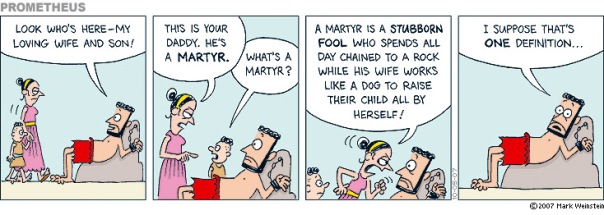
Being a “martyr” is not like when your mom has to drive you to band practice and she makes everyone notice what a wonderful sacrifice she is making. At least that is not what being a martyr meant to the Bible writers and the early Christians. It is not the same as a martyr complex.

Related image

The word martyr derives from the Greek word for witness. When Jesus says to his disciples – “You will be my witnesses,” he could have been translated, “You will be my martyrs.” When governments and mobs started killing Jesus-followers for witnessing to what they had seen, heard and were experiencing, the dying part of being a martyr got attached to the word. Now all we think about martyrs is that they are dying for a cause.

Dying for a cause appeals to many people, like Islamic radicals driving a truck load of explosives into something or a band of marines saving their brothers. Dying for the cause can seem pretty exciting. When Paul was teaching the Corinthian church about spiritual gifts he confronted a group of people he had to correct about such enthusiasm. They were similar to the anti-disciples, here:

The church at Corinth had a faction in it which tended to care more about the gifts they received from God than they did about the intended recipients. They liked being radical for the sake of it. They were sort of like teenagers who are so thrilled to drive the car fast they don’t mind who dies in the process.

Some of the Christians in Corinth cared more about receiving the powerful gifts of the Spirit than they cared for the Giver of the gifts. It was like you might have reacted last Christmas when you had opened your sixth present and forgot to look at the tag that said who gave it to you. When it came to the exciting new possibilities of exercising the power of the Holy Spirit, some in the Corinthian church loved the expression of power. And some of them didn’t mind bearing witness to how great they were – even greater than Paul who brought them the news of God’s great gift in Jesus!

martyrs

Paul’s corrective to those seeking power

In between chapters 12 and 14 of the first letter to the Corinthian church, right in the middle of his teaching on the gifts of the Spirit, Paul inserts a beautiful chapter about love. At the beginning he writes: If I…surrender my body to the flames, but have not love, I gain nothing.

Surrendering one’s body to the flames might be considered another spiritual gift: the gift of martyrdom [link to Bible studies about them all]. Since Paul is talking about spiritual gifts, that’s always sounded right to me – and I know of people with that gift. Some of the Corinthians probably liked that idea of facing danger for their faith. They liked to be the ones to look like powerful witnesses of God’s work in the world. They wouldn’t mind going out in a firefight.

But those bold members of the church would most likely have expected to win a firefight. That kind of lust for power, competition to be the best, to be the most spiritual, to be the best looking Christian is still a problem in the church as a whole. At least I think it is a problem to see the church in competition with the Muslims for market share, or something, as if life were a mall and we want to be Nordstroms not the Dollar Store. In some famous cases, like the notorious Buddhist Thich Quang Duc, one might leap into the flames to burn away the dross and to etherialize one’s spirit, making a powerful point in the process. People do such things.

This lust for surrendering one’s body to the flames, for being a spectacular witness, is probably less a problem in Circle of Hope than it was in the Corinthian Church. In Circle of Hope most of us love love, and we are good at it. I think we are more likely to read the love chapter and de-emphasize chapters 12 and 14 as being “a bit much.” We will sacrifice almost anything to get love and we feel terrible if anyone says we are not giving enough. We’ll even sacrifice the truth to be seen as loving; we might even sacrifice Jesus if he got too scary looking.

We don’t fight, we don’t even want to have strong opinions, because we know that people won’t think we love them, worse yet, they won’t like us. So Paul would probably change chapter 13 for us: “Wait a minute, God may give it to you to surrender yourself to the flames some day as a witness for the truth. You may need to get into trouble with people who don’t like Jesus.” He might re-write the line for us:  If I say I have love but never surrender my body to the flames, what kind of love is it?”

Our transhistorical body blog often pinches this general spirit among us. I hope we never forget how to say “Ouch!” We try to honor the martyrs who showed us how to keep faith in confusing, oppressive times so we can remember how to do it. To name three recent examples: March 24 — Oscar Romero, April 4 – Martin Luther King Jr., April 9 – Dietrich Bonhoeffer

These disciples were loving and well loved. But they certainly got themselves into trouble, didn’t they? They were martyrs for witnessing to the inconvenient truths of the gospel. Just like Jesus did, they got into trouble when they crossed the boundaries of class, ethnicity, tradition, politics and power. They insisted that Christ is all and there is no life unless he is in all and powerful people felt threatened and responded as powerful people often do. I am pondering whether we have a such a vision worth dying for or at least worth dying trying for, like our great ancestors in the faith.  Will we share our revelation with love or will we let it be corrupted as we succumb to the constant drumbeat to support the powermongers or at least maintain as much personal power as we can?

I’m still reading email while Trump can’t stop tweeting

One of my New Years resolutions this year was to write a letter each week to a significant person in my life. I mean a poorly-scribbled, pen-to-paper letter. (And you may be saying, “So where’s my letter?!”) I also use Facebook messenger, texting, WhatsApp, Instagram, Twitter, and all sorts of other innovations. But, like so many people, social media is losing its lustre in my eyes. The platform seems to dull connection rather than heighten them. So I am trying to get more basic.  I have my own farm-to-table approach to communication; I want those I love to know who grew their note in a palpable way — I sign my letters with my own hand.

More devices, less communication

The more communication devices we have, the more distance there seems to be in the world. Some days the disconnection we experience in the church is palpable. We are getting forced apart by choices to connect at minimal levels with quick, minimal devices [old Sherry Turkle Ted talk]. As a church, we keep talking about this surplus-opportunity- yet-dearth of communication all the time. Because we are fully adapted to the devices and the  social networks that dominate them, and we wonder if they will quench the Spirit, if they haven’t already. The newness contained in one cell phone (which is probably giving you cancer) is downright terrifying. Facing the overwhelming pressure of rapacious capitalism applied to communication is hard to combat. But Trump’s tweets are sending people for the doors — he’s so bad we can’t miss how the systems are set up to abuse us.

Anza-Borrego State Park

Some people among Circle of Hope advocate severely restricting all use of machines to interact. They have a point. And I am not judging them when I note, “There are Amish in every age of the church.” Lord knows I often wish I were living off the grid in the Anza-Borrego desert somewhere collecting dew for my garden. And I am back to handwriting letters! So I relate to that application of “resist and restore.” Newness is usually suspicious and often frightening. The Amish said “enough” in about the 1880’s.  But I think we have to admit that the newest form of the same old evil is much scarier than the old evil to which we already conformed. For instance, the old school farming practices of the Amish pollute the Chesapeake Bay watershed. They might feel righteous for not adapting to new ways, but their old ways had some evil in them too.

I am usually more on the other side of the argument. I want the latest technology with which to communicate and to work. I can’t get it fast enough. I am even Google-ized now. I even downloaded (and used!) Venmo this week. I want to discern what evil the technology  carries and resist it. But I also want to seize the opportunity it gives me and use it. As a church, talking about technology is hard. We have been talking about coming up with a “theology of technology” for years. But we can’t quite get there. I suppose it is because we are like Asian carp — too busy adapting to our new environment to think about what it means to be an invasive species.

1) We’re too busy mastering the changing technology. We don’t have time to think about whether we have anything to say about it. That’s pretty scary since it means that the technology already runs us, we don’t run it. [Not over Smashing Pumpkins].
2) We are too small-minded to have a group project like coming up with our own thoughts about what new technology means to us. We are doing very individualized stuff and don’t see group thinking as possible. Our thoughts can be as small as our screens. If you wonder why we can’t connect and break up shortly after we do, don’t underestimate how technology has atomized us and how we have adapted to the illusion of togetherness the media perpetrates. We are sitting ducks for huge forces because we inept at getting together in real time.

Seven years ago, a 25-year old blogger from the East Village wrote down seven things a twentysomething can’t do. Now he’s 32, but I think things may have become even more pronounced. Six of his seven things had to do with building decent relationships, mostly about communicating. We’re all losing our capacity to connect. We want to do it. The many devices we are being sold to communicate could increase our ability to connect, and in some great ways, they have. For instance, I really like texting about where I am and when we are meeting, and about what laundry detergent to buy. But my experience is that people who fully commit to the phone screen for communicating are too small to really do it. They may be wired, but they are not always connected.

My “big” discipline: read email

The powers are determined to make us all rats in their cages. They dominate the devices and conform them to proper rat-usage. SO, I think we should sit down and read our email.

I admit, I don’t seem to know how to have this discussion yet. One time the Cell Leader Coordinators talked about it and they had what, for them, amounts to a spat. I said that I need to read my email on a big screen, which gives more honor to the writer and their art. I don’t think we should do major communicating as the body while we have ten seconds at a stoplight to scan an email or blog post.

I know, that mentality seems unrealistic, kind of Amish. Nevertheless, right now, part of my discipline of communicating is to read my properly filtered email, daily. As you know, I send quite a bit of it, as well. Circle of Hope feels like a major inbox loader for people who haven’t shut off notifications to their phone and feel like they are holding a pulsing, overstuffed screen in their hand. Some people unsubscribe from the Covenant List because they count it as clutter! Some of the cell leaders don’t even read the the info email from their pastor each week, or all the way through. Some of the Leadership Team don’t even take time to read emails they use to lead the church with some integrity and vision. It is a challenge to be that disciplined and committed, but it makes a difference as to whether we are knit together meaningfully.

These are four reasons I still read email and don’t  encourage people to use my cell phone for texting, even when I give them the number, unless it is a texting subject (like “tacos or pho?”).

1) I’m trying to communicate.

To me, communicating is about relating, not just data. I want to say something I actually thought about and receive a thoughtful reply. That seems more like love is growing in the world. I don’t want to merely pass out info and have data hogs sniff around to see if it is something they want to consume. Dialogue creates deeper community. When we can’t be face to face, heartfelt writing can be a decent replacement.

2) I want to hear more.

It is hard to keep up with my email. I would rather talk face to face or in a meeting or even over the phone (although I’m not always that great over the phone). But those ways of communicating are hard to keep up with too. Communicating is hard. But I still want to hear more and connect more with more people. To be the church, we need to listen to one another and listen to the Spirit in one another. That takes quite a bit of listening in quite a few ways.

[The opposite is also true, of course. If you are addicted to checking email because you think some life-altering message is in you inbox, that’s not so good. More is usually the enemy of something. Checking email more does not necessarily mean you are listening more. Here’s a link for the addicts.]

3) It is good to slow down and connect.

All this sounds kind of strange, I guess, coming from a person who was there when the original email was sent back in the 70’s. It was so amazingly fast then! Now, sitting down in front of a screen and composing something thoughtful and loving seems like it is kind of old fashioned. Maybe this is my nod to the “Amish” types. The new Amish-types are often people who still know how to write in a language other than textese.

Being alone, concentrating, and writing, are all good, meditative ways to be who we are in Christ and live a life of love. I am writing this with love, too. It takes time. Even as I write, I am facing the cost of acting this way — there seems to be so much to do! But the writing is helping me to be. The way you pause to read and respond is helping you to be, as well, I hope.

4) I am committed to good infrastructure that extends the kingdom.

At this point, email has been a great way to connect the disparate elements of Circle of Hope. Every year, as we grow larger and add more congregations, we have a big challenge to be one church. We are always pushed to be smaller units, if not just random individuals. Holding together by speaking the truth in love is a major counterattack on the powers that want to dominate us. Our cells and Sunday Meetings are the major ways we express our commitment to being an incarnation of Jesus. But by the time they are over they can instantly be run over my the next media avalanche. We need a daily means of togetherness. Our computers and email can help us if we think about what’s going on.

Hey, if you got this far in this blog post, I feel loved. Thanks. You honor me, like I have tried to honor you with my time and thinking. That is splendidly weird and Jesus-like, and it won’t go for nothing.

Reconciliation begins with forgiveness – primarily of you.

Conflict burns. Like that welt on your hand that takes weeks to heal after you hit the side of the oven, the reminder and pain of conflict remains long after a disagreement ends. Some of us would rather not cook up a relationship at all for fear of being scorched again! Whether we address conflict head-on or mostly absorb offenses, handling the emotional aftermath is hard. If we aren’t careful, resentment can bubble up into a new flame and consume us. Are you keeping a fire going somewhere in your relationship circle right now? In your marriage or family, maybe?

Forgiveness by Stephanie Miller

It is good to have a strategy ready for conflict. And it is important to deepen our consciousness for what to do with the emotions that follow it, and often make us sore. Having a healthy conflict and working through the aftermath both require a basis of forgiveness to end in healing and not further heartache.

In Matthew 18, right after Jesus’ instruction on moving from conflict to reconciliation, Peter asks a probing question. “Lord, how often will my brother sin against me, and I forgive him? As many as seven times?”

The religious leaders of Peter’s day had already put a numerical cap on forgiveness. They taught to forgive three times, and you’ve earned the patience badge on your spiritual Fitbit meter. But then after your three strikes you’re out (and in the U.S. possibly in prison forever). Peter,  as passionate as ever, threw in four more just to be sure.

Jesus’ response must have been a bit aggravating: “I do not say to you seven times, but seventy-seven times.”

Then he tells a story to explain his daunting answer. A servant is brought before his master to settle an account. We’re let in on a secret in verse 25. This servant who promised to pay back everything can’t pay. Yet his master doesn’t hold him to his empty promise, but personally absorbs the debt.

That reminds me of someone.

Shortly after, this forgiven servant pursues a fellow servant who owes him far less than he had owed his master. He seizes him and begins to choke him: “Pay what you owe.” The fellow servant’s reply sounds familiar: “Have patience with me, and I will pay you’’ (Matt. 18:29).

Domenico Fetti (c. 1620)

My pain instead of yours

Is this fellow servant also making a promise he cannot keep? MaybeIt’s infuriating when we’re on the receiving end of empty promises, isn’t it? Picturing such experiences in his story, Jesus gives us a taste of what forgiveness really feels like. God does not forgive worthy sinners, but guilty ones. That’s what makes forgiveness so wonderful but so hard. When we radicals actually apply the Bible and pursue the steps outlined in Matthew 18:15-20 we are doing it as forgiven people, looking for forgiveness to bind us all in grace.

Andrée Seu Peterson writes: I asked a few people if they’d ever forgiven anyone and what it felt like. They gave me answers so pious I knew they’d never done it. . . . Forgiveness is a brutal mathematical transaction done with fully engaged faculties. It’s my pain instead of yours. I eat the debt. I absorb the misery I wanted to dish out on you, and you go scot-free.

Most of us don’t want any of that when we address conflict, if we dare to address it at all! No, we want a fellow sinner to satisfy our righteous demands—for their own soul’s sake, of course. But that seventy-times-seven thing calls our bluff.

Perhaps you theoretically think you can muster up enough forgiveness to meet the criteria. At least you don’t want prisoners to rot without rehabilitation or ex-offenders to lose their voting privilege! But have a fight with someone in the cell and they could get cut off. If your mate loves porn or other men, you might never get over it. If someone besmirches yours or the church’s reputation, they’re out. Our church has gone through long seasons when personal codes of justice trump forgiveness every week, somehow, and it would be legit to question whether we pay attention to Jesus at all.

Later in the Lord’s parable, the Master punishes the servant he forgave, calling him wicked because he couldn’t forebear with another’s empty promise: “I forgave you all that debt because you pleaded with me. And should not you have had mercy on your fellow servant, as I had mercy on you?” (Matt. 18:32–33)

Our gratitude for what God gives us is revealed in how merciful we are toward those who owe usOur horizontal relationship with one another reveals the nature of our vertical one with God.


Forgiveness is an antidote to resentment

Walking through conflict can be tricky. As we progress through telling brothers or sisters their fault, acquiring witnesses and perhaps eventually telling it to the church, our self-righteousness can flare up and engulf our insides even as we seek to maintain a pious shell. When our adversary doesn’t seem to know the script—to repent in dust and ashes—it’s easy to be a Peter, sigh, and ask, “How many times, Lord, must I go through this with this person?”

When we dwell on the person’s behavior and not the finished work of Jesus, we can get stuck in resentment. Outside communion in Christ, the Jesus way to conflict resolution, even when sincerely followed, will probably leave us empty and disillusioned. 

So what do we do when bitterness invades our souls, especially if the offense cuts deep?

  1. Admit: I can’t shake the bitterness. Pray something like this: “God, I need your help to stop feeling rage. I’m not sure I even want to let this go. Lord, please take this away.”
  2. Revisit: God promises us life. When we think of the promises of God, we often think of his unconditional love—the stuff Pinterest memes and coffee mugs are made of. But there are sobering promises, too: “Beloved, never avenge yourselves, but leave it to the wrath of God, for it is written, ‘Vengeance is mine, I will repay, says the Lord’” (Rom. 12:19). Listen to God’s implicit question in the Lord’s parable: “Will you trust me with these hurts, these regrets, and these unpaid debts?”
  3. Reset: Go back to square 1. We are forgiven. It is where we are born again. It is the doorway to our eternity. The very offense that causes us to go to another sinner, looking for their redemption, is a similar offense to whatever drove Jesus to the cross on our behalf.
  4. Recalibrate: Look toward square infinity. Some people have wrecked Matthew 18’s practical road toward harmony by making it a means to purify the church from whatever might cause them to forgive. But the Lord loves the people who sin against us, even hate us – and we just might meet them in the age to come. Their tiny faith might not be enough to satisfy us, but it might be plenty to assure them of eternity. God’s goal is redemption, first of all, not merely justice. Jesus is our justice, any other justice we experience in this world is right and desirable, but it is not the hope on which we stand. Any person we saddle with the requirement to make things right with us could easily wither under the weight of our demand.

As we labor under the burns that take so long to heal and flinch with the fear of being burned again, try these additional actions:

  • Stop re-reading that hurtful email or text message.
  • Stop meeting with the friend who seems to enjoy hearing all about what was perpetrated by that terrible person you can’t forgive.
  • Stop going to those places with all those memories.
  • Stop savoring a cycle of painful or vengeful thoughts but shift your mind to dwell on what is good. When you are tempted to seek revenge—if only in your mind— think on your Master who saw you trying to make things right on your own, making promises you could not keep, and forgave you anyway.

Forgiveness is the foundation of the life of Christ visibly alive in the church. It doesn’t begin with other people getting with it, repenting and being forgivable. It begins with each of us.

I am disappointed; what can I do?: Six ways to deal

In preparation for dinner Saturday, I turned on the Pandora “Hymns” channel. Soon we were listening to American Idol runner-up David Archuleta singing “Be Still My Soul” (complete with his Mariah Careyesque trill on various long notes). He sings it sincerely. It has been a comforting song since the 1850’s and I was comforted.

Be still, my soul: the hour is hast’ning on
when we shall be forever with the Lord,
when disappointment, grief, and fear are gone,
sorrow forgot, love’s purest joys restored.
Be still, my soul: when change and tears are past,
all safe and blessed we shall meet at last.

Image result for david archuleta be stillDavid is 26 now. He’s got a little more depth since he’s returned from his Mormon mission in Chile. He’s already had a long career. He started singing since at ten when he was inspired by a recording of Les Miserables (he later sang some of it for soldiers in Afghanistan). He was runner up for American Idol ten years ago — Utah was disappointed he did not win. His father was banned from the Idol backstage, then he was caught in a prostitution sting and then he was divorced. So David has faced some Utah-sized disappointment of his own. Spending most of your life in a Disneyfied atmosphere would be difficult enough.

He’s popular in the Philippines and other Asian countries. An interviewer there says “Helping and inspiring others, particularly those who are undergoing depression, has become a big part of David’s purpose in life. He admits that he himself went through a phase when he was depressed due to being bullied in school.” He told her, “Even when I was little, I’ve always had self-confidence issues. I got bullied and I was known as the quiet kid. I sat by myself during lunch and I would be made fun of. I was socially awkward. I think feeling good enough was something I always wondered.” Sometimes he gets on stage and looks like he is being bullied — most of the time, not so much.

We’re all disappointed sometimes

So even though he can sing like an angel, David Archuleta carries some disappointment with him and fears more of it, just like us. And like Mormons, Buddhists, Muslims, and us he’s looking forward to a time “when disappointment, grief, and fear are gone, sorrow forgot, love’s purest joys restored.”

Image result for living hope resurrection

Jesus followers look forward to a time when God

“will wipe every tear from their eyes. There will be no more death or mourning or crying or pain, for the old order of things has passed away” (Rev. 21:4).

Some of us were ten-year-olds who become entranced by Les Mis and grew up to become talented optimists — most of us didn’t. We need God to save us from disappointment. We need to find some exultation, like Peter expressed when he wrote,

“In his great mercy [God] has given us new birth into a living hope through the resurrection of Jesus Christ from the dead, and into an inheritance that can never perish, spoil or fade” (1 Peter 1:3-4).

One day, the joy we have experienced in flashes will be the light in which we live. But even now we know our hope is not in vain because Jesus has delivered the first fruit of our future by rising from the dead, as we will.

I was inspired by the great hymn, by David, by John and Peter (and a little by Les Mis). So I am reminding us to hope. We have all experienced disappointment. Some of it has been severe, lately. Divorces depress more people than just the partners divorcing. Being cut off by former friends hurts. People have resigned their covenant with the church. Some people refuse to reconcile. We have not succeeded in all our goals. No amount of Disney-like happy talk or Archuleta pop confection  will overcome what we feel for long. For the long–haul of difficult lives, we need Jesus.

Feeling better is not all up to you

When I say that we need Jesus, many Christians interpret that to mean, “I need a trust upgrade.” They have been taught that if they feel something or suffer something it denotes a lack of faith. They must want something more than Jesus. The idea is: Jesus is our treasure and if we want something else, we are setting ourselves up for disappointment. It is no wonder so many church people are so controlling, they are supposed to control their behavior so they will feel good! They need to get some treasure and protect it! There is something to be said for that strategy, but not much. It is true that if we keep doing dumb stuff, things won’t work out well. If we never get mentally and spiritually healthy, life will be difficult. If we are self centered, we will get ourselves and that’s it. But we’ll never be smart enough or healthy enough to avoid our share of disappointment, failure and grief. Stuff has already happened and more is coming.

If all you want is to be the American Idol and you don’t win you’ll lose hope. (99.99% of singers beware).  You might even blame God for not giving you the desires of your heart, as supposedly promised. If you are responsible for making Utah feel better because you win the contest, you might even feel responsible for a great deal of disappointment in the world. In Circle of Hope, this can be translated: people got divorced, people left the church, people were fighting, I/we/God must suck.

Image result for disappointment

I am so taken with the Lord’s vision for the world, I face disappointment every day. I am working with Jesus for transformation and it hasn’t happened just liked I wanted, has it? I keep allowing myself to be flabbergasted by the sin and death at work in the world, even though another load of it will be delivered in the news tomorrow, fake news or not. What do we do when the sorrow hits? When friends desert us? When we are not so smart? When our plans don’t work out?

I don’t think we should get smaller until we think we can keep things under control better. I think we should be as big as we are in the Spirit and start again right now, in resurrection hope. It is an everyday thing.

Six ways to deal with disappointment

Here are some things I collected for my journey after I bumped into David Archuleta on Pandora. If you are disappointed, there are some things you can try.

  1. Sing

Singing is a perfect way to pray. It reorients body, mind, heart and soul in a common direction toward our source of hope. Try David’s hymn. Sing along, or just be still and know God is with you.

  1. Talk to someone.

That’s what David Archuleta tells depressed Malaysian teenagers to do. He’s right. If you are 35-50 and you think you should know better, have lost the friends you used to talk to, are feeling marriage strains, you must not stay alone. Take a risk and talk about how you feel. A psychotherapist could help.

  1. Visit the Bible again.

You might just be on the endless loop of yourself inside. Just meditating on the two portions of the Bible quoted above might throw a wrench in the works and put you on a different track. If your spiritual disciplines seem to have failed, they might just need some deepening. Try something else. Take a day off and ask some deeper questions than you usually have time for. When you’re done reading this, blank out the screen and turn your face towards God.

  1. Listen to your suffering.

My experience has taught me that disappointment is a great teacher. If we are going through a seasonal (not chronic) depression, resisting it or anesthetizing it with something won’t get me anywhere. If you are blaming someone (or something, like injustice or Trump) you’d better reel that in and meditate on your own development in the safe place you have with God.

5. Let the past go and start from here.

This is the exciting news Peter was so happy about when he wrote his letter. He has a famous role in the story of the last days of Jesus. He was disappointed and distraught by the Lord’s death. He was disappointing, too, because he did not have the stuff to face his fears. But he got restarted after the resurrection.

We don’t know exactly what is going to happen. The future is always foggy. But we have the risen Savior with us, and that is our security. No matter what we have done, or what has happened to us, today is a beginning with Jesus. It will always feel like things are in the way, but there is no good reason, at least, not to take a first step again.

6. Bless the people who leave you on their way.

As a church, we prize our community and we let people into our love. So we get hurt — a lot. Some people get hurt and solve the problem of feeling bad by restricting or shutting off their love. We try not to do that, even when it is tempting. We hope we can suffer with Jesus and gain a resilient heart that can keep following in his way until the end. Even though our numbers are growing, people are always leaving, and it never feels good. We get connected. It is tempting to shut our doors, so we never have to feel left.

I think Jesus is an open door/open tomb kind of person. He blesses those who curse him. I think we should always keep the back door open to anyone we have loved. They might return. Besides, getting even or cutting off is not what we do. (I’m not talking about unrepentant  people who have abused us, or people on whom we are unhealthily dependent). Slamming the door in self-protection is not what Jesus does to us, even though we aren’t the best of friends for Him.

But even more than managing our back door, we should turn toward the front door.  There are six million people in the metro, a few of them, no doubt,  would love to be invited into your life. We are never just our past, we are always looking with confidence into the future. The past is gone, the new has come, and is coming. Look for the people who are new to you with the wisdom you are carrying now,  as the person you have become, and move into the next phase of your life.

Making six points about something makes it look easy or predictable! Our future and our feelings are not going to be easy and they are seldom predictable. But the love of God in Jesus is evident and permanent.  And the promise in the old song, sung by a young man, and often heard in our meetings is consistent:

Be quiet and listen for the assurance.
It won’t be long until we receive in full what we know in part.
One day disappointment, grief, and fear will be gone;
the tears will be wiped away and our living hope will be kissed by joy.
Be quiet and listen for the assurance.
Change and sorrow will be part of the journey
but we will arrive home safe and blessed.

We are called to develop a trust system.

Relationships in the community, whether it is the church community or the city community take trust if they are to flourish. The proverb says:

One who has unreliable friends soon comes to ruin,
but there is a friend who sticks closer than a brother — Proverbs 18:24 NIV

The proverbs are so honest about life! This one is drawing a contrast we all experience. On the one hand, there is wickedness and superficial gunk that messes up the togetherness we’d like to experience. There are friends who pretend to be friends; they fill up your time with a lie. There are companions who do nothing but chatter; they fill up conversation space but not your heart. There are acquaintances who remain superficial; they fill up on your affection and generosity but never attempt mutuality or sacrificially give. There are a lot of people who might share a drink with you in a noisy bar, but they don’t bind themselves.

On the other hand, there is a friend who is worthy of the title — it is possible! We are all looking for them, or despairing that we can’t seem to find one. There are people who will go deep, who will connect, who are real, who can be relied upon. Those are the kindred souls with whom we feel bound our whole lives. We want that.

Jesus is that kind of friend who sticks “closer than a brother” — the “friend of sinners” (Luke 7:34), the one who comes with the ancient promise of God: “Never will I leave you; never will I forsake you” (Hebrews 13:5). People who have Jesus for a friend are blessed (see John 15:14). We can trust him. If we follow Jesus, we’ll see he is moving into the world to make friends and make more friends who can be a friend like him. He is restoring a trust system. We’re moving with him when we  dare to look at what the world is really like (and ourselves!) and try to figure out how to be like trustworthy brothers and sisters in the world.

Trust is shot down on the streets

The recent outbreak of consciousness about the proliferation and protection of automatic weapons has highlighted the level of mistrust in the United States. While hundreds of thousands rallied during the March for Our Lives, NRA allies in Congress pushed the Concealed Carry Reciprocity Act. “Congress is currently considering bills that would force every state to recognize every other state’s concealed carry permits,” said Sen. Stanley Chang, D- Hawaii.  Ideological warfare and mutually assured destruction playing out on every block destroys friendship; Christian intellectuals lament the death of trust.

Violence from your neighbor: a teenager or mentally unglued person with a gun no one will regulate, a drug dealer with an automatic weapon, a soldier or insurgent with bombs and weapons in your neighborhood, a super-rich country flying drones overhead, none of it makes for trusting relationships. The proverb notes this.

A violent person entices their neighbor
and leads them down a path that is not good. — Proverbs 16:29

Philly.com keeps track of homicides and puts them on a map.  Periodically they dip into Camden. They try to tell the truth. The president has 75% of the population suspecting that news outlets broadcast “fake news.”  But they try. They also point out the valiant people who try to undo the violence.

Trust is the alternativity we crave

Many people have been “lead down a path that is not good.” We, the people of God, the Jesus-followers, the Church are called to be the alternative, the antidote to the poison, along with good people who would painstakingly make a murder map so we can see what is going on. The proverbs invite us to trust those who can be seen to deserve it, because they are the cement of society. Jesus invites us to develop a trust system so we can rebuild what is being torn down.

We can start by being trustworthy and daring to trust another. We can build cells, teams, congregations, and a network that is devoted to building a trust system. The Circle of Hope proverb in the title says we are convicted to do just that. What might that practically mean today? A few general ideas:

  1. Trust first. Life is too short to wait until someone proves trustworthy (as if you had that right, anyway). Let them prove untrustworthy and make it hard for them to do it. Treat them like Jesus treats you, who entrusts you with the Spirit of God.
  2. Tell the truth. The world is too messed up to hide (as if you could succeed in that). Let people know who you are. Speak the truth in love to them like Jesus speaks to you, who affirms your value and hopes for your best.
  3. Risk relying on people. The world is too dangerous to be alone (as if you ever are). Let people hurt you and recover. Submit to others out of reverence to Christ, who will save you, who lives with you in an eternal now.

One more proverb:

Deceit is in the hearts of those who plot evil,
but those who promote peace have joy. — Proverbs 12:20

There is no little deceit woven into our hearts and seeping into us from the troubled world around us. A few people reading this probably think that proverb is “fake.” But most of us know, since the Holy Spirit brings the conviction to life in us, that promoting peace is the way to joy, even if it is hard, disappointing or unaffirmed. We are called to develop a trust system. Just living in the alternativity of its promise is joy enough. When we taste more of its reality, it is that much better.