Category Archives: The Mission

Wildness and worry: How Paul puts them together

GNMTPPNW01
The ruins of the Council House in Philippi where Paul and Silas may have appeared before the Magistrates before they were thrown in prison.

A boring picture of rocks, then two pieces of the New Testament letters of Paul is not the most exciting way to begin this blog post. I hope it gets better for you.

I am trying to describe how wildness and worry go together in us.  And I mean both words in their best sense, since some of you may think both or either are not that attractive.

  • Wildness, when we are thinking of the Holy Spirit, is alluring — at least it is attractive in people who are free enough to experience and express God’s presence.
  • Worry, on the other hand, is usually seen as unattractive — and it should be when it is all about our fear. I am thinking of it as an inevitable feature of caring for others and for the redemption project, as you will see.

Here are the two Bible portions on my mind:

2 Corinthians 11:21-29

Whatever anyone else dares to boast about—I am speaking as a fool—I also dare to boast about. Are they Hebrews? So am I. Are they Israelites? So am I. Are they Abraham’s descendants? So am I. Are they servants of Christ? (I am out of my mind to talk like this.) I am more. I have worked much harder, been in prison more frequently, been flogged more severely, and been exposed to death again and again. Five times I received from the Jews the forty lashes minus one. Three times I was beaten with rods, once I was pelted with stones, three times I was shipwrecked, I spent a night and a day in the open sea, I have been constantly on the move. I have been in danger from rivers, in danger from bandits, in danger from my fellow Jews, in danger from Gentiles; in danger in the city, in danger in the country, in danger at sea; and in danger from false believers. I have labored and toiled and have often gone without sleep; I have known hunger and thirst and have often gone without food; I have been cold and naked. Besides everything else, I face daily the pressure of my concern for all the churches. Who is weak, and I do not feel weak? Who is led into sin, and I do not inwardly burn?

Galatians 4:19-20…5:7-13

My dear children, for whom I am again in the pains of childbirth until Christ is formed in you, how I wish I could be with you now and change my tone, because I am perplexed about you! …The only thing that counts is faith expressing itself through love.

You were running a good race. Who cut in on you to keep you from obeying the truth? That kind of persuasion does not come from the one who calls you. “A little yeast works through the whole batch of dough.” I am confident in the Lord that you will take no other view. The one who is throwing you into confusion, whoever that may be, will have to pay the penalty. Brothers and sisters, if I am still preaching circumcision, why am I still being persecuted? In that case the offense of the cross has been abolished. As for those agitators, I wish they would go the whole way and emasculate themselves!

You, my brothers and sisters, were called to be free. But do not use your freedom to indulge the flesh; rather, serve one another humbly in love.

When I was on my pilgrimage recently, following the Apostle Paul through Greece, I had a recurring fear: “If I tell anyone how much I identify with this man, will they label me a grandiose fool?” But last week I had to admit to my spiritual director that Paul has been my spiritual guide from day one of my faith. As I have the vantage point now to look back on many years, I can see how much that is true. I think the parts in bold, above, are key elements of his teaching, and I have tried to make them key to my life.

My new Paul icon from Berea

I identify with both Paul’s wildness and worry

You can decide if the Spirit speaks through Paul, or not, as he would heartily agree you should. So I offered two little portions of his letters today that demonstrate something I recently put together for myself, as well: There is a connection between his wildness and his worry.

My director was parsing out meaning in my deluge of storytelling the other day and he noted how I spoke with delight about how I stood before the “bema” in the ruins of Philippi, undoubtedly near where Paul stood himself, and loved the wildness of the whole scene. Then I was talking about my worries about the future of Circle of Hope and he noticed such a change in my demeanor that it was striking, “What are these two things? Do they go together?” I think he wanted me to stop worrying and move with my bliss.

I eventually told him, “It is all part of the same story.” I had been talking a lot about Paul so I said, “I think I can connect these two things to Paul, want to see me try?” He did. And I remembered today’s verses.

In our dialogue, I had been alluding to our Church Planting Summits last year, when we had all sorts of scenarios for the future of our movement. My director was surprised at how wild we are, since he has been a Presbyterian for a while. For instance, when Presbyterian pastors end their service in a local congregation (like I did in 2016), they are generally sent packing and have a strict no-contact clause in the ending agreement. Circle of Hope did not do that with me. So there I was last summer leading a discussion as Development Pastor about how we should connect as congregations (association, aggregation or composition?) and helping us consider combining congregations if they would be better together than struggling as small groups apart. He marveled at the flexibility! He could see the benefit of being one church in many locations. He said, “Most churches just try to survive and most of their energy goes toward protection, not freedom.” You are rather wild.

But I am also rather worried – quite often. I sometimes think I would rather buy a beach view and practice my well-earned inner peace apart from worries. But then I realize that I hooked my wagon to Jesus and God is very concerned about the earth. It is not so much that the Lord is just worrying over us like something shameful or terrible is going to happen to his creation – he knows the end. But he is worrying like a mother hen might brood over her eggs until they are hatched; and the Lord is fussing like a human mother whose children are just getting mature enough to drive a car.

The wildness of creation is at work. Re-creation has been set loose by Jesus. The sentient, loving beings who carry the heart of it all are yet to be fully revealed. Will they all make it to the good end? I am worried with that kind of worry.

Paul demonstrated both his wildness and worry when he wrote

You can see the complementary nature of wildness and worry in the Spirit in the verses I shared. The passages are often consigned to the “worry” category: “You dear Corinthians with whom I spent so much time. Are you really going to divide up and think you are more special than your teacher?” And “You dear Galatians who responded so favorably to the gospel, are you now going to listen to people who teach you need to be Jews first so you can be Christians?”

I can relate to the worry side. I often think it is wrong to worry — and mistrust in the end is probably wrong. But I might say, “Circle of Hope are you going to squander your community and alternativity now that it is so sorely needed? Will you really think about yourselves first and not imagine a future of mutual trust in Jesus?” Maybe we all relate more to anxiety, so when we see it in Paul we remember it.

But the wildness is also in these passages. I mean that very attractive Spirit-driven wildness that makes Paul such a notable and world-changing guy. I suppose if he walked into the Sunday meeting we’d either adore him or be scared to death by him. The way he makes his point to the Corinthians is to list all the wild things that have happened to him because of his calling in Jesus. Prison, floggings, shipwrecks, bandits, hunger, it goes on. When I was following his journey, just the amount of walking he did seemed daunting to me. The prospect of entering a new town in a car provoked enough anxiety in me! — when I was in Philippi, I was complaining that it was too hot and I was glad to get back to my air-conditioned vehicle! Paul was entering a new continent with a brand new message expecting God to work a wonder – and repeatedly that is just what the Spirit did.

To the Galatians he appeals to their highest, wildest selves in contradiction to teachers who had come in and appealed to their lowest and enslaved selves. He speaks so boldly people have been criticizing him for being too aggressive ever since. But Paul feels free and he speaks freely. And he thinks the Galatians can handle their freedom in the Spirit without being reduced to the Jewish law, which was just a tutor for their adulthood in the Spirit as the children of God. When I thought of Paul being hauled up in front of the magistrates, I was reminded of how much faith he had in the work of the Holy Spirit Jesus unleashed!

Image result for Painting
A “celebration of what can be” by David M. Kessler

I can’t seem to have wildness without worry, either

I am not sure I convinced my director, but I began to convince myself that my wildness and worry went together. There is no way to take risks unless I hope they will make a difference. There is no way to exercise my freedom without hoping others experience the joy of it. There is no way to be part of a cell or team and not long for the fullness they represent or despair over the trials they face. There is no way to build the wild thing called the church and not worry over its future and brood over the fragile new birth springing up in it all the time. Paul was not just traveling around Greece for the sheer exhilaration of exercising his thrilling new freedom to do so! He was nurturing a people who would be set upon, almost immediately, by their own unprocessed sin and by people ready to redirect their movement into channels that suited themselves more than Jesus!

The movement of the good news in Jesus keeps on rolling in about the same way it did in Paul’s time. As I look back on how Jesus has led me, it makes me happy to think my mentor from the past was so influential. I wish I could be more like him, even now. But I am delighted the same Spirit who moved him made me like him at all! — intrinsically wild and often worried for good reasons.

An alternative : Trump is a lot like Nero, which brings me back to Paul.

I certainly enjoyed my relatively Trumpless trip to Greece following around the Apostle Paul! It was refreshing and clarifying. The Greeks have a corrupt government, too, they say. So it is no surprise to them that a Donald Trump is taking hold of the U.S. Treasury. But the people who live in the home of democracy, whose ancestors invented all the temple architecture in which Lincoln  and Jefferson are enshrined, were kind of hoping the United States would hold out and not end up that way.

The U.S. ended up that way. I don’t say “we” ended up that way, since I am not elected by the people, or stealing from them, or planning to enslave them in new ways as I undo the fabric of their society, be it ever so  humble. I live here, but I would hardly let myself be governed by Trump in any sense that really mattered.

Like I texted my brother, I consider our branch of the Christian family to be a permanent and long-standing example of the Sons and Daughters of Liberty he was texting about (1 Cor. 7).  I admit I had to go to Google to see who they were — they were the secret society devoted to overthrowing the rule of King George III in the American colonies.  He thinks we should be ready to overthrow Trump — and knowing him, he is only half joking.  He is a rather conservative guy with a daughter in the FBI, but he hates being embarrassed. And Trump, along with his Bible-misinterpreting Attorney General are very embarrassing. I know they embarrassed me in Europe. I literally called myself Canadian a few times.

It was good timing to be following around the Apostle Paul on a long-held dream of a trip. Walter Wangerin’s fictionalized narrative of his life helped, too. Paul had the Roman emperors Claudius and Nero to deal with, we have Trump.  Wangerin’s biography reminded me that after Nero killed his mother five years into his reign to solidify his power at age 21, he was welcomed into Rome as a hero. People in the Eastern Empire thought of him as a god and longed for his return after he committed suicide. That’s the same emperor who executed Paul and Peter. We can’t really tell what people will swallow or even worship. Humankind is messed up. But isn’t it amazing how important Paul ended up being and how comical, if morbid,  Nero seems now!

I was surprised at how moved I was when i arrived in Veria (Berea) and found the small memorial park devoted to Paul’s work there. I was struck by how the simple message of the work of Jesus on our behalf is a powerful antidote to what ails the world and carries a restorative power that no strange ruler can ultimately undermine. As soon as as our wheels struck runway back in the U.S., Jeff Sessions reminded me that I live in crazy land in need of the gospel. Justifying the separation of parents and their children (in honor of Father’s Day, I guess) with Romans 13 (missing Romans 12, obviously), isn’t the craziest thing offered by the latest administration, but it is high on the list. I was happy to be carrying a revitalized antidote with me from Greece.

I had already heard a small voice in me get louder while I was away, telling me not to rest while Trump fills the earth with lies and people believe he is a god. I’m not going to react to Trump every day, that’s for sure; he does not deserve it. Jesus is Lord and Trump probably won’t even live but a few more years.  What I am going to do every day is nurture the alternative to Trump: the church — even if parts of it are walking with the liar in search of the power and safety of American wealth and whites-only power.

I was emboldened to listen to the promptings of the Spirit when I kept remembering that Paul walked into Greece with nothing but the message of Jesus and upended the Roman Empire, eventually. Of course the Romans cleverly co-opted the church, but the truth has been upending Romanizing stuff ever since. I hope our church gets better and better at upending. We don’t have a lot of power, but we certainly have Jesus.

One last picture. Archimedes (287-212 BC) was a genius inventor from the Greek colony at Syracuse. When we were in the Archimedes Museum in Olympia (another ancient extravaganza) we were so intrigued we went up to the second floor. In the farthest corner was a replica of a weapon designed by an Archimedes disciple.  It is an automatic bow and arrow machine, ancestor of the AR-15. If all of humankind’s inspiration is used for better killing, doesn’t the world need a Savior? If people think vague assurances by a couple of liars in Singapore makes us safer, don’t we need a Savior? My answer has always been, “YES!”

We have one. I am glad Paul did so well at introducing him to people. Eventually the word got to me, too. In a world where somehow we ended up with a Nero-like president, getting back to the basics of being the alternative makes an awful lot of sense again.

Anything might work because nothing really works.

We had a sweetly earnest cell plan intensive the other night in the basement of 2212 S. Broad. All those couches reminded me of the youth group I used to lead! I suppose that’s why I remembered a lesson I learned very early in my life of mission.

Here’s the lesson: Anything might work because nothing really works. What I mean is: God works. I am just a vehicle, an opportunity, a marginally-capable participant. In the cause of redemption, God has used a lot more surprising partners than me to get things done.

Related image

The cell leaders were mainly talking about how to make connections with people without seeming like Verizon trying to get someone to switch. [Hate this commercial]. They were lamenting those awkward conversations when they suspected someone felt weirdly pressured to sign on the dotted line when they were only being invited into a cell group — a group that would likely feel like a precious gift after a few minutes or meetings. “The ask” is always so hard.

So I told a story about being a youth pastor and feeling compelled to make new relationships with high school students. I used to somewhat-illegally go to Arlington High School and sit at one of the lunch tables hoping I would connect with someone. It was, of course, awkward enough to go to lunch when I was in high school. This was even more awkward. And more than a few kids let me know how weird it was, including the ones I already knew! But I also made some new friends, and many of them became friends just because they appreciated just how far I would go to get a chance to meet them [Love this commercial].

Related image

I had learned a lesson from Jesus and I was just determined enough to apply it. Jesus also went to great lengths to get to know us. One time he found someone to heal in Jerusalem and the leaders were mad because he did it on the Sabbath. He told them, “My Father is still working, and I also am working” (John 5:17). Then they were mad that he said God was his father. Nothing worked with these people! He might have gone to a meeting in a basement and lamented that his healings resulted in too little and people responded poorly when he called on them! I would do that and have.

At the same time, I heard what he was saying and went out and tried again. Because the Holy Spirit has repeatedly made it plain that God couldn’t care less about the rejections and absurdities that people throw against Love and Truth. God is at work, so I can trust that. “My Father is still working” — and if that doesn’t work, then nothing works.

The fact is, I throw out a lot of resistance and nonsense myself! And what I come up with as a strategy is usually weak, at best. If I were basing my next move on my predicted effectiveness, I would certainly do nothing. I can demonstrate how ineffective I am (even when others think I’m successful!). Fortunately, God could not care less about my estimations of myself. He died for me when I was turned away and uses me in spite of myself, repeatedly.

That motley, beautiful crew in the basement had a shocking number of success stories to tell the other night — that is, if you consider God transforming lives to be success and you don’t restrict Jesus to making your plans for world redemption work out properly. You could tell we thought very little of our successes. The stories were told to encourage us not to give up, for the most part.

When we prayed, I silently hoped that we would see you at work, Lord. Anything we do is just for revealing you. If people don’t see you at work, what is there to do but heal them, or at least be at the table when they show up for lunch and provide the opportunity for living bread?

Nothing works. People will reject a healing done before their eyes by the Son of God! But anything can work: a prayer, a meeting, a note, a cold call, a random encounter, a song, because God is at work and Jesus is alive in his people. Why wouldn’t we just take the best shot we can according to whatever we have available at the moment? Stranger things have introduced people to eternity.

Why Five Congregations?: It is more than a strategy

Becoming part of any organization, from a corporation to a little league can be very confusing for a while — a church, especially Circle of Hope,  is not that different. You can walk into all our meeting places, except Ridge Ave, when no one is there and any number of people who come in will ask, “This is a church?” Quite a few have looked at me about the same time and said, “You are a pastor?” If I explain, they say, “Most of you meetings are on Sunday night?” Once the high school kids from Pequea BIC in Lancaster Co. stopped by for a little visit. They predictably said, “You have other sites and pastors?” It can be very confusing.

Here is the main reason we are one church in five congregations: Jesus said “I am the way the truth and the life, no one comes to the father except through me” (John 14:6). People need a lot of Jesus doorways in different forms.

  • We are wandering in the dark; we need the light of the world to guide us.
  • We are slaves to our own understanding; we need reconnected to what is beyond us.
  • We are sinful and broken; it is only by the work of Jesus and his merit that we can be forgiven, and restored.

We want to make Jesus accessible like he has made God accessible to us. That’s why we are five congregations in one church.

More directly, we have a great purpose and we are doing the best we can to live up to it. The Bible gives us a mission statement for our family business. It guides us. People call it “the great commission.” It is Jesus’ last words to his disciples.

“Go and make disciples of all nations, baptizing them in the name of the Father and of the Son and of the Holy Spirit, and teaching them to obey everything I have commanded you. And surely I am with you always, to the very end of the age” (Matthew 28:18-20).

The essence of the Lords’ plan for redeeming and recreating the world is to draw together disciples who make disciples who make further disciples. We have planned our life together to do what we have been given to do, making the most of what we have to make an impact in our time and place.

More practically and specifically we are five congregations because it is an practical, radical, attractive strategy. Some people reading this might bristle as soon as the word “strategy” is used, but it is what it is. Strategy is just about getting from here to there in the best way we can imagine. We’re trying “to get to” making disciples who thrive, who make it to fifty with a vibrant, world-changing faith. It is at least possible that Jesus uses billboards, TV, airplane advertisements flying down the coast, charismatic talking heads on big screens and all that to call together disciples. But his main strategy is you and me and anyone else we can get to follow him telling someone else that he is our way, truth and life, now — and showing that in a way that can touch our hearts and minds, face to face. We might not be as desirous or patient as God, but the Lord has decided to need us, even if we have not decided to need Jesus, yet.

So our strategy is to go with Jesus on this, he is the way. His way is our way. He is the truth and the life; we want people to get to God and their true selves through his work. We also presume that you will hear and feel the great commission and be a follower who connects with others who will eventually follow the Lord you follow. You love God and you love them so you find ways to makes a connection just like God found a way to connect to you. If you don’t care about that, we are mostly out of business, because that is what our family business is.

Here is how we do it.

We make a cell. That is how Circle of Hope started, with the nucleus of one cell. And if you look at Jesus and the twelve disciples, that’s basically what he did, too. So we had one, then we had two and quickly three, and on we have gone over the years, multiplying cells and watching them live or them die on their own spiritual strength. That’s the basic body-life way we operate. The cells get together and form a congregation.

South Broad was the first congregation that formed (at 10th and Locust, then Broad and Washington). It drew from the entire region. We have always had a wide region in which we operate, and we still do. Marlton Pike also has a very wide region — all of South Jersey. North Broad also see themselves as having a wide pull, but mostly they are North Philly. Frankford and Norris draws from all over, but they are mostly Kensington and Fishtown. Our newest congregation on Ridge Ave tries to attend to all the Northwest. We used to have congregations in G’town and Frankford, but they dispersed.

Multiplying congregations is part of our strategy: When the congregations get over the 200 adult mark we start looking to see if they are going to have enough expansiveness to multiply. We think of it as bees in a hive — when the hive gets too big, it “hives off” into another hive. Right now, South Broad has about 130 adults after sending people off to the Northwest last year. If we had 230, we might think about sending off 50 or so to begin a new congregation. Better to have 270 and send 70, but that would be a judgment call we would have to make.

There are a lot of practical reasons for having multiple congregations instead of one big one, but our best reasons are about making disciples. We have a strategy for making authentic disciples of Jesus in the megalopolis. See if you think we are making the right decision.

Being one church in four congregations allows us to be big and small

We are as small as a cell, and as big as the whole church; as face-to-face as a congregation and as unknown as what the Spirit is doing next on the frontier of the constituency.

In terms of congregations, since that is theme of this post, we like the congregations to be relatively small. I say relatively because most churches in the United States are smaller than our typical size. Even though you see all those megachurches on TV, most churches are between 70-100 people. They are a big cell group with a very energetic leader, the pastor. It takes multiple leaders and multiple cells not to be a 100 person church; we think having multiple cells is more expansive. So for us, small means about 200, which is about the number social scientists say an interested member of a social group can hope to connect with in some meaningful way, like remembering names. We like to be face to face. Jesus had twelve, then the 70 and then there were 150 in the upper room on the day of Pentecost. It was personal.

But there are also advantages of scale, being five congregations in one church. In larger groups, one person or one clique has a tough time dominating, so there can be multiple centers of leadership and accountability. That’s why we like to have two Sunday meetings, so it is built into us that there are more people than just the ones who are in the room. One of the biggest advantages of scale is sharing resources. Circle of Hope has a common fund, so if one congregation has less money than they need, the others can help. We have one mutuality fund, so we can distribute it where there is most need. We have a common set of compassion teams that we all share. We have the covenant list and share list that are fruitful places to contact a lot of people. We draw from the whole network for our Leadership Team. Our pastors are not singular, but are a team, so they have less psychological issues with isolation and get a lot of stimulation.

Jonny Rashid sent over another image after this was published.

Being five congregations as one church allows us to be complex and simple, old and new

We are as complex as a network of cells, teams, businesses and events that have grown over time and as simple as the next new relationship we make.

On the complex side, it might be quite daunting to think that one congregation could come up with Circle Thrift and other good businesses. I am sure we would still have big ideas, but more complexity takes more time and staff and organization.

At the same time, we are quite simple. Our pastors do not run the one big church all day; they are mainly local pastors. We hope you feel like you can call up and talk to your pastor. I have a new friend with a 2000 person church in Delaware. People are on a three-month waiting list to get on his schedule, and he is their pastor. We want to know and be known, and that includes our leaders.

Being big and small also allows us to be old and new. At a Love Feast several years ago Gwen overheard someone saying, “Welcome to the covenant. I joined in three months ago.” So she chimed in, “Yes, welcome. I joined in 16 years ago.” Hiving off new congregations helps us stay new and attentive. Being a long-lasting network helps us have continuity and stabilizing lore.

Being five congregations as one church allows us to be in a neighborhood and also city/region-wide

We are fully part of our neighborhood and fully part of our whole city and region.

A few years ago we started naming our congregations after their addresses. We’re all identified with neighborhoods; our region likes things local. You may not do this, but quite a few people over the years have signed in on the welcome list as “Tony from 12th and Mifflin,” or some such address. We want to actually live, as congregations, in our neighborhoods. It is true we have cells in all sorts of neighborhoods, but the congregation has a home, too, in its neighborhood, and we like to think we are a vital part of it.

On the other hand, we don’t want to be just our neighborhood, because our region’s neighborhoods see themselves as so distinct they don’t even talk to each other sometimes. Broad St., right outside my door, was a demarcation line for 50-60 years until that began to break down lately. We thought it would be a good representation of Jesus to be in different neighborhoods, but actually be one church. We did not want to give in to the arbitrary dividing lines that keep people apart.  We even decided to cross the river, and that was no small deal. Tons of people work every day in Philly and cross the bridge, but when they think about doing that to be one church and it seems like a big deal. We like to push the boundaries of what seems possible.

It does not make any difference how we are structured if no one cares about the family business. It would break a lot of hearts if we actually did it, but I and the leaders are pretty much content to let the whole thing die if no one applies themselves to working the strategy. I think I should trust your passion to run the business, just like Jesus trusted his first disciples. You have to want the Lord, have the purpose, and do the strategy, or it is all just a lot of talk.

People do not move into eternity with mere talk. They need to make a relationship with God in the person of Jesus, who is the way, the truth and the life. For many people, each of us is the only Jesus-is-my-way kind of Christian they have ever met. It is not an easy business to be in, but it is our family business. I am doing my best to tend it with you.

The Spirit’s Impressive Church Planting Track Record

The South Broad stakeholders had a lot of good ideas on Saturday morning! I think we were just getting warmed up when our two hour time-allotment was over. I was impressed with the work of the Holy Spirit among us. We have gifts and vision – and the Lord has transformed lives in so many ways! People told stories to illustrate what they were saying over and over — transformation is so common among us we can use the instances as just another example. We should trust that Spirit.

We don’t make the body, Jesus does. We’re just working with the Spirit of God, here.

The Holy Spirit is just as ready to guide us as he guided all those people in the New Testament. The Lord is the ultimate church planter. The Spirit has never reduced church planting into a reproducible model. The everfresh work of church planting must be reduced into a loving, dependent relationship! Every cell, congregation and church is planted a unique way. So if you are called to plant the church (and you are) you need to develop an ever increasing, intimate relationship with the Holy Spirit and trust the Lord’s work.

Image result for upper darby to philadelphia view

Seeing how the Lord was working and seeing how we need to stop worrying, controlling and judging instead of trusting, made me want to remember how the Spirit is guiding us. So I have two things for us. First, I want to lay out how the Spirit planted the first churches on three continents and how that inspires us. Then I have one piece of advice for keeping up with Jesus as you plant with him.

Jerusalem

Jesus told his disciples to WAIT for the Spirit before beginning to make disciples in the city. As they obediently prayed, the Spirit showed up and empowered courageous witness that pierced the hearts of 3000 unbelievers. What a way to launch a church plant! It has never been done quite the same way since.

How did your church start? Do you even know? Or do you think it started when you showed up? It was probably impressive and it was probably so long ago that most people can’t even relate to it. It is interesting to look back and learn things. But the more important question that looking back usually begs, “How is the church starting NOW?”

Samaria

After this impressive start, what happened next? No doubt the disciples never predicted that persecution was the church planting strategy the Spirit would use. For instance, Philip was one of the Acts 6 leaders who were recognized as being “filled with the Holy Spirit and wisdom.” It seems the Spirit helped Philip stay on task rather than panic once persecution scattered him to Samaria. The Spirit empowered his message of Jesus there until there was “much joy in that city.”

Terrible things in the world, great failures in leaders and in communities are often just the new seedbed of the next church. Aren’t we experiencing that right now? The oddly-successful church planter Robert Schuller was fond of saying, “Turn your scars into stars.” We have some failure among us; don’t you? Do you think we can trust God to turn it all to good when we trust the Spirit?

Africa and Caesarea

Next, to plant churches in Africa, the Spirit inspired an encounter between an evangelist and a seeker. The Lord said to Philip, “Go toward the South…” Philip did his part, “he arose and went.” He came upon an Ethiopian court official reading Isaiah and the Spirit said, “Go over and join this chariot.” Philip and the Ethiopian discuss Jesus; the man asks to be baptized and continues his journey home to plant the church in Africa.

Stories like this pile up in Acts just like they pile up among us. In Caesarea and Joppa, both Peter and Cornelius received visions that brought them together to move the good news of Jesus into new territories. When Peter spoke about Jesus in Caesarea, “the Holy Spirit fell on all who heard the word.” The believers who had traveled with him were “amazed” that Jesus poured out such grace “even on the Gentiles.” The Holy Spirit was building quite a church planting resume: Jerusalem, Samaria, Africa, and now Caesarea.

Stories almost as strange were told this month among us. God spoke in dreams, through random encounters, through random acts of kindness and deliberate plans. Boundaries were crossed. We can trust the Holy Spirit to plant the church.


282 South Philly Stock Photos, Pictures & Royalty-Free Images - iStock

Asia Minor

Next, we see “the hand of the Lord” was also simultaneously with the believers who were scattered by the persecution in Antioch, about 300 miles north of Jerusalem. During one of their meetings, “while they were worshiping the Lord and fasting, the Holy Spirit said.…” As we know from experience and from looking at the story in Acts, the Holy Spirit was not dictating rules and regulations, Jesus was leading his body to ACT. Our job is always to “keep in step with the Spirit.”

The leaders in Antioch were reshuffled, much like we have done since we began our “second act” in 2015. Three leaders stayed in Antioch and two leaders, Paul and Barnabas, were sent out by the Holy Spirit on a great adventure to plant churches throughout Asia Minor. During their second visit to each city, they appointed elders in each church, because the Spirit had been at work calling, gifting, and guiding.

The Spirit at times says “GO” and sometimes says “NO” to our plans. Paul had the noble desire to go back on the road to strengthen the churches that had been planted. However, in the middle of that noble work, he was “forbidden by the Holy Spirit” to speak the word in Asia. Next, the Spirit of the Lord didn’t allow them to go to Bithynia. There are limits to what we can do.

The Holy Spirit is bigger than our imagination. We can only hope to appreciate our own slice of the mystery. We are always doing more than we are capable of doing; we are always given less than we think is necessary. When we look over our meager work and our troubled region we may respond with passion or despair. More deeply, we should respond with trust and gratitude. Our cup is half full. It is amazing there is living water constantly available at all!

Macedonia

When the Spirit says, “No,” we can often expect something better. In Paul’s case, the Spirit gave him a vision that sent him to a new continent. He ended up in Philippi to plant the church. The leading city of Macedonia had no synagogue, where he would expect to begin his work. He didn’t panic. He found a few God-fearing women meeting at the river. The Lord opened the hearts of Lydia and her household. The next core group members added to the church at Philippi were a freed slave girl with a spirit of divination and the jailer. The Spirit impressively planted a church in Philippi with an unlikely cast of characters and through an unpredictable series of events.

I know people are reading through Acts right now and are getting the rest of the story. It is impressive. The are anticipating new acts. It is time to move into the next territory and the Lord is leading us to do just that.

Related image

We can trust the Holy Spirit

Each cell, each congregation, each church is special. Each challenge is unique. Each core group is unpredictable. It just takes the Holy Spirit’s guidance and the message of Jesus to successfully plant a church from its smallest form to the largest — not fabulous talent or charisma. The Holy Spirit goes before us and leads you every step of the way. Jesus is so impressive, we don’t have to be. You just have to trust Him.

Jesus has already been where we are going. When we look over the meeting room on Sunday or in the cell, Jesus is with us and in each of us. We don’t need to get people to do what they don’t want to do, we need to catalyze what the Spirit is already doing! We are cooperating. If we are creative at all, it is all about co-creating. We don’t need to feel over-responsible for what people do our don’t do; Jesus is with them. We don’t need to protect them from what they fear; Jesus will save them.

Following the Holy Spirit is about the character of our relationship with God, not the competence of our job performance. It’s about a relationship to be developed with the person of the Spirit, more than a technique to be mastered. Dallas Willard says it well: “Perhaps we don’t hear the voice of God because we don’t expect to hear it. But perhaps we don’t hear it because we know that we fully intend to run our lives on our own and never seriously considered anything else. The voice of God would be an unwelcome intrusion into our plans. By contrast, we expect the great ones in The Way of Christ to hear that voice just because we see their lives wholly given up to doing what God wants.”   

From the apostles in the upper room, to Phillip after the persecution, to the people worshiping and fasting in Antioch, they were all “wholly given up to doing what God wants.” They were done trying to run their own lives. Ray Ortlund Jr. says: If our purposes rise no higher than what we can attain by our own organizing and thinking, then we should change our churches into community centers. But if we are weary of ourselves and our own brilliance, if we are embarrassed by our own failures, then we are ready for the gift of power from on high”(The Gospel, 104-105).

When I look around us, I admit I see plenty of people who are not weary of themselves yet — and they are wearisome! But those people are far from the majority. Most of the people in our church did not get involved with our radical little group of subversives to look great. Like the stakeholders demonstrated the other day, they got involved to follow Jesus and plant the church. They got involved to give their gifts in love. And they can be trusted to give them, just as the Spirit can be trusted to use them.

Standoff: We have treasure to apply to the trouble

There was another standoff on Saturday night.

Image result for white house correspondents dinner
Michelle Wolf’s performance, which included a harsh skewering of White House Press Secretary Sarah Huckabee Sanders, left the media sharply divided over its level of propriety. — CNBC

White House Correspondents Dinner

President Trump did not go to the White House Correspondents Association dinner in Washington Saturday night (although Ivanka, Kelley and Sarah did). The headliner was comedian Michelle Wolf, and she took no prisoners. She was not really that funny, just kind of mean. For instance, with Ivanka watching this was her joke: “There’s also, of course, Ivanka. She was supposed to be an advocate for women, but it turns out she’s about as helpful to women as an empty box of tampons. She’s done nothing to satisfy women. So I guess like father, like daughter.”

In a speech that lasted for more than an hour, President Trump sought to reinforce his position as a Washington outsider victimized by a system threatened by his presidency. — Credit Tom Brenner/The New York Times

Trump rally in Washington Township, Michigan

The President was in Michigan having an oppositional event. And he did not take prisoners either, beginning with a harangue against the “dishonest people” in the media and the “phony Washington White House correspondents thing.” Following a string of tweets on Saturday morning that blasted Senator Tester, who made it plain that Ronny Jackson was unfit to head the VA, Trump told the crowd that “what Jon Tester did to this man is a disgrace,” and said that the concerns raised about Jackson were “vicious rumors” designed to “destroy a man.” The President also issued a threat: “I know things about Tester that I could say too. And if I said them, he’d never be elected again.”

It was a liar standoff. Mean people being mean. We apparently like that stuff. And if we stop liking it, Laurence Fishburn’s career may be severely diminished.

Will the church completely adopt standoff relating?

I hate to say it, but I think we like stand-off relating in the church, too.

The church tends to be very adaptable to whatever culture Jesus wants to redeem. Sometimes it is TOO adaptable and ends up sponging up than sponging out, sucking up poison instead of releasing antidotes. The church has been divided up by politics for years. Us Anabaptist types try to hold on to our third way, but we often end up mimicking the fights of the world and dividing up over them as if Jesus weren’t our unity. Our church is not immune from standoffs that end in walk outs that result in cut offs. In an era in which forgiveness is finally super relevant, we’re tempted to forget about forgiveness and go ahead and try to win the stand off or at least adapt to standoff reality as if it were reality.

A new book by Bill Schneider (you may have seen him on CNN) shows just how bad it has gotten. It is called Standoff: How America Became Ungovernable. He’s been covering politics since 1976, and in the book he traces the development of a massive cultural divide that developed over that time between what he calls “Old America” and “New America.” Old America privileges tradition, religion, guns, isolationism, “street smarts,” and whiteness; New America favors progressivism, the environment, gender and racial equality, globalism, education, and diversity. Trump, observes Schneider, did not invent this divide, he merely capitalized on it.

I think I joined the New America about 1974 in many ways. Thank God that was also about the time I was signing up for radical Christianity. I think many of us in Circle of Hope are members of the New America mainly because so many of us are new and the old America is old, but also because we’re diverse in many ways, we are living into climate change, and equality seems like it should be moot, not a fight.  I can only hope that people who start new can also get radical with Jesus, who is so old he always seems new.

We have treasure we should not squander

What I want to suggest is simple. In 1976 a lot of things seemed new in the United States, too, to us 20 somethings and the old stuff sucked. Latching on to Jesus made more sense then and it makes more sense now. After many years of sticking with faith, I can tell you it offers a lot more than the interchangeable solutions of the world. The alternativity of the church is the best hope for the world that keeps inventing new ways not to fix itself while totally believing the opposite is happening. Like Jesus says, “Every[one] who has been trained for the kingdom of heaven is like the master of a household who brings out of his treasure what is new and what is old” (Matt. 13:51-53). We’ve got treasure that winning a standoff will not supply. From that treasure, we might even win a few standoffs. But even better, we would win if we lost them.

Our faith is more precious than the drama or despair of the present moment. Though we suffer great torment, we dare not give in to the temptation to pick up the fights and weapons of the world and squander the treasure we have to offer to the pains of our passing-away era. The healing alternativity of our faith supplies what is needed for the constant trouble of loving our mates, loving unfinished people in the church, and caring for coworkers and neighbors. It is certainly a better direction than creating and dying from a standoff. And the treasure of our faith applies generally. We care about every troubled person and the systemic issues that trouble them. But we care from a deeper place than any standoff demonstrates. If we can’t care from a heart that knows the love of God, I wonder if our “caring” is not more empty promises leading to more standoffs, just more lies from mean people.

Martyrs have a vision worth dying for: Power is not enough

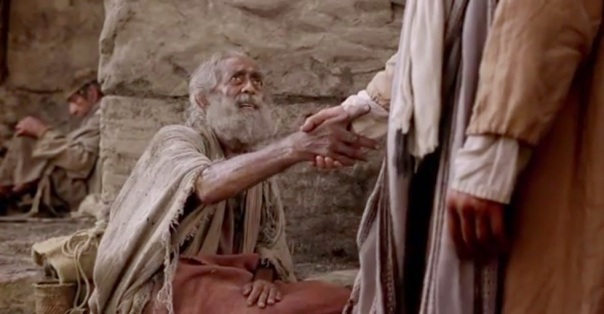
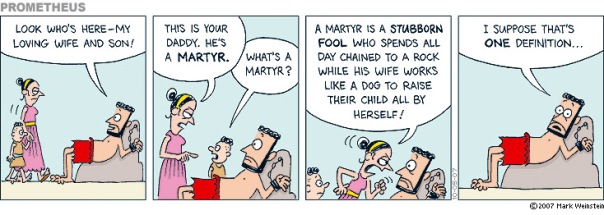
Being a “martyr” is not like when your mom has to drive you to band practice and she makes everyone notice what a wonderful sacrifice she is making. At least that is not what being a martyr meant to the Bible writers and the early Christians. It is not the same as a martyr complex.

Related image

The word martyr derives from the Greek word for witness. When Jesus says to his disciples – “You will be my witnesses,” he could have been translated, “You will be my martyrs.” When governments and mobs started killing Jesus-followers for witnessing to what they had seen, heard and were experiencing, the dying part of being a martyr got attached to the word. Now all we think about martyrs is that they are dying for a cause.

Dying for a cause appeals to many people, like Islamic radicals driving a truck load of explosives into something or a band of marines saving their brothers. Dying for the cause can seem pretty exciting. When Paul was teaching the Corinthian church about spiritual gifts he confronted a group of people he had to correct about such enthusiasm. They were similar to the anti-disciples, here:

The church at Corinth had a faction in it which tended to care more about the gifts they received from God than they did about the intended recipients. They liked being radical for the sake of it. They were sort of like teenagers who are so thrilled to drive the car fast they don’t mind who dies in the process.

Some of the Christians in Corinth cared more about receiving the powerful gifts of the Spirit than they cared for the Giver of the gifts. It was like you might have reacted last Christmas when you had opened your sixth present and forgot to look at the tag that said who gave it to you. When it came to the exciting new possibilities of exercising the power of the Holy Spirit, some in the Corinthian church loved the expression of power. And some of them didn’t mind bearing witness to how great they were – even greater than Paul who brought them the news of God’s great gift in Jesus!

martyrs

Paul’s corrective to those seeking power

In between chapters 12 and 14 of the first letter to the Corinthian church, right in the middle of his teaching on the gifts of the Spirit, Paul inserts a beautiful chapter about love. At the beginning he writes: If I…surrender my body to the flames, but have not love, I gain nothing.

Surrendering one’s body to the flames might be considered another spiritual gift: the gift of martyrdom [link to Bible studies about them all]. Since Paul is talking about spiritual gifts, that’s always sounded right to me – and I know of people with that gift. Some of the Corinthians probably liked that idea of facing danger for their faith. They liked to be the ones to look like powerful witnesses of God’s work in the world. They wouldn’t mind going out in a firefight.

But those bold members of the church would most likely have expected to win a firefight. That kind of lust for power, competition to be the best, to be the most spiritual, to be the best looking Christian is still a problem in the church as a whole. At least I think it is a problem to see the church in competition with the Muslims for market share, or something, as if life were a mall and we want to be Nordstroms not the Dollar Store. In some famous cases, like the notorious Buddhist Thich Quang Duc, one might leap into the flames to burn away the dross and to etherialize one’s spirit, making a powerful point in the process. People do such things.

This lust for surrendering one’s body to the flames, for being a spectacular witness, is probably less a problem in Circle of Hope than it was in the Corinthian Church. In Circle of Hope most of us love love, and we are good at it. I think we are more likely to read the love chapter and de-emphasize chapters 12 and 14 as being “a bit much.” We will sacrifice almost anything to get love and we feel terrible if anyone says we are not giving enough. We’ll even sacrifice the truth to be seen as loving; we might even sacrifice Jesus if he got too scary looking.

We don’t fight, we don’t even want to have strong opinions, because we know that people won’t think we love them, worse yet, they won’t like us. So Paul would probably change chapter 13 for us: “Wait a minute, God may give it to you to surrender yourself to the flames some day as a witness for the truth. You may need to get into trouble with people who don’t like Jesus.” He might re-write the line for us:  If I say I have love but never surrender my body to the flames, what kind of love is it?”

Our transhistorical body blog often pinches this general spirit among us. I hope we never forget how to say “Ouch!” We try to honor the martyrs who showed us how to keep faith in confusing, oppressive times so we can remember how to do it. To name three recent examples: March 24 — Oscar Romero, April 4 – Martin Luther King Jr., April 9 – Dietrich Bonhoeffer

These disciples were loving and well loved. But they certainly got themselves into trouble, didn’t they? They were martyrs for witnessing to the inconvenient truths of the gospel. Just like Jesus did, they got into trouble when they crossed the boundaries of class, ethnicity, tradition, politics and power. They insisted that Christ is all and there is no life unless he is in all and powerful people felt threatened and responded as powerful people often do. I am pondering whether we have a such a vision worth dying for or at least worth dying trying for, like our great ancestors in the faith.  Will we share our revelation with love or will we let it be corrupted as we succumb to the constant drumbeat to support the powermongers or at least maintain as much personal power as we can?

Resisting word wars: Incarnation means winning the right to be heard

People are getting less interested in the rantings of our politicians all the time because the thin veil of their manipulative mendacity is worn so thin.  The expensive ads by campaigns and superpacs do not move most of us anymore. It makes me wonder whether anything can move us. Since I am in the being moved “business” that’s an important question.

Unfortunately for Jesus, politicians practice the same kind of speechifying that churches have practiced for generations. The politicians get up in a pulpit and relate ideas in hope of convincing people to share their point of view and vote them into power. Their point of view does not necessarily need to have any relation to who they are or even what they actually do — they are making a point, not a relationship. A politician might hound Al Franken out of the Senate while protecting the serial groper-in-chief. Obama talked like a populist while being funded by the banks he bailed out. In like manner, professional ministers are regularly exposed as not much different. They don’t win the right to be heard by actually relating as humans; they win the battle for power by appearing solidly, consistently beyond normal discourse.

Winning the right to be heard

By now, I think we are all accustomed to demanding our right to be heard and have forgotten the prerequisites for getting heard. We rely on our protected free speech even though people can’t rely on our moral behavior, that’s in our protected privacy. It is a recipe for miscommunication. The new rules seem to be: “I can be as mean as I want and others should not take that personally, since we’re just talking.” I hope you have not witnessed a Twitter war or had some Facebook opponent try to take you out. But it happens. They exercise their right to divide people up in honor of their quest for a moment of empowering assertion; but “it isn’t personal.”

Everything is personal. We’re all related at some level. I still think I need to win the right to be heard.” No one trusts what we say before they trust who we are. We often talk about “incarnational mission” in our church. “Incarnational” has become a a buzz word among Christians these days, but incarnation has been God’s missional methodology from the moment Jesus was born of a woman. A purposeful life that is, by nature, incarnational is not difficult to imagine, especially if you look at what Jesus does and not just what he says. God got a hearing by becoming one of us, and continues to guide us as one who “comes alongside” in the Holy Spirit.

I learned about winning the right to be heard as a freshman in college. I kind of bumped in to Jesus humbly trying to get me to listen to him as I was discovering  the need to win the right to be heard by my new friends. I had basically deserted my pulpit-centered Baptist church as a senior in high school as I wandered around in the wilderness of depression and doubt. I came out on the other side having met God in significant ways. I was so motivated that I decided to introduce myself to my dorm hall as a Christian. I did this in ways that make me cringe a bit now, but they turned out to be strangely effective methods. People became Christians. I was not a good missionary, but the fact that I existed was weird enough to get some attention. I had no method but to be who I was, since that was all I really knew how to do.

I had no pulpit, and what I did say was not particularly impressive. But I did exist. I did not hide who I was. I was an incarnation, which is the essence of evangelism. This experience at an impressionable age solidified a truth in me that has stuck with me my whole life: God can use anyone. It also helped me understand that being relatively normal is the best way to deliver the extraordinary. God became a regular human in Jesus, born of a wonderful, but relatively typical woman and the impact was extraordinary.

Image result for trump zuckerberg

We don’t need word power

Toni Morrison is famous for saying in her Nobel Prize acceptance speech:

“The systematic looting of language can be recognized by the tendency of its users to forgo its nuanced, complex, mid-wifery properties for menace and subjugation. Oppressive language does more than represent violence; it is violence; does more than represent the limits of knowledge; it limits knowledge. Whether it is obscuring state language or the faux-language of mindless media; whether it is the proud but calcified language of the academy or the commodity driven language of science; whether it is the malign language of law-without-ethics, or language designed for the estrangement of minorities, hiding its racist plunder in its literary cheek – it must be rejected, altered and exposed. It is the language that drinks blood, laps vulnerabilities, tucks its fascist boots under crinolines of respectability and patriotism as it moves relentlessly toward the bottom line and the bottomed-out mind.”

Some Christians may have practiced such oppressive speech in the name of their sovereign God, but we are trying to outlive their bad influence and convince people, person by person, that the Lord Jesus is still the dying and rising God beside us in our dying and rising.

Many politicians and other power hungry people foist incessant word-warfare on us, and many of us are willing to learn their craft — we also try to demand or buy the right to be heard. I think Jesus followers should resist that temptation and, instead, win the right to be heard by being regular people who come up alongside others and persistently exist. We enter human dialogue as ourselves in Christ, not as bodiless proponents of some ideology beyond us. We have the relationship with God we have as who we are and we reveal that connection in the same way we tell any other story that allows someone who cares to understand us. If we ever gain a sympathetic ear for who we are and for Whom we have come to know, it will probably be less about how powerfully we communicate or manipulate than it will be because we are real.

Our faith does not need millions dollars behind it to make it real. Jesus’ life, and Martin Luther King’s for that matter, were powerful because of who they were and what they did, not merely because of what they said. In an era in which most public language can be justly suspected as lies, we need a renewed devotion for incarnational mission. It is a new era full of a new variation of people who seem to be turning off the powerful manipulators beaming down on them.  According to Ad Age,

“in the last quarter of 2017, time spent on Facebook every day declined by 5 percent, or 50 million hours, a drop the company attributed to its intentional efforts to prioritize more meaningful content. But it also saw the number of North Americans on the platform fall for the first time, to 184 million from 185 million in the third quarter.”

I hope for more people to wake up and live real lives.

Unfortunately, a lot of people think Jesus is beaming down on them in a similar coercive way. They don’t want Christians to follow them around with notifications, either. Jesus has been associated with the establishment in Eurocentric countries for so long, it is hard to get Him separated. But he isn’t one and the same with Trump and Zuckerberg, manipulating huge communication platforms to dominate us or profit from us. Jesus is still like the baby, now crucified and risen. Like Jesus, I want to win the right to be heard, so people can see that I am not some ideological parrot and so they can better see Jesus alive and alive in me. Whether I am effective at that mission or not is important to me. But I think Jesus will manage to be real, regardless of my ability, as I have always experienced him to be.

March for Our Lives: Enough is coming. Thoughts and prayers are welcome.

We were marching around Stroudsburg with a surprising number of people who wanted to be in solidarity with the March for Our Lives movement last Saturday. (We can even be glimpsed and heard in the video!). We were chanting:

  • Thoughts and prayers are not enough!

When we got to the corner of Main and the I-80 onramp, a lady in a big black SUV rolled down her window and shouted

  • Jesus is the answer!

The crowd shouted louder.

  • Thoughts and prayers are not enough!

She had a big voice and kept on shouting,

  • Jesus is the answer!

The crowd shouted even louder and then the light changed.

Well, she was right, I guess, depending on the question. If we ask Senator Toomey if he is going to desert the NRA and advocate common-sense gun reform — AT LEAST the ban on assault weapons of all kinds, I doubt that I just want him to answer “Jesus.” If the lady who told us about being caught in a shooting and experiencing the loss of her dear friend and her husband, who died protecting her, asked me what I wanted to do about the flood of weapons that directly caused her emotional and physical disability, I doubt I would say, “Jesus is the answer.” Jesus is the answer, but we are the questioners and answerers who are his hands and feet in the world. He can get specific.

I think the crowd was right, too, depending on what they meant by “enough.” Thoughts and prayers can sound like an insult, if they are meant to be “enough” of a response. The young man from Parkland directly asked Senator Rubio at the CNN Town Hall if he would stop accepting NRA money and the senator would not answer the question. The teens at the DC rally continually pointed out that he and the rest of the government have mostly offered “thoughts and prayers” for the thirty-eight days since the Parkland assault. Tiny fixes that seem like something in relation to nothing have been enacted, but nothing that would save children from dying or save the lady at our rally from having an assault weapon turn her leg, as she said, into ground beef. But if thoughts and prayers are useless, what is enough? Would you like an inquisition about everything? Guns, sex, drugs, consumption of fossil fuels, etc. with you in charge of it? Are you so mad you are not going to stop until you get the power of which you have been so far deprived? Sending thoughts is still kind, unless it is a substitute for action. Prayer is crucial, unless it is just a mask for venality. Don’t throw the heart out with the heartless.

Our march was a bit too strung out to effectively shout the slogans together:

  • What do we want? Gun reform!
  • Protect children, not guns!
  • Hey, hey NRA, how many people died today? (About 96 we were told).
  • No more AR-15s! (outside the gun store shown in the video).

The crowd favorite was

  • Enough is enough!

But my favorite was simple:

  • Vote them out!

It will apparently be uncool not to vote on a lot of campuses this fall.

I prefer democracy to other forms of government, I think. Someday the country may try it. But no form of government will succeed at bringing the world to right unless Jesus holds the answers to its questions. And no one, no matter how passionate or articulate, will do much for democracy unless they think well and they have kind thoughts for others, and unless they pray well and rely on the prayers of others.


As Miley Cyrus sang in DC (wearing clothes this time), the kids all singing along:

There’s always gonna be another mountain
I’m always gonna wanna make it move
Always gonna be an uphill battle
Sometimes I’m gonna have to lose
Ain’t about how fast I get there
Ain’t about what’s waiting on the other side
It’s the climb

The anthem says, “Enough is not enough for most of us humans. There is always going to be another mountain and I am going to climb them!” Even when we say “enough is enough” I’m not sure we know what we are talking about. What do we really know about what is “enough?” And what do we really mean when we say things like “It’s the climb?” Yes, it is about the climb when we know we have value with every step we take — unprocessed, unfinished and unknowing as we are. But Miley is totally wrong (as she often is – back off people, she is 25) when she says it is not about what is waiting on the other side.

I am not enough; this moment is not enough; we are connected to eternity past and present and we know there is another side. Enough is coming. Jesus is the answer. Thoughts and prayers are welcome, since it is an uphill battle. Every step we take has value because Jesus is walking with us and making love possible.

Even when someone is shouting at you from an SUV and even when a crowd is making you look like a jerk, even when someone sings a misleading song and all the kids know it, and even when someone doesn’t seem to care how hard you try to share your love in your song — enough is coming. Jesus is the answer — and often quite specifically. When Jesus moves through our Jerusalems this week, he will face the same turmoil we usually face. If he dies from an AR-15 provided by Senator Toomey, it won’t be pretty, but the resurrection will be spectacular. Let’s turn our faces into that.

Builders or spenders?: Five ways to keep building

I read a book about the Byzantine Empire a few years ago. I’m not over it. Periodically, I waft off into a little lesson on Greek emperors. That behavior does not make me popular.  But I just instinctively do it sometimes because I am ruminating  on the lessons their lives are teaching me. Every leader can learn great cautionary tales from history. Don’t you wish the present leaders of the U.S. would would seriously listen to a few tales? One lesson they could learn from the Byzantine emperors is this: humankind is adept at lying, not least of all to themselves.

I saw this remnant of Byzantine glory in Istanbul.

Builders and spenders

As I read the intriguing, pared-down history of the Byzantine Empire, focused on the emperors, I was interested to see that one way I could categorize them was as builders and spenders. Some emperors built up the territory, built up the treasury, built up the walls, built alliances and trade. Their successors regularly lived off or squandered all they had built up. Their successors let the navy deteriorate and lost territory, they spent the treasury on luxury and useless living, they neglected the walls and roads and insulted the allies. Often a new emperor who was a builder would arrive just in time to stave off total disaster and rebuild the place.

Building something is hard. You can see how hard it is when you live in the United States. In our lifetimes, the United States is the Byzantine Empire on steroids. I had one of those “aha” moments about how wealthy we are when I was driving up 95 by the airport and I realized what an amazing road I was on, next to this huge airport! We are rich, rich, rich. People are lamenting the lack of jobs when the unemployment rate is 4.1% (Spain ~ 16%, Congo ~ 46%). Everyone thinks they deserve to be rich as their birthright! The 1% recently harvested the profitability reflected in the low unemployment rate with their “tax reform.” They are spenders. Maybe the whole U.S. Empire is dying. Maybe a new emperor will save it. But right now we are rich. It will take a long time to squander everything the country has created and stolen.

I think it might be hard to imagine building something in the United States (like Circle of Hope in all its manifestations) because it has become customary to train everyone to manage the wealth of others or the wealth they expected to receive [Here are some options for you!] [Here you go in case you are in elementary school.] I know many people consider managing and increasing wealth as a productive enterprise. I think that is lying to oneself. Wendell Berry starts off one of my favorite poems by revealing that lie again.

Love the quick profit, the annual raise,
vacation with pay. Want more
of everything ready-made. Be afraid
to know your neighbors and to die.
And you will have a window in your head.
Not even your future will be a mystery
any more. Your mind will be punched in a card
and shut away in a little drawer.
When they want you to buy something
they will call you. When they want you
to die for profit they will let you know. — Manifesto: The Mad Farmer Liberation Front,  Wendell Berry, excerpt

He goes on to say that we should get in touch with God and the earth so we can be and can do something real — like grow something, like build a church. Churches seem to have a lot of people trained to perform Christian musicals and create weekly variety shows on Sunday, but do we train each other to build practical things?  (I have to say this, even though I love a good musical from almost any source!). I run into people living like what is built is there for them to manage or perform rather than living like they were meant to build something useful or beautiful or new — like they are creating with the Creator. People come to Jesus like he is another emperor and they are going to manage the wealth he provides. I think the church trains them to do it.  Jesus is, to them, like the founder of the empire and they are the successors, living behind the walls he built, protected from enemies, privileged to have the glory and riches of his kingdom. On one hand that metaphor works. On the other hand, it can be a disaster, since the attitude often means that no one is building anything. And, ultimately, the land is not fat enough for everyone to just live off it.

We’ve got to build something. We usually need to rebuild what has been torn down or gone to ruin. But most of all, we need to build something new with the ever-fresh inspiration of God as Jesus becomes incarnate through us in our era. For instance, as Circle of Hope we have built, by God’s grace, something I am happy to live in. I could probably travel happily on one alley of Circle of Hope — and here we have a freeway (maybe no airport, yet). Even if none of us ever did another creative thing, it might take years to kill us — we’ve been that creative and diligent. But, of course, we need to build something now. Unlike bad Byzantine emperors, we need to scan the horizon, see what’s coming, seize opportunities, care for the big picture, and make the most of what we’ve been given.

Five practical ways to build something

The following are simple things that might help us shake off the empire mentality that stalks us and help us find some fresh new ways to see ourselves in the world as it is now. As Berry suggests:

Go with your love to the fields.
Lie down in the shade. Rest your head
in her lap. Swear allegiance
to what is nighest your thoughts.
As soon as the generals and the politicos
can predict the motions of your mind,
lose it.

I doubt that my suggestions will seem like we are losing our minds altogether. But they might start something fresh building.

1)     Be a friend. The foremost and everyday discipline of a builder is: Build a new relationship and be yourself in Christ in it. This is the crucial building activity that makes or breaks the Kingdom of God. If you already have enough love, enough friends behind your walls, the walls of the Kingdom are crumbling.

2)     Start the project. Build the next church, don’t just make cosmetic changes and tell yourself you’ll get to the real project when the rest of life settles down. For some reason, practically serving Jesus is easy to put off. He often takes second place to the latest lover or the newest employer.

Right now, God help us, we are considering buying the biggest mess we have ever bought in the neediest neighborhood at the highest price we’ve ever paid.  It is the building in the picture above at 115 W. Chelten. We may not decide to do it, but just thinking about it has already started to reshape us and inspire us. I talked about it all through snow day and I am pretty refreshed right now, and impressed with the leaders who are daring to dig into the idea.

3)     Pitch in. Add your capacity to the work. Don’t assume someone else is going to do it, just because someone else has provided what you presently enjoy. Yes, that means all of us should pitch in, not just the leaders. Please don’t say “that’s not my job” too often. It is not the leaders’ church. Everyone has the job of being a builder; Jesus resides in each of us and all of us.

I am certainly not saying, “Get busy you slackers!” Our church is a beehive of activity.  LOTS of us love to pitch in. The newest congregation we just hived off is the one with the audacity to consider a huge building!  All the congregations can tell stories about what they have been building, lately, this week! (Maybe they will tell them in the comments).

As far as attitudes that ground being a builder and not just a spender go:

4)     Own the whole thing. You may be a barista in someone else’s store, but in the church, you are an owner. Don’t let the subjugation you experience in the world leak over into the church. Don’t be a mere spender of what someone else has collected.

5)     Spend on the future. The walls are not just the “government’s” responsibility. I’m talking metaphorically, here, not because we should build walls or we care what the government does. The walls were symbolic of Byzantium’s strength. When they were in good order it was because a builder cared and spent time and money to repair them. Jesus does not do the work of the church by himself. If we are living off whatever is there, the walls are crumbling. The church is an expression of whatever life in Christ we have; it is not a hobby we enjoy when “life” isn’t too busy. What is worth our lives right now and tomorrow? That’s a Christian question.

Five lessons are enough for now. But I hope there is some small inspiration here to build the church with Jesus. I think most of the leaders in the U.S. government and elsewhere have been living off the spoils of the empire and don’t care much about building the future. The attitude has trickled down to us regular Joes and Janes until a lot of us never even think of building something. We just “get ours” and assume there will be more to get later. That doesn’t work in the empire and it certainly does not work in the church.