Last week the Cell Leaders met at our Marlton Pike site for their monthly training and relating as a team. I thank God for them! The main topic was burnout. If you are interested in a more extensive review, you can find it at our Way of Jesus site. This post is a taste.
Most of us have days when we feel bored, overloaded, or unappreciated. Those might be days when the dozen balls we keep in the air aren’t noticed, let alone rewarded. Those might be the days when dragging ourselves out of bed requires a lot of determination. That’s just life. However, if you feel that way most of the time, you may be experiencing what people call burnout.
Burnout is a state of exhaustion—emotional, mental, and physical, usually caused by excessive and prolonged stress.
Generally, burnout occurs when you feel overwhelmed and unable to meet constant demands. As the stress continues, you begin to lose the interest or motivation that led you to take on a certain role in the first place.
Burnout reduces your productivity and saps your energy. You are left feeling helpless, hopeless, cynical, and resentful. Some would say you are depressed—so you are probably angry, snappish, messing up relationships, so you get isolated, and don’t want to face things. Eventually, you may feel like you have nothing more to give.
Mostly this is a workplace issue. But Americans work all the time. They seem to think life is working or vegging—two choices. For exercise they work out. For family fun they do activities. Their devices make them multitaskers all day and night. Since people work all the time, they apply the word for this workplace malady to everything. They burn out on Taco Bell. They burn out on relationships. And they burn out on church — people burn out from being a cell leader, or a team leader, and maybe the pastor—although we seem to retain those rather well.
Burnout is the situation where too much is going out and not enough coming in.
Burnout is a mismatch between effort and recovery.
Burnout is the gap between expectation and reward.
Burnout can be prevented and healed by Jesus.
I do not think the way Jesus works burns us out. I think Jesus keeps filling us with enough to do what we are given to do.There are important words in this promise:
Jesus – We need a relationship with the living God.
filling us – This takes experiences, discipline, community.
given to do – Not what we can imagine, or feel guilty about, but what we are given. This takes discernment, commitment over time.
I believe Jesus can sustain us in a world that might destroy us, but we’ll have to be serious people to access the possibility.
The spiritual core of burnout is often missed when psychologists write about it. Burnout is often about the need to move on. The move could be to a new location or job. But most likely it is to a deeper place inside.
Jesus says, “I am the vine, you are the branches. Those who abide in me and I in them bear much fruit, because apart from me you can do nothing.” (John 15:5 NRSV)
Jesus says in this quote that he will fill you with what you need to do what you are given to do. You will notice that Jesus does not think there is another world, another reality, where you can do things without him. If you do things without Jesus, you burn out, permanently.
I think burnout points us to a deeper place where we can experience what God has given us. “Do not let your hearts be troubled” Jesus says. “In this world you will have many troubles, but take heart, I have overcome the world.” Burnout may be a time when we have passing troubles and Jesus helps us overcome them. But burnout may tell you that the way you have seen your life is wrong and you need to go a new direction. I think burnout may tell you another kind of job is needed. But it may also tell you that you need another kind of life.
There are things we think and do that everyone knows lead to anxiety and depression. Even though they are somewhat obvious, we still need to list them periodically so we can retrain our rutted brains. If you feel stuck in self-destructive behaviors, unhealthy relationship patterns, behaviors dictated by fear, or you feel like changing your life is a hopeless cause, then one place to start is meditating on changing your mind. If you are a cell leader or a people helper, sympathizing with what is making you feel uncomfortable around someone rather than reacting to it might help them find an alternative way of life.
Here are seven things we might say from the depths of a mind rut for which we need an off ramp. Following each statement are some of those basic things the Bible writers teach as good for making our ways straighter and smoother.
These are some thoughts that have been developing in me ever since I studied Matthew 13 in preparation for our training on Saturday. Jesus keeps disrupting me with them. I hope he will bless you in the same way.
Jesus is an artful, courageous-but-loving disrupter of homeostasis.
The Lord’s goal is to help people, like us, who are prone to resisting change to keep changing in God’s direction. We’re working on being disrupted by Jesus so we can be disruptive with Jesus in a world stuck in its ways.
Jesus has lovingly stirred me this year. He is artfully refocusing us all. The newness feels good.
The pearl of great price by Daniel Bonnell
Jesus comes to us breathing the air of eternity and moving with the rhythms of the Kingdom of God. As a result, He inevitably disrupts our sin-soaked sense of reality just by showing up and being himself.
When we meet Him, this “Pearl” of truth and love often seems like a shocking discovery.
“Again, the kingdom of heaven is like a merchant in search of fine pearls;on finding one pearl of great value, he went and sold all that he had and bought it. (Matthew 13:14-6)
“Why did I not see that Pearl before?” we ask. We have reasons. Even though our spiritual lenses are foggy, the Ultimate Disruption to the fragile equilibrium we protect still comes to us like wind and moves us. We find Jesus to be of greater value than anything to which we are tied.
Sometimes we feel caught in a web, or writhing like a fish in a net, trying to move but surrounded by people who tie us up.
They judge us foolish, even irresponsible for selling out for the Pearl.
“Again, the kingdom of heaven is like a net that was thrown into the sea and caught fish of every kind;when it was full, they drew it ashore, sat down, and put the good into baskets but threw out the bad. So it will be at the end of the age. The angels will come out and separate the evil from the righteousand throw them into the furnace of fire, where there will be weeping and gnashing of teeth. (Matthew 13:47-50)
by Fiona French
We are surrounded by people who don’t “get it” about Jesus and feel threatened or bored by his demands. That’s not OK, but it is realistic. When the church brings in its net, it is a mixed catch.
I don’t think we are “ashore” yet. The Lord ended His story looking into the future. So things are not all sorted yet. I am sailing through time with a lot of God’s beloved, unfinished creatures. I am mixed up with people who resist and wonder why I’m trying not to resist with them. Soon the net will be full and brought to shore. Until then I’m in a mixed bag, fin to fin with “fish of every kind.” The final judge of what gets thrown out is God, not me.
Our new normal in the kingdom of God always has a bit of instability to it. For one thing, none of us is personally complete. For another, we are in a net with some bad fish, and everyone in the net is trying to get loose. For another, we are all on the way somewhere and the journey is not over.
The promise Jesus offers to those with ears to hear is that everything is happening in “the kingdom of heaven” and the mysteries of our time will be sorted by God in the end. I take heart in that promise when I resist not knowing what is coming next.
We have the stability of knowing our end and of knowing the One who will bring everything to its end. Ultimately, we have a great equilibrium which the world cannot offer. Even so, we have a hard time hanging on to our treasure.
The world nets people every day and sorts them out into its baskets. It is especially judgmental about people who judge it for doing that. If they are sorting you out, don’t stay their basket; they don’t have the right to keep you anywhere. Even if their latest law promises to make everything right, don’t let their judgments delude you.
Jesus asked them, “Have you understood all this?” They answered, “Yes.”And he said to them, “Therefore every scribe who has been trained for the kingdom of heaven is like the master of a household who brings out of his treasure what is new and what is old.”When Jesus had finished these parables, he left that place. (Matthew 13:51-53)
A healthy homeostasis is anything but staying the same.
Healthy homeostasis is being a stable organism which allows newness in while retaining the necessary oldness.
With us, there is a constant movement in and out. There is a permeable “in” and a flexible “out,” like our cells work. Jesus gives a profound version of this truth. He says His kind of “scribe,” who knows all the new laws of the kingdom of God He is revealing, brings out the old and the new. They discern the treasure. The old is new and the new is old.
What these scribes understand is we are constantly being formed, yet constantly at home in the kingdom. People who are locked up in their past, who cling to the church of their 20’s, or who build walls around their country or children don’t “get” Jesus, like people did not recognize his true self in his own home town. Did the following scene get played out in you life somewhere along the way, yet?
Finally, He came to his hometown and began to teach the peoplein their synagogue, so that they were astounded and said, “Where did this man get this wisdom and these deeds of power?Is not this the carpenter’s son? Is not his mother called Mary? And are not his brothers James and Joseph and Simon and Judas?And are not all his sisters with us? Where then did this man get all this?”And they took offense at him. But Jesus said to them, “Prophets are not without honor except in their own country and in their own house.”And he did not do many deeds of power there, because of their unbelief. (Matthew 13:54-58).
Nazarene clinging to their homeostasis?
Jesus the great disrupter of the homeostasis went home to Nazareth. They did not see him as a pearl. They judged him as some kind of “fish” they could understand, caught like them in the “net” they called home. If his deeds of power did not come from where they understood, “They must not be real.” If he came from that family system, “What makes him think he is anything but from that family system?” Their resistance quenched the Spirit.
Jesus followers are always working on meeting the status quo as change agents and always interested in feeling deeply at home in eternity, moving yet rooted. We are brave enough to be ourselves in Jesus. But we are always going to be coming up against the kind of resistance which keeps people in bondage and quells miracles. It is difficult, isn’t it?
How do you see the incident in Nazareth? On the one hand, the writer definitely blames the people for their unbelief: “He did not do many deeds of power there, because of their unbelief.” He seems as frustrated as you might be about people who are poking you with the fin of their faithless ways. On the other hand, it is at least possible that Jesus did not do miracles in Nazareth because the questions the people were asking were the exact questions he needed to excite in them.
They didn’t need a miracle, he astonished them just by showing up as his true self.
“Where did this man get this wisdom and these deeds of power?“ That’s a good question. “What is this newness? Why do I feel this strange feeling? Why am I so irritated?” They were going to get plenty of chances to see works of power, including a resurrection, but maybe, for now, their questions were leading them to seek for treasure and eventually see it right in their own home town.
The presence of Jesus disrupts us enough to dislodge us from our sin-soaked homeostasis. If we understand who he is and what he is talking about, then we can reconfigure around a new love and an eternal truth in the kingdom of God. It is amazing how our frustrations with the past and our questions about the future combine to lead us to the kingdom of God.
The wisdom or rightness of whatever we are doing depends primarily upon our motivation or purpose for doing it. “Why?” and “what for?” make a difference. Jesus followers know why they are alive and what to live for.
The Apostle Paul masterfully helps us with our decision making about activities that could “go either way” in several of his letters — “Is this action wise or right?” For instance, in his day there was a debate about what to do with food that comes from the temple “store” after having been sacrificed to idols. He writes:
The one who eats everything must not treat with contempt the one who does not, and the one who does not eat everything must not judge the one who does, for God has accepted them. Who are you to judge someone else’s servant? To their own master, servants stand or fall. And they will stand, for the Lord is able to make them stand.
One person considers one day more sacred than another; another considers every day alike. Each of them should be fully convinced in their own mind.Whoever regards one day as special does so to the Lord. Whoever eats meat does so to the Lord, for they give thanks to God; and whoever abstains does so to the Lord and gives thanks to God. For none of us lives for ourselves alone, and none of us dies for ourselves alone. If we live, we live for the Lord; and if we die, we die for the Lord. So, whether we live or die, we belong to the Lord.For this very reason, Christ died and returned to life so that he might be the Lord of both the dead and the living. (Romans 14:3-9)
We may not have a similar circumstance in our own time (although some people think eating genetically modified foods might be something sacrificed to a corporation). But lately we have had the debate about ingesting drugs of various kinds; there is a parallel. This is the second half [previous post] of some thoughts we explored in our last “Doing Theology” time; Paul is a good guide to questions we have to keep asking.
This might be a question more suitable to what we are discerning:
Is it right or wrong to drink and glass of wine or smoke a joint?
The Bible seems to teach it depends — who is doing it, where and when? For myself, I rarely drink any alcohol in public and usually don’t serve it because I am aware that some people should never drink any alcohol and I am in solidarity with them. In his argument about eating temple meat, Paul, likewise, says that even though he feels free to eat whatever he chooses, he abstains when he is around people who are against eating such things because he doesn’t need to do anything — especially if it causes someone to stumble over a debatable matter. He has enough confidence in his freedom not to need to exercise it just to prove he has it. His argument (above) easily applies to most ampliative drugs, since they are unnecessary.
More important to most of us is this question:
Are you using drugs to enjoy the gifts of God to the glory of God and to edify the body? Or are you trying to escape or numb pain? Is your drug use about God and others or just about you?
An ampliative or therapeutic drug is just a substance. It can (at least many drugs can) be used for good or it can be used sinfully or ignorantly. Instead of its potential good impact, it could have unintended or sin-ridden consequences. Like anything, it can take on meanings beyond what it is and have undue influence. Whether you use a drug or not, if Jesus is Lord and extending his kingdom motivates you, then you will be able to work things out – God has accepted you even if you have an alternative approach to someone else’s, or you interpret your needs differently, or even if you are just plain wrong at this moment.
You could use a drug and think “nothing can touch me. I am free and strong!” Or you could use a drug in fear, to escape what you should be facing. You could use a drug and feel holier than everyone else. Or you could not use a drug you need and be a big detriment to everyone who has to make up for how badly you behave. You could use a drug ignorantly or rebelliously and become addicted.
We’ll have to work it out.
How does one decide about using therapeutic drugs or attempting to use ampliative drugs therapeutically?
Here are some important questions to ask on the way to answering that question:
Are you avoiding the hard questions that the drugs might help you avoid?
Will the drug/medication aid your maturity or will it numb the process or even blind you to it?
Are you praying things through or is the drug your refuge?
Do you have friends and therapists to talk to or does the drug help you avoid scary relationships?
Is taking the drug/medication an expression of faith and service or is it running and numbing? Conversely is refusing to take it relying on yourself instead of humbly admitting your need?
Will not using the drug/medication build up or tear down the body?
Questions that help do theology from where you are starting:
How are you presently using drugs of all kinds?
Have you or your loved ones (friends or family) ever been prescribed or used drugs to their detriment? What happened?
What are the most important parts of this dialogue so far for your future health and the future health of Circle of Hope?
What is God telling you about using ampliative or therapeutic drugs?
Here are some “one-liners” we collected at the end of our Doing Theology time. These are not ‘last words,” just the wisdom some people were willing to offer:
Talking about drug use more lets everything that might be suppressed get out into the light. Not talking can leave us lost in feeling defective.
As a church, it is better to be known as a fertile ground for recovery than as a place where one is free to party.
Peer pressure is a big thing in a community. It runs things. We need to remember that what we do influences others.
Drinking wine could be joyful if Jesus is behind it. He obviously thought so.
We should handle substances relationally, not legally. Our sin addiction keeps us isolated and prone to cutting people off.
Avoidance is part of humanity. The Zoloft user could easily tell the alcoholic to get the speck of sawdust out of his eye while she has a plank of dependency in her own.
Jesus can transcend the space of our deepest suffering, dependent on a drug or not. We yearn for transformation.
Suspicion of one’s personal capacity is warranted. None of us is all that self aware. None of us is capable of competing with the billions of dollars spent to get us to use unnecessary drugs.
The body of Christ is useful in all healing processes. Just learning how to be the body is healing. The therapeutic dyad central to psychotherapy amplifies this truth.
Where does my necessary suffering end and unnecessary begin? I cause a lot of my own suffering. We all need the mirror.
Getting connected to something beautiful usually starts before sobriety.
How do we get to the place where we can ask the question: “Show me how I work so I can be healed?”
Rationalization and spiritualization are enemies of transformation.
That is the extent of the Egyptian Arabic Jonny has taught me and I still can’t pronounce it. (Shame on me!) According to him, it is an important phrase to know if you want to know about Egyptians and maybe the whole Middle East. He often calls them a shame culture. For people schooled in western philosophy and theology, the sociologists need to remind us that we are from a guilt culture.
The generalizations of sociologists are hard to defend but they can be instructive to think about. Want to know more about how they label you? Here’s a full treatment of the building blocks of godless societies: fear, shame and guilt. It will help you get your mind around the ideas: link.
What runs a shame culture
If you don’t want the full treatment, here’s the idea of what runs a shame culture:
Basically, shame is an act against the accepted system of values. You feel shame when you are going against what others think you should be going with. It is especially activated when an outsider finds out that you have committed a shameful act. One author puts it this way: “He who has done a shameful deed must conceal it, for revealing one disgrace is to commit another disgrace.” There is an Arab proverb that says, “A concealed shame is two thirds forgiven.”
My dad loved Spade Cooley and lived in a lot of shame.
A 20th Century Syrian scholar, Kazem Daghestani, tells of an Arab husband who caught his wife in bed with another man. He drew a gun and pointed it at the couple while addressing the man. “I could kill you with one shot but I will let you go if you swear to keep secret the relationship you have had with my wife. If you ever talk about it I will kill you.” The man took that oath and left. The husband divorced his wife without divulging the cause. He was not concerned about the loss of his wife or her punishment but about his reputation. Public shaming and not the nature of the deed itself or the individual’s feelings had determined his action. That’s an old example from mid-twentieth century, but it is still applicable — and it tells the story of a lot of what happens in the Middle East. People are carrying secret shame.
Your secret shame
You are probably carrying secret shame too, Egyptian or not. When you got up today, your “shame attendant” probably started doing its internal job. Maybe you looked in the mirror and said, “Yuck.” You got ready for a shower and it said, “Too fat. Too thin. Too hairy. Too out-of-shape. Too unattractive to make love to.” The background music of our secret shame is playing all day and we never let anyone else hear it because that would feel even more shameful. So we end up dragged around by it all day; trying to feel better in spite of it all day. Right now as I write this, my left foot still hurts because I went down to the basement to turn on my laundry in the dryer (Forgot it last night, stupid) and I hit my foot on my toolbox. (Did not take it clear down to the workbench, lazy.) When I yelled in surprise and pain, my first thoughts were, “Why did you leave that there (you dummy!)?” And I also immediately thought that I did not want to tell Gwen I had hit my foot because she disapproves of me leaving my stuff lying around. My shame attendant was in full swing.
At my conference this weekend Curt Thompson called shame the “vector” that evil uses to dis-integrate the universe. He is an MD so I think he meant: Shame is like “an organism, typically a biting insect or tick, that transmits a disease or parasite from one animal or plant to another.” Shame transmits anti-love and dis-connection. It transmits the dis-ease resident in a shame-activated person to another victim. It is a spiritual self-destruction virus. But he might mean this:
Regardless, shame is a dis-integrator. It separates us from our true selves and definitely keeps us from transparently loving of others. Our shame attendant monitors our every move so we present a self that conforms to whatever we think will make us look good enough to survive the constant threat we perceive. Gwen cares more about my toe than about her sense of proper tidiness. But my shame attendant needs that to be proved before it allows me to receive her love. I am still tempted to think I will be ashamed if I show up as myself. In other contexts, when my true self poked his head up from his bunker, the shame attendant was spot on and someone did shout “Shame on you!” in some way, trying to get me back into line with what is killing everyone. Some sociologist chimed in and said, “From a shame culture, eh?” I’ve been bitten by the tic so many times that I am tempted to give up altogether.
Jesus wore the shame
As a matter of fact, Curt Thompson said that the whole temptation of Jesus story is written for the salvation of people who live in a shame culture and for each of us (all of us) who have a shame attendant. We see that the ultimate shame attendant, the devil, accuses the Son of God and tries to get Him to give in to conforming to a God-free, love-free, truth-free world. “Prove it!” Satan keeps saying to Jesus. “You don’t know that your needs will be satisfied, because you aren’t worth saving. You don’t know that you are honored as the Son, it needs verification. You have no power in this world that the world does not give you, prove your allegiance.”
This daily, relentless fact of shame’s dis-integrating power is why Dr. Thompson was so thankful to point out that the life of Jesus and facts of the cross so completely disintegrate the dis-integrator:
Let us throw off everything that hinders and the sin that so easily entangles. And let us run with perseverance the race marked out for us,fixing our eyes on Jesus, the pioneer and perfecter of faith. For the joy set before him he endured the cross, scorning its shame, and sat down at the right hand of the throne of God.Consider him who endured such opposition from sinners, so that you will not grow weary and lose heart. (Hebrews 12:1-3)
In the King James Version it says Jesus “despised” the shame. He looked at it as the disintegrator it is. Even more, he fought it to the finish and publicly wore it by hanging on a cross. People shouted “Shame on you!” while he was dying there. But bringing the shame of the world into the light crippled its power. Rising from the dead provided hope for all of us making our way through this world into our own resurrection.
We are a circle of hope because of the great promise of God in Jesus:
Hope does not put us to shame, because God’s love has been poured out into our hearts through the Holy Spirit, who has been given to us (Romans 5:5).
Despise the shame that creates that “despicable you” your shame attendant is relentlessly trying to make the true you. In Christ, we are the children of God and the whole universe is waiting to see what we will become.
Subscribe to Development! Hit the “follow” button after you type in your email. Thanks for reading!
When I was on retreat last week, I felt guilty about being on retreat. Then I read an entry in my journal that said, “I am probably better for the church on retreat than I usually am in my office!” It was a good reminder. I felt less guilty about my luxuriant silence.
My review of my journal kept demonstrating other troubles that disturb my peace. Like how I swing from utter confidence in God to being “daunted” (that is the usual word). Silence overcomes what daunts. To be confident in God in the face of what is daunting takes enough silent time to recognize how God is present as I am present.
I am not sure I had enough time. I stayed in town, so now I remember why people go to the desert. But making the effort to retreat into some silence was richly rewarded, if only for the eight reasons I am about to share with you.
As I meditated on my journal, looking for how Jesus has been leading me, these remarkable moments of grace kept popping up. Sometimes I feel, overall, like life is kind of overwhelming and my journal reflects that. It is like one of David’s Psalms where he is stuck in a cave somewhere and Saul is looking for him — but then there is a paragraph in my journal entry that looks like the end of one of David’s laments when he, too, remembers how God has worked and praises him. “This is troubling…BUT God is glorious.”
Just last week (in one week!) I wrote down things people said to me that were so great they became part of my praise. I experienced regular flashes of unexpected glory. Put them all together and it was quite a week! Here are just eight of the reasons I had for feeling better in my often-ruined place.
1. I feel God
A friend who has been bravely struggling to get their journey back on track has been struggling for so long with feeling “dead” inside. They came up to me, gave me a hug and said, “I feel God.”
2. Why don’t we get a new building?
I sometimes think we have been thoroughly colonized by people who make the rest of us afraid to do anything but hunker down and survive — protect what we’ve got so someone doesn’t steal it. But someone was just thinking out loud about Broad and Washington’s future and said, “Why don’t we get a new building?” That courage and imagination moves me. Maybe we don’t need a new building — but why not imagine, “Why not?”
3. I think God is caring for me.
Another friend had some difficult circumstances to face last week. Their family background did not teach them to expect things would work out well. But they wondered out loud if their lack of anxiety meant they were just going off the rails. They had a strange lack of fear. Then they doubted their interpretation and said, “I think God is caring for me.” They were strangely not ruined.
4. The old me is not very tempting anymore.
Someone was contacted by some hysterical people from their boundary-less past. The expectation was that my friend would join in the troubled situation and play their usual part. But my friend realized “The old me is not very tempting anymore.” They had a whole new set of responses that did not quite feel normal yet, but which felt a whole lot better.
5. We should not sing that because of white privilege
Our Design Teams are always encouraging one another to think the best thoughts we can muster. So we think over what songs are in our repertoire. We were talking about some of the non-English songs we sing and someone suggested, “We should not sing that because of white privilege.” They meant that so-called white people have the luxury to appropriate the cultures of others without too much thought. I am surrounded by deep thinkers.
6. I can come down.
Burglars kicked in the back door of the former, now empty, Shalom House the other night and stole copper pipes out of the basement. They left the water intake flowing and the basement was flooded! My realtor got a call and so we were all pretty upset together. I called my friend, the plumber, at 8:30pm while standing in four inches of water. He said he wasn’t going to answer, but it was such an odd time for me to call that he did it anyway. Then he said some praiseworthy words, “I can come down.” He saved the basement from being [more] ruined.
7. We talked to each other and reconciled.
In the course of working together last week, a couple of comrades got into a disagreement. They are still learning from it. I ran into one of them at the store and they were still kind of mad. But they were quick to say, “We talked to each other and reconciled.” I hope they know how precious that is in God’s sight.
8. We stand like growing trees on a ruined place
By the time Saturday rolled around last week, it had been rather full and, in some ways, daunting week. I’m in a stretch here with a lot to do, so I sometimes do more doing than being. Just in time, the voice leading us in daily prayer offered a very encouraging piece of Bible story and poetry:
If we will have the wisdom to survive, to stand like slow growing trees on a ruined place, renewing, enriching it… then a long time after we are dead the lives our lives prepare will live here, their houses strongly placed upon the valley sides…
Lots of the Philadelphia region is a ruined place; many of the people are too — and parts of all of us qualify, I think. In my focus on the ruin, inside and out, I often forget about the resurrection we are perpetrating by growing in the Spirit for a long time in our place. As you can see, I have not even had to wait until years after I am dead to see the fruit from our forest; it pops right out of someone’s mouth — sometimes when I least expect it.
The process of getting some personal autonomy is very important. We need to gain the capacity to be ourselves apart from our parents and to become our true selves in relation to our ultimate parent: God. We yearn to achieve this maturity and we also resist it every step of the way. It is a difficult journey. We can end up too autonomous and we can end up lacking in self-reliance. Most of you reading this have probably taken self-reliance too far.
It’s no wonder you are so splendidly alone at the command center of your own private universe. You were trained to be so at a very early age. Our society is pretty much convinced right now that being self-reliant is the epitome of maturation.We start lessons on autonomy early in our culture. We start getting frustrated with what you can’t do by yourself as soon as you can do anything by yourself. Gwen and I used to laugh over a book we had when our children were small that was all about doing things by oneself. We still use this little girl’s voice when we are making fun of each other for being too self-reliant because we heard her saying in our imaginations: “I can do it by myself.”
I went looking for that old book and I found a LOT of books with that same basic title. We really want people to be able to do it by themselves! I ran across a version by one by my favorite kid’s book authors, Mercer Mayer. What’s more, I found a youtube of someone reading it to us! So here is your training for autonomy, in case you missed learning how to be needless of parents and community…and God: All By Myself by Mercer Mayer.
However it happened in your family, we have put a heavy emphasis in our society on the universal need for individuals to individuate. We keep getting trained to be the one and only person in so many ways these days. At least our superheroes keep teaching us that lesson. Batman is alone in his cave, the master of all technology — nothing is more isolating than spending half your day trying to figure out why your computer does not work, since you are supposed to know everything. Then there is Superman, the ultimate American, alone in his fortress of solitude, being the lonely baby Moses from Krypton, figuring out how to answer distress calls, by himself, from all over the world — he is just like you in the center of your mess trying to figure out how you’ll meet all the requirements and save the world.
As a result of this training, how often do you not call someone for help because you are sure they would be too busy — so you do the best you can to do it by yourself and try not to die from stress? Are you afraid to be inadequate? Are you afraid to be a burden? I hope not, but I would not be surprised if you were.
If your parents had not trained you, you would probably have learned the same survival lessons on your own. Because it is true that we had better learn to be self-reliant if we live in a world without God. A world without God cannot be trusted, and the people who inhabit it are dangerous and demanding. When it comes down to it, if you don’t have God you’ll be in trouble if you can’t rely on yourself. Married couples are often shocked by this reality when they finally get a look at the incapable, overly-dependent mate they are stuck with. They realize that their partner has some significant weaknesses that are not miraculously going away. So they have a dilemma, “Do I take care of this untrustworthy person my whole life? Do I have a major power struggle that lasts a decade until they shape up? Or do I take off now before I get in too deep?” This struggle comes on a spectrum from modest to major, of course. It might be “Do you really think I am going to pick up your clothes or fill the gas tank your whole life? You can do that by yourself.” But it might also be “Oh my, your mother really did make you feel incapable and despicable and you are just seeing that!” or “Your lack of having a father left you with a whole set of deficits” or “The fact that you just became a Christian means that you have a ton of new things to change into and you are not there yet.” The balancing of self-reliance and dependence is not that simple.
Self-reliance in community
In the church we have similar dilemma. We make a covenant with someone or just love someone and take them into our hearts and our church and then we discover that they can’t do stuff. They can’t pay their bills, or respond to a phone call or even greet us warmly. They have issues even though they have been in therapy for a few months. They make the same mistakes all the time, even after you got the courage to say something. What do we do? I have little discussions about this all the time. I am usually on the side that says, “It does me no harm to carry a person who seems to be unable to be self-reliant. So what if they can’t pull off autonomy?” I don’t want to infantilize anyone by being the only one who can do something – keeping people unable or never letting them have their own power. But at the same time, I don’t need to despise people and deprive them because they supposedly should be better than they are.
A lot of people solve the problem of needing to rely on God and others by never attempting anything that is beyond their capabilities — I can’t fail at what I don’t try. They try really hard to never get in a mess. You might say their whole life is focused on avoiding problems that would point out that they have problems. The contestants on the Biggest Loser are always learning the lesson of relying on others because they are all attempting something that has been beyond themselves. For instance, Jennifer did not win this season but she made a huge difference in her life — and she eventually overcame her fear of attempting what seemed impossible for her: the box jump. The moral to the film clip is: You can do it by yourself if you never try the box jump and just stay locked up in whatever you use to vainly protect yourself. In Jennifer’s case it was her self-protective weight. But if you try something beyond your present capacity you’ll need to rely on someone other than yourself, too, like Jillian — even better, God!
The best way to learn to rely on God is to try something that requires God to do. Has that become your instinct yet? Is it your reaction, to rely on God and his people? Are you learning that, or just sticking with autonomy, as you have been taught from birth? Likewise, one of the best ways to learn to rely on others is to try something that requires a community, not just an individual, to do – which are most things worth doing. When you need help do you reach out in love, or do you just search Google for two hours? While sorting out how to live in love with healthy, mutual dependence, you’ve probably taken self-reliance too far. If you start with God-reliance it will probably loosen you up to take further steps to undo the pressure to do it by yourself.
Why aren’t we spiritual ancestors of St. Patrick more like St. Patrick? Unlike him, we are often stuck on a treadmill of trying harder at things that aren’t working. We keep looking for answers to questions that no longer need to be answered. We get stuck in endless either/or arguments when the dichotomies were false to begin with. We undermine the leaders we so desperately need to help us off our treadmill and out of our arguing. We need the kind of nerve Patrick had.
Some of what I am thinking comes right out of Edwin Friedman’s book Failure of Nerve. But St. Patrick (387-461). demonstrated how to be a healthy and effective leader long before system theory gurus discovered what he already knew. Whether is it a family, a cell, a church or a business, a person who lives out of their true self makes a good leader. Friedman thinks knowledgeable people can become this “differentiated” person, and some can. But, for most of us, we need Jesus at the heart of the process to have a prayer of becoming so mature and useful.
Right now most systems we encounter are stuck in a morass of anxiety and ineffectiveness: the schools, License and Inspections, the Water Department, to name a few, but also some families, some communal households, quite a few cells, some compassion teams. Why don’t we have more leaders like Patrick in these places? Why aren’t Christians in the United States, in general, more like Patrick – building defiant fires on hills and daring the powers-that-be to oppose Jesus? How did St. Patrick’s Day become famous for being a day when people get drunk? Could it be a failure of nerve?
It could be. Someone has to get free. Someone has to go first. Someone has to risk realizing their imagination.
Patrick got free.He was a barely-Christian teenager when has was captured by Irish slavers. While he was stuck on his hillside tending sheep for the man in the wilderness of Foclut, he did not conform, he turned to prayer. Eventually he had a vision that told him to escape. He writes that he heard a voice tell him, “Come and see, your ship is waiting for you.” After running for his life across the whole island he made his way onto a ship departing for France where he perfected his faith. That’s nerve.
Patrick went first.Restored to his family in Britain, perhaps he could have taken his place in their patrician life and helped rebuild and protect his homeland. But he was not content to stay on the treadmill. He writes, “I had a vision in my dreams of a man who seemed to come from Ireland. His name was Victoricius, and he carried countless letters, one of which he handed over to me. I read aloud where it began: ‘The Voice of the Irish.’ And as I began to read these words, I seemed to hear the voice of the same men who lived beside the forest of Foclut . . . and they cried out as with one voice, ‘We appeal to you, holy servant boy, to come and walk among us.’ I was deeply moved in heart and I could read no further, so I awoke.” He went to Ireland and immediately began having success in leading people to a knowledge and faith in Jesus. That’s nerve.
Patrick risked realizing his imagination. He wrote, “Daily I expect murder, fraud or captivity, but I fear none of these things because of the promises of heaven. I have cast myself into the hands of God almighty who rules everywhere.” It seems like he almost delighted in taking risks for the gospel. He wrote, “I must take this decision disregarding risks involved and make known the gifts of God and his everlasting consolation. Neither must we fear any such risk in faithfully preaching God’s name boldly in every place, so that even after my death, a spiritual legacy may be left for my brethren and my children.” The famous prayer attributed to him called “the breastplate” is all about gaining nerve in the face of threats. That’s nerve.
Isn’t the lack of nerve the way to a rut?
In a famous letter, amazingly still preserved from the 5th century, Patrick takes a stand against a great enemy with which he was very familiar: slavery. A British tyrant, Coroticus, had carried off some of Patrick’s converts into slavery. Patrick, now a bishop, excommunicated him and told him to repent and free them, writing: “Ravenous wolves have gulped down the Lord’s own flock which was flourishing in Ireland and the whole church cries out and laments for its sons and daughters.” That’s nerve.
Being one’s true self and trusting God in the midst of a world that is always difficult often makes one a leader, it at least allows us to influence people by being the presence of Jesus and offering an alternative to the destruction happening. Patrick did not think he was particularly qualified to be such a person. Despite his success, as an older man he writes, “I still blush and fear more than anything to have my lack of learning brought out into the open. For I am unable to explain my mind to learned people.” Nevertheless, he gives thanks to God, “who stirred up me, a fool, from the midst of those who are considered wise and learned in the practice of the law as well as persuasive in their speech and in every other way and ahead of these others, inspired me who is so despised by the world.”
So many in the world get drunk on St. Patrick’s Day! Is it a way to avoid looking at their lack of nerve? So many more don’t get drunk and don’t even know it is a special day honoring a special man. They are so consumed by the slavery of whatever dominates them that it is hard for them to even visualize an alternative: drunkenness or holiness. They need a leader, they at least need a person with some nerve. Someone has to get free. Someone has to go first. Someone has to risk realizing their imagination.
The other day a distant acquaintance accused our church of not talking about sex enough (in the neighborhood gossip column, at least). It was right after we enjoyed an open forum about our theology of sexuality attended by over 100 people! It never ceases to surprise me that the more one does something, the more excuse it gives a few people to criticize you for not doing it!
If anything, Circle of Hope has been a good place to work through the trauma of our over-sexualized society. As our forum uncovered, a lot of people have had painful sexual experiences, and not just because the powers that be limit their sexual expression (since they don’t really do that anymore). Sex is painful because they are confused. And it is painful because they get run over by the wave of immorality that is surging through the culture. (Maybe using the word immorality even made you uneasy, since who could say what that is?). It is painful because sex has become an incessant demand and a constant source of scientific study. And it is painful because a lot of people can’t figure out what Jesus says about it.
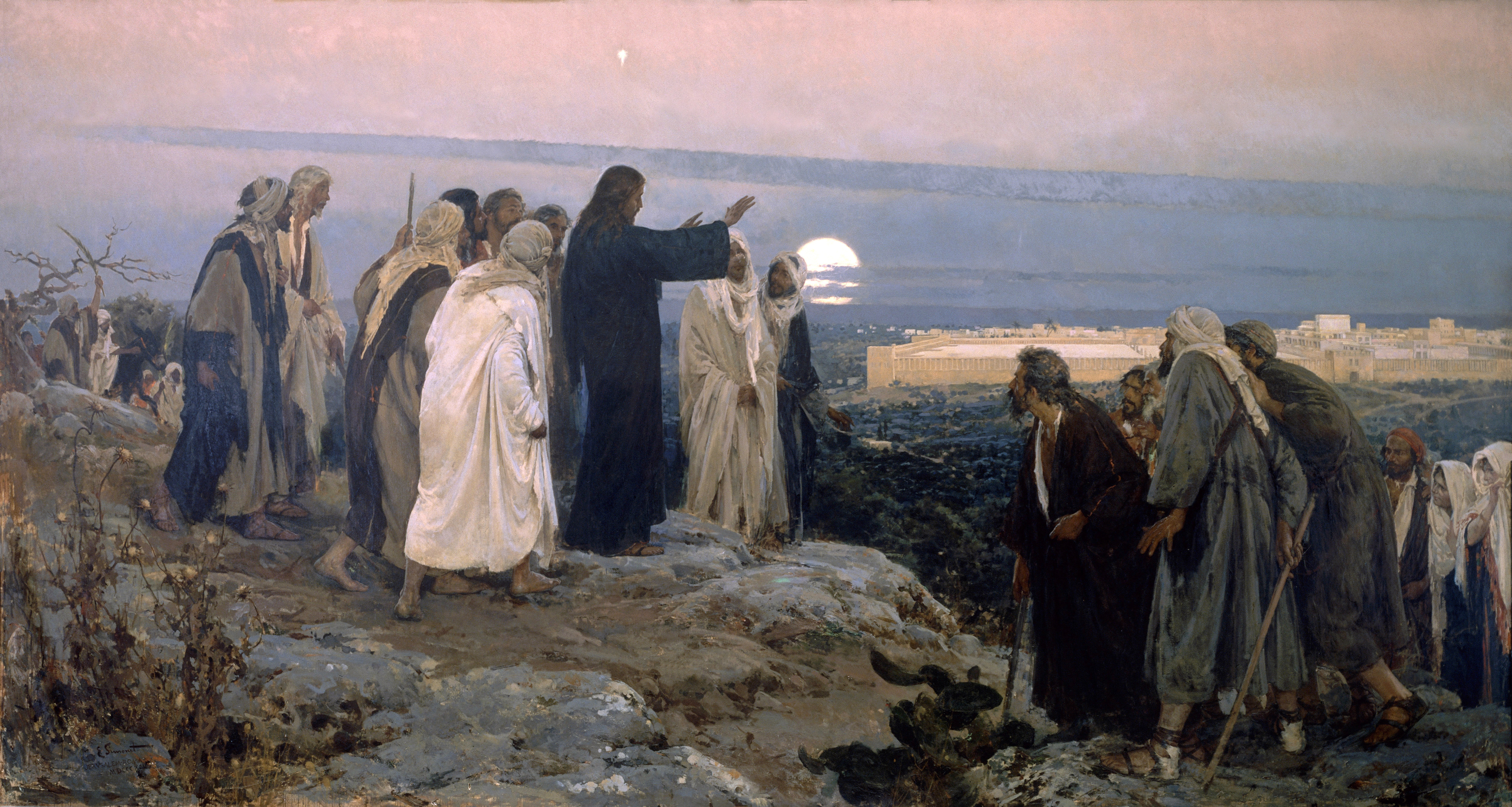
Enrique Simonet, 1892
Listening to people lately has helped me collect a few of the assumptions I often share when people want some spiritual direction about what to do with what they feel and how they are acting. When you only have your own impulses and a lot of societal pressure to work with, things can get confusing – and painful. So here are five things about Jesus that I think should inform how we have a dialogue about sexual behavior (among other things, of course). These five things will not solve everyone’s problems, and I’m not speaking from a place that has been processed by the leaders of the church, but I hope to name some basic things that guide life in Jesus and that apply to how we continue the dialogue about sexuality.
1) Jesus was not organized by sex.
We tend to be. I am often loathe to say it when I am listening to someone struggling with how they are going to have sex, but it has to be part of the process: I don’t think Jesus cares that much whether we have sex at all. He obviously thinks there are more important things in life. Paul’s logic leans toward seeing sex as a distraction to joy; it certainly is not the source of all joy. Some people take that fact to be a prescription. I just see it as a reality that should inform my reality.
2) Jesus did not exercise his rights, much the contrary.
We are tempted to think gaining and asserting our rights is a solution for most things. In this era, feeling justified about where one falls on the spectrum of sexual orientation, or justified about indentifying as, for instance, queer or pansexual is something of a crisis for a lot of people. But human rights are not a basis for salvation. God did not exercise God’s rights, quite pointedly, when submitting to being a human and then a slave to humans. Paul boasts of giving up his rights so he can have the experience of being free from them and having a larger purpose. Rights are important within oppressive contexts, which are most contexts. But having freedom in Christ is more important than having it granted by the powers that don’t follow Jesus.
3) Jesus’ resurrection proved that he was, surprisingly, on the right side of history.
We are tempted to suspect that Jesus might be old-fashioned. But being on the right side of human history is not a Christian concern. If there is anything we have always been on, it’s the wrong side of history – at least a view of history based on humankind’s capacity to get it all right in the end. We’re participants with everyone else, but our view is based on God’s capacity to bring it all to right in the end. Jesus showed up the foolishness of human understanding concerning how one’s personal history works out by rising from the dead. Paul clearly teaches that we are already living in the first days of our eternity. Our participation in history will not define us, but God’s participation in it already has. The world may be evolving in a certain direction without God, but we are moving in another with Jesus.
4) Jesus is an outcast; he is not just kind to outcasts.
We tend to think love is being nice to people others are not nice to, since that is certainly part of it. But people who see the world from a position of power often feel that their best love is shown by their kindness to outcasts. They want to include people in the empire where everyone has a bit of the police and rescue squad embedded in their character. Their empire will save the world (like the U.S. did in Iraq). Having that outlook makes it difficult to follow Jesus — because Jesus is not just kind to outcasts, he actually is one. We are enjoined by Paul and the writer of Hebrews to embrace being the “scum of the earth” so we can embrace our dependence on God, not rely on our own power or the power the godless domination system deigns to give us. This condition does not mean we are not kind to outcasts but it does change what we think kindness is: more solidarity than inclusion.
5) Jesus offered an open, positive approach and got killed.
We tend to save ourselves with avoidance. Even so, I think we, and many other believers, have overcome that and have been practicing an open, positive approach to the dialogue on sexuality (and sexual morality). That openness may not be noticed or even welcomed by someone bent on making us look bad. But take heart, a quick scan of the gospels will show Jesus offering the bread of life and people accusing him of being demon possessed and of trying to overthrow the government. Paul and John appear to feel they are getting treated the same way. If you are doing the best you can to not let truth kill or love lie, it still may not be enough to satisfy some people. I think we should suffer not being enough, not write unsatisfied people off, and keep serving. Our imperfection is no surprise. If we have trouble dealing with each other that seems normal — it can’t be easy for Jesus to deal with me, either. Besides, none of us knows everything we think we know, so someone’s dissatisfaction with us may have something to teach us.
Summing up big thoughts in little paragraphs is never enough. Each of the five things above probably deserves the question, “But what about…?” I am just going for underlying assumptions, not trying to figure out all their applications. But we need starting points for making decisions. In all the dialogue about sexuality and morality, there are a lot of “”But what abouts…?” to work though. I pray that we continue to be a safe place in Christ to explore them.
We had a winter wedding and draped the sterile “sanctuary” in ivy filched from front lawns all over town and made into garlands by loving friends. We thus began our somewhat-ignorant stumble into fidelity. On the occasion of our anniversary this week, my very-deep wife found an essay by Wendell Berry that eloquently summarizes much of what we instinctively discovered and practiced. What she focused on was Berry’s piece of wisdom that we have found to be true:
“No matter how much one may love the world as a whole, one can live fully in it only by living responsibly in some small part of it.” We have practiced that in marriage, family, church and city.
The essay she quoted was written in 1977 as part of his book: The Unsettling of America: Culture and Agriculture. Berry wrote his prophetic book as the American Empire flowered and turned to fruit, and as the society began to democratize and monetize everything. If you are a Christian who longs to be a humble creature, you might like to read it all: [link].
For today I offer you two long quotes from it that seem to go together to me. Berry makes important points about topics we have been exploring for a few years as a Circle of Hope. He is writing at a time when the adoption of the concept of “identity” and other new definitions are beginning to bud. By our time we have eaten the pie.
“The so-called identity crisis, for instance, is a disease that seems to have become prevalent after the disconnection of body and soul and the other piecemealings of the modern period. One’s “identity” is apparently the immaterial part of one’s being–also known as psyche, soul, spirit, self, mind, etc. The dividing of this principle from the body and from any particular worldly locality would seem reason enough for a crisis. Treatment, it might be thought, would logically consist in the restoration of these connections: the lost identity would find itself by recognizing physical landmarks, by connecting itself responsibly to practical circumstances; it would learn to stay put in the body to which it belongs and in the place to which preference or history or accident has brought it; it would, in short, find itself in finding its work. But “finding yourself,” the pseudo-ritual by which the identity crisis is supposed to be resolved, makes use of no such immediate references. Leaving aside the obvious, and ancient, realities of doubt and self-doubt, as well as the authentic madness that is often the result of cultural disintegration, it seems likely that the identity crisis has become a sort of social myth, a genre of self-indulgence. It can be an excuse for irresponsibility or a fashionable mode of self-dramatization. It is the easiest form of self-flattery–a way to construe procrastination as a virtue–based on the romantic assumption that “who I really am” is better in some fundamental way than the available evidence proves.
The fashionable cure for this condition, if I understand the lore of it correctly has nothing to do with the assumption of responsibilities or the renewal of connections. The cure is “autonomy,” another mythical condition, suggesting that the self can be self-determining and independent without regard for any determining circumstance or any of the obvious dependences. This seems little more than a jargon term for indifference to the opinions and feelings of other people. There is, in practice, no such thing as autonomy. Practically, there is only a distinction between responsible and irresponsible dependence. Inevitably failing this impossible standard of autonomy, the modern self-seeker becomes a tourist of cures, submitting his quest to the guidance of one guru after another. The “cure” thus preserves the disease….”
Wendell Berry
Berry goes on to apply his thoughts on identity and autonomy to marriage. He has a lot to say to us in a time when single parenthood or parenthood by less-committed cohabitors is common:
“…Failing, as they cannot help but fail, to be each other’s all, the husband and wife become each other’s only. The sacrament of sexual union, which in the time of the household was a communion of workmates, and afterward tried to be a lovers’ paradise, has now become a kind of marketplace in which husband and wife represent each other as sexual property. Competitiveness and jealousy, imperfectly sweetened and disguised by the illusions of courtship, now become governing principles, and they work to isolate the couple inside their marriage. Marriage becomes a capsule of sexual fate. The man must look on other men, and the woman on other women, as threats. This seems to have become particularly damaging to women; because of the progressive degeneration and isolation of their “role,” their worldly stockin trade has increasingly had to be “their” men. In the isolation of the resulting sexual “privacy,” the disintegration of the community begins. The energy that is the most convivial and unifying loses its communal forms and becomes divisive. This dispersal was nowhere more poignantly exemplified than in the replacement of the old ring dances, in which all couples danced together, by the so-called ballroom dancing, in which each couple dances alone. A significant part of the etiquette of ballroom dancing is, or was, that the exchange of partners was accomplished by a “trade.” It is no accident that this capitalization of love and marriage was followed by a divorce epidemic–and by fashions of dancing in which each one of the dancers moves alone.”
Identity, autonomy, privacy, and competition have come to “encapsulate” most of the people we know. They are concepts that form new sanctuaries and they can’t be disguised by draping the ivy chains of our Christianity over them.
May you have some time this Advent, away from the monetization of our holy-days, to do a ring dance, to spend some time in the wilderness rediscovering how you are a much-loved creature, and to celebrate your responsible dependence
on God (who gives you yourself and gives himself to you in Jesus),
on your spouse (if you are given one) and
on your community (which you have been given).
We are the sanctuary in which God’s Spirit dwells. During Advent, as we remember how God comes in to our creatureliness in Jesus, it is a good time to remember how that same Spirit makes us God’s dwelling place as a people in our own time and place. This is also a good verse for a Christmas card: “Do you not know that you are God’s temple and that God’s Spirit dwells in you?If anyone destroys God’s temple, God will destroy that person. For God’s temple is holy, and you are that temple. Do not deceive yourselves. If you think that you are wise in this age, you should become fools so that you may become wise. For the wisdom of this world is foolishness with God” (1 Corinthians 3:16-18).


 The Apostle Paul masterfully helps us with our decision making about activities that could “go either way” in several of his letters — “Is this action wise or right?” For instance, in his day there was a debate about what to do with food that comes from the temple “store” after having been sacrificed to idols. He writes:


 The essay she quoted was written in 1977 as part of his book: The Unsettling of America: Culture and Agriculture. Berry wrote his prophetic book as the American Empire flowered and turned to fruit, and as the society began to democratize and monetize everything. If you are a Christian who longs to be a humble creature, you might like to read it all: [