Category Archives: A life in the Spirit

Resurrection: latch on, let go

I saw a particularly sweet segment of CBS Sunday Morning while I recuperating from breakfast on Easter morning. It was about a man who lived across the street from the High School where Gwen used to teach back in the day in our old hometown of Riverside, California. A bartender named Donnie Edison had a stroke in that house when he was only donnie edison34. He was depressed and disabled and laying hopeless on the couch when he heard the ping of baseballs hitting metal bats as the high school baseball team practiced after school. His love of baseball got him off the couch. He made his wife load him into his wheelchair and take him to practice, even though he did not know a soul at the school. But just seeing the kids out there living gave him some purpose. Soon the coach made him an assistant. He learned to walk again. Before long he was volunteering in the high school’s special ed program and then he was going to college to become a special ed teacher. One of the things he did was get the regular team to play whiffle ball with the special ed kids. The segment ends with “There is nothing more beautiful than the sound of a found purpose.”

It is a small resurrection, isn’t it? — I was dead on the couch and now I can walk. Donnie was thankful for the stroke that saved him. His little death led to his unexpected life.

The Resurrection we celebrated yesterday is, however, much more than getting off the couch when you were dead in your depression, as blessed as that is. Once Donnie becomes a special ed teacher, there is a lot more to consider about how to follow Jesus through this dying we are living into the living into which he is leading. We celebrate the resurrection because it happened one time, once and for all. But we also celebrate it every year, religiously, because it keeps happening and it needs to keep happening. The big Resurrection we celebrated yesterday unleashes the many small resurrections we witness every day. The scripture we focused on from John shows that plainly.

Latch on to small resurrections

As you probably know, one of the disciples named Thomas was not with the rest of Jesus’ first followers when Jesus first appeared to them. When they told him they had seen the Lord, he would not believe ALL of them until he saw Jesus himself. “Unless I see the nail marks in his hands and put my finger where the nails were, and put my hand into his side, I will not believe.”

About a week later the disciples were together in the house where they met. The doors were locked because they were afraid the authorities were going to round up people who were saying Jesus had risen. Jesus came and stood among them. Almost immediately, he turned to Thomas and said, “Put your finger here; see my hands. Reach out your hand and put it into my side. Stop doubting and believe.”  Thomas said to him, “My Lord and my God!”

This story speaks to an entire segment of the population about how they relate to the resurrection. You need to put your hands in the wounds of the resurrected Jesus and stop doubting. Thomas was disconnected. He needed to latch on. We don’t generally respect “doubting Thomas” for needing something more than just hearing the story from someone else. But a lot of us do need more.

thomas caravaggioDonnie Edison needed to convince his wife to heist him into his chair for weeks and wheel him over to the baseball practice for whatever reason. You probably need to put yourself into a place where you did not belong before. Thomas had to put his hands into the Lord’s side. You think about him doing that and it seems so gross. Getting faith can feel so gross, so awkward, so out of line, so unacceptable, that you might just stay on your couch. A few people reading this might have no faith in Jesus, so the resurrected Jesus comes to you in a story, in the Spirit, and in the lives of people who give witness to their relationship with Him and questions your lack of faith. Others reading have the faith you used to have before you had your latest stroke, or got your latest job, or got married, or had kids, and now you need to latch on to the resurrected Jesus this year. Stick your hand in. Do it.

Let go of your past resurrection

If you were at the empty tomb yesterday morning, you heard what happened on the morning Jesus rose. The message the Mary is essentially the exact opposite of what Jesus told Thomas, which I say was “latch on, stop being disconnected, lay hold of resurrection life.”

The scripture in John about the morning speaks to another segment of the population, as well. In the morning it was “don’t hold on to me.” After Mary recognized the risen Lord, she apparently fell at his feet and embraced them or hugged him. Jesus said, “Do not hold on to me, for I have not yet ascended to the Father. Go instead to my brothers and tell them, ‘I am ascending to my Father and your Father, to my God and your God.’”

mary do not holdLike many of you reading, Mary was in a condition you might not want to leave. She as not skeptical about Jesus at all, she loved Jesus. She was connectable and she was connected. But she needed to let go of the Jesus she had known intimately as she followed him throughout his ministry after he had freed her from what tormented her. He was moving into what was next and she needed to go with him, not hold on and try to get him to stay where he had been or where she still was.

Some of you have had a great decade. You’ve shown great faith, made faithful choices. You connected to Jesus and his people. Now what? — ride it out at that level for the next 20-30 years? If you meet the resurrected Lord today in that assumption, thinking that tomorrow is going to be like today only maybe better, the first thing he will have to say to you after he speaks your name is to tell you, “Don’t hold on to me.” The same thing goes for the whole church, Circle of Hope has been great, but “Don’t hold on to where we have been,” Jesus says, “move with me into where I am going.”

The paradox that people could be told to latch on at night, right after they had been told to let go in the morning is the kind of thing that makes people not like Easter! It is too mysterious. They get frustrated with the death and resurrection and return to following religious law in one way or another. Today’s the day they do it – glad to be over Lent and the big Easter celebration and ready to get back into what is regular.

I want to follow Jesus and become like him in his death and so become like him in his resurrection. The fact is, just as that sentence shows, laying hold and letting go are both happening at the same time if you are following someone into new territory. With every step, we take hold of something new and let go of something old. As soon as we let go of one thing along the way of Jesus, there is something new to grasp. We don’t “get it,” we follow. I for one have loved that journey and I can hardly wait until next Easter to see what I have discovered about life in Christ next.

The three doorways of contemplative prayer

We often talk about “contemplative prayer.” How is that done? Let me try to teach in five minutes what you can learn in five years.

To begin, we often start by becoming still and aware with what we call “breath prayer.” Seekers practice breath prayer as a basic skill for being quiet enough to pray. If you consciously keep filling your lungs with air and deliberately release it slowly, you will become calm. If you imagine that you are breathing in something worth receiving and breathing out something that needs releasing, that adds to the prayer. Breath prayer is a basis for what Martin Laird calls the three doorways of contemplative prayer in his book Into the Silent Lands.

You can focus your practice of contemplative prayer on an old idea for centering it: a prayer word or phrase. Many people use what is called the “Jesus prayer” as their phrase. One variation of this prayer is: Jesus Christ, Son of God, have mercy on me. I use this prayer almost every day in my practice. It doesn’t matter what word you choose. You could use, “I wait on you in silence,” or, “I no longer live but Christ lives in me.” The content of the prayer is nice, but the goal is to use the good phrase you choose as a touch stone for becoming still and aware in the silence. The goal is to let go of all other concerns and recollect yourself. When you become aware that your attention has been stolen, gently return your attention to the prayer word or phrase so you can stay in the moment with God.

Practice that for a moment using a phrase that is great for Holy Week: “I no longer live but Christ lives in me.”

contemplative stillness

As you practiced, you may or may not have felt something. Sometimes awareness can feel like a bodily sensation — a tingle or a warmth, or a soul sensation of peace. Hopefully you felt rest and a sense that there was something beyond your normal awareness. Prayer is not always sensate, but it makes an impact in places we experience later. We can see the results of contemplative prayer in ongoing awareness of God’s presence throughout our day, in a lessening of anxiety over time and in a peace that pervades territories where it was not evident before. When we open our hearts and minds to God’s presence we gain insight and feel favor by forming a personal relationship with God. In the process of deepening our relationship with God, coming with a lack of expectation usually leads to better feelings than searching for what we want or for what we think we ought to be experiencing.

1) The first doorway to enter in contemplative prayer begins when you choose a prayer word and stick with it until you don’t need it anymore.

This practice helps us deal with the fidgety and flighty aspects of our being.

The prayer word or phrase is like a vaccination. A small dose of the disease: words, is introduced to the body to call forth the antibodies that will ward off the full disease: the preoccupation with our inner dialogue and invasion by our huge collection of data. Our overactive minds are like a disease infecting the silence where we meet with God Spirit to spirit. A good mind is great for teaching a class, but it obscures the deeper ground of being and leaves us with the sense that we are separate from God and others. We end up getting our sense of self from pasted-together bits and pieces of mental process rather than from relating to God. The vaccine of the prayer word detaches us from our inner chaos and helps us let go of our clever minds. But we’ve got to practice before this way of prayer is effective. It is like learning to play the piano or developing some other skill.

Jesus son of God have mercy on me is the phrase to which I return when I notice thoughts are invading my stillness and distracting my attention from yearning for God’s presence.

2) The second doorway is becoming one with the prayer word.

When you get started with this kind of prayer it can be like hitting a brick wall. Repeating your prayer word or phrase can take quite a bit of mental effort. The more we practice, the more our contemplation becomes simple awareness instead of activity. We start to feel the benefits of calmness. We start learning not to control everything, but to go with God. Life and wisdom are not found in trying to control the wind, but in hoisting our sails to move with the Spirit in the present moment. This praying is hoisting sails.

The second doorway is deeper. The first doorway was like a refuge for our weary, anxious souls. The second is a matter of having our sights lifted to what comes after we are not so fidgety. We begin to see the things about ourselves that were previously out of our perception. Our therapist often does beginning soul work like this too. There is kind of an unloading of the unconscious. You can see how rich a place this might be, noticing and letting go of the usual inner videos and audios that dominate our internal landscape. Eventually they lose their power to control us. When some people get to this place, maybe they stop using a prayer word altogether. They can just sink into awareness without using it so much.

3) The third doorway is being present in awareness itself

This sounds kind of spacey, and it is. We have gotten though the doorway into stillness. And we have entered into deeper awareness of things in us that we have let go into God’s hands. Now we are invited into a shift from recognizing thoughts to recognizing how we recognize. We are simply aware. Deep calls to deep in the roar of your waters (Ps 42). We become aware of the deafening silence of earth and the new sound beyond sounds of knowing God. We hear what Elijah named “the still small voice.” In this home we can also experience the I am of being ourselves. We enjoy the self-forgetful communion with God for which we are created, and it transforms us and enlivens us.

I feel more at peace just talking about this practice which is so dear to me! I have been delighted to see its results in so many other people. They no longer live in their old, dominated selves, but Christ lives in them and they live in Christ.

Subscribe to DevelopmentHit the “follow” button after you type in your email. Thanks for reading!

Prayer: walk by faith, not by sight.

“Walk by faith, not by sight” (2 Cor 5:7). We often think of this as waiting for God to do something in the future that we would not normally expect — “I am moving ahead, hoping for the best. I am walking by faith, not by sight.” That is good.

Faithing

SONY DSC

When we practice the prayer of contemplation, “Walk by faith, not by sight” is something more immediate. It is about becoming aware of the unknown things God is doing in the present moment. Prayer amounts to faithing, walking into what’s happening with faith as a sense guiding us,not just seeing and reacting with our physical senses. God is with us, right now; prayer helps us be with God right now.

When I say “contemplative prayer” you might think of mindfulness techniques that people are teaching to jr. highers to help them settle down. That’s a beginning, but that is not the prayer of contemplation. The prayer of contemplation includes the techniques for reducing anxiety, but it is more. Contemplative prayer, and any spiritual discipline, disposes us to allow something to take place. We are not doing something to get a result; we are not making something happen, necessarily. We are doing something to allow communion with God to be our condition.

It is like this: A gardener does not actually grow plants. She practices skills that facilitate growth that is beyond her control. Prayer is like that. A sailor does not produce the necessary wind to move the boat. He harnesses the gift of wind by exercising skills that can get him home. Prayer is like that.

Basic contemplative prayer

The basic skill of contemplative prayer that facilitates and harnesses is inner silence. There are two practices within this skill set that are very important: stillness and awareness. When we attempt to be silent, we need to consider how to face the inner noise with which we struggle. We do many noisy things when we pray, too; we are embodied spirits, after all. But at the center of us is the silent place where God is simply giving himself to us and we are communing spirit to Spirit. We long to carry this silence with us in the midst of the noisy world and be content that we are in Christ and Christ is in us. We want to be at home. One of the early teachers of the church said in this center we are constantly being called home, away from the noise that is around us to the joys that are silent. He said, “Why do we rush about looking for God who is here at home with us, if all we want is to be with him?”

Martin Laird, a teacher from Villanova who wrote a book called Into the Silent Lands, tells a story about a prisoner who was accustomed to cutting himself or burning himself so that his inner pain would be in a different place — on the outside of him. This suffering man came upon some people whose mission was to teach prisoners to pray and turn their prison cells into monastic cells. The prisoner learned from them and after several weeks of meditating twice a day he said, “I just want you to know that after only four weeks of meditating half an hour in the morning and night, the pain is not so bad, and for the first time in my life, I can see a tiny spark of something within myself I can like.” That is the home we are talking about.

rittenhouse square parkOur sense of separation from God is often a matter of our broken perception. We can’t feel God. We have an idea of what we should feel and we don’t feel that. Contemplative prayer is the place we let go our perceptions and become aware of God with us, as the scripture guides us:

  •  My soul, wait in silence for God only, for my hope is from Him (Psalm 62:5).
  • I am in my Father and you are in me and I in you (Jesus in John 14:20).
  • I have been crucified with Christ and yet I am alive; yet it is no longer I, but Christ living in me (Galatians 3:20).

From the perspective of the created order we are separate from God. But from the perspective of being aware, we see Christ when we look inside. When we pray, we are not merely becoming aware of our thoughts and feelings (although that is good!), we are learning to be aware of God and to be with God who is with us.

Retraining the heart

It is like this: A man was taking his dog to a field where the animal could run and he ran into another man walking four dogs. They got to the open field and let their dogs go so they could enjoy running around in a big free space. But one of the new friend’s dogs was off to the side running is relatively tight circles and did not join in with the other dogs. The man asked his new friend, “What’s with your dog?” He gave him an explanation. “Before I got this dog, he had spent years living in a cage. He was used to getting all his exercise, just as you see. He has the field, but he is trained for the cage.” I did not see this dog do this personally, so I can’t prove to you that dogs do this, but I do know myself and I have seen many of you who are reading this. We have the wide open field of grace and freedom to romp in but we run in the contours of our former cage. The prayer of contemplation is retraining our hearts to roam the wide open spaces of eternity freely.

  • My heart is like a bird that has escaped from the snare of the fowler (Psalm 123:7).

Our minds tend to run in the obsessive tight circles of our mental cage. We believe we are separate from God, and we were. So now we need to learn something else. I heard something shocking from a friend not long ago. When he was a child his father sang a little ditty that he thought was funny: “Charlie Wilkins is no good. Let’s chop him up like so much wood.” I know this little boy as an old man and you can still see that putrid song playing in his head. Just like that, we may believe we are condemned by God. So now we need to learn freedom. Prayer is the training ground.

When we think about things, we have a cage of thoughts that guide us. Contemplative prayer helps us go beyond them and enter into the silence where we don’t merely think about things, we commune with God. We concentrate attention in our heart to the place of knowing, the place of awareness that is not full of the cacophony of our mind and surroundings but is full of God. It seems like we are just sitting there doing nothing, when we pray and that is exactly right and exactly good. In that nothing of ourselves and our surroundings we enter the silent land of our true being with God.

Next time I will tell you more about how this is done. But, like I said, we don’t need to perfect techniques to pray as much as we need to access the skills that are built in to our beings by our loving Father. Be silent and turn your heart to God whether you think you know what you are doing or not. Take a step of walking by faith, not by sight. You’ll have a good time with God.

[Another version of this post]

Subscribe to DevelopmentHit the “follow” button after you type in your email. Thanks for reading!

You’ve probably taken self-reliance too far

The process of getting some personal autonomy is very important. We need to gain the capacity to be ourselves apart from our parents and to become our true selves in relation to our ultimate parent: God. We yearn to achieve this maturity and we also resist it every step of the way. It is a difficult journey. We can end up too autonomous and we can end up lacking in self-reliance. Most of you reading this have probably taken self-reliance too far.

It’s no wonder you are so splendidly alone at the command center of your own private universe. You were trained to be so at a very early age. Our society is pretty much convinced right now that being self-reliant is the epitome of maturation. We start lessons on autonomy early in our culture. We start getting frustrated with what you can’t do by yourself as soon as you can do anything by yourself. Gwen and I used to laugh over a book we had when our children were small that was all about doing things by oneself. We still use this little girl’s voice when we are making fun of each other for being too self-reliant because we heard her saying in our imaginations: “I can do it by myself.”

all by myselfI went looking for that old book and I found a LOT of books with that same basic title. We really want people to be able to do it by themselves! I ran across a version by one by my favorite kid’s book authors, Mercer Mayer. What’s more, I found a youtube of someone reading it to us! So here is your training for autonomy, in case you missed learning how to be needless of parents and community…and God: All By Myself by Mercer Mayer.

However it happened in your family, we have put a heavy emphasis in our society on the universal need for individuals to individuate. We keep getting trained to be the one and only person in so many ways these days. At least our batmansuperheroes keep teaching us that lesson. Batman is alone in his cave, the master of all technology — nothing is more isolating than spending half your day trying to figure out why your computer does not work, since you are supposed to know everything. Then there is Superman, the ultimate American, alone in his fortress of solitude, being the lonely baby Moses from Krypton, figuring out how to answer distress calls, by himself, from all over the world — he is just like you in the center of your mess trying to figure out how you’ll meet all the requirements and save the world.

As a result of this training, how often do you not call someone for help because you are sure they would be too busy — so you do the best you can to do it by yourself and try not to die from stress? Are you afraid to be inadequate? Are you afraid to be a burden? I hope not, but I would not be surprised if you were.

If your parents had not trained you, you would probably have learned the same survival lessons on your own. Because it is true that we had better learn to be self-reliant if we live in a world without God. A world without God cannot be trusted, and the people who inhabit it are dangerous and demanding. When it comes down to it, if you don’t have God you’ll be in trouble if you can’t rely on yourself.  Married couples are often shocked by this reality when they finally get a look at the incapable, overly-dependent mate they are stuck with. They realize that their partner has some significant weaknesses that are not miraculously going away. So they have a dilemma, “Do I take care of this untrustworthy person my whole life? Do I have a major power struggle that lasts a decade until they shape up? Or do I take off now before I get in too deep?”  This struggle comes on a spectrum from modest to major, of course. It might be “Do you really think I am going to pick up your clothes or fill the gas tank your whole life? You can do that by yourself.” But it might also be “Oh my, your mother really did make you feel incapable and despicable and you are just seeing that!” or “Your lack of having a father left you with a whole set of deficits” or  “The fact that you just became a Christian means that you have a ton of new things to change into and you are not there yet.” The balancing of self-reliance and dependence is not that simple.

Self-reliance in community

In the church we have similar dilemma. We make a covenant with someone or just love someone and take them into our hearts and our church and then we discover that they can’t do stuff. They can’t pay their bills, or respond to a phone call or even greet us warmly. They have issues even though they have been in therapy for a few months. They make the same mistakes all the time, even after you got the courage to say something. What do we do? I have little discussions about this all the time. I am usually on the side that says, “It does me no harm to carry a person who seems to be unable to be self-reliant. So what if they can’t pull off autonomy?” I don’t want to infantilize anyone by being the only one who can do something – keeping people unable or never letting them have their own power. But at the same time, I don’t need to despise people and deprive them because they supposedly should be better than they are.

A lot of people solve the problem of needing to rely on God and others by never attempting anything that is beyond their capabilities — I can’t fail at what I don’t try. They try really hard to never get in a mess. You might say their whole life is focused on avoiding problems that would point out that they have problems. The contestants on the Biggest Loser are always learning the lesson of relying on others because they are all  attempting something that has been beyond themselves. For instance, box jumpJennifer did not win this season but she made a huge difference in her life — and she eventually overcame her fear of attempting what seemed impossible for her: the box jump. The moral to the film clip is: You can do it by yourself if you never try the box jump and just stay locked up in whatever you use to vainly protect yourself. In Jennifer’s case it was her self-protective weight. But if you try something beyond your present capacity you’ll need to rely on someone other than yourself, too, like Jillian — even better, God!

The best way to learn to rely on God is to try something that requires God to do. Has that become your instinct yet? Is it your reaction, to rely on God and his people? Are you learning that, or just sticking with autonomy, as you have been taught from birth? Likewise, one of the best ways to learn to rely on others is to try something that requires a community, not just an individual, to do – which are most things worth doing.  When you need help do you reach out in love, or do you just search Google for two hours? While sorting out how to live in love with healthy, mutual dependence, you’ve probably taken self-reliance too far. If you start with God-reliance it will probably loosen you up to take further steps to undo the pressure to do it by yourself.

Patrick had nerve

St_-Patrick2Why aren’t we spiritual ancestors of St. Patrick more like St. Patrick? Unlike him, we are often stuck on a treadmill of trying harder at things that aren’t working. We keep looking for answers to questions that no longer need to be answered. We get stuck in endless either/or arguments when the dichotomies were false to begin with. We undermine the leaders we so desperately need to help us off our treadmill and out of our arguing. We need the kind of nerve Patrick had.

Some of what I am thinking comes right out of Edwin Friedman’s book Failure of Nerve. But St. Patrick (387-461). demonstrated how to be a healthy and effective leader long before system theory gurus discovered what he already knew. Whether is it a family, a cell, a church or a business, a person who lives out of their true self makes a good leader. Friedman thinks knowledgeable people can become this “differentiated” person, and some can. But, for most of us, we need Jesus at the heart of the process to have a prayer of becoming so mature and useful.

Right now most systems we encounter are stuck in a morass of anxiety and ineffectiveness: the schools, License and Inspections, the Water Department, to name a few, but also some families, some communal households, quite a few cells, some compassion teams. Why don’t we have more leaders like Patrick in these places? Why aren’t Christians in the United States, in general, more like Patrick – building defiant fires on hills and daring the powers-that-be to oppose Jesus? How did St. Patrick’s Day become famous for being a day when people get drunk? Could it be a failure of nerve?

It could be. Someone has to get free. Someone has to go first. Someone has to risk realizing their imagination.

Patrick got free. He was a barely-Christian teenager when has was captured by Irish slavers. While he was stuck on his hillside tending sheep for the man in the wilderness of Foclut, he did not conform, he turned to prayer. Eventually he had a vision that told him to escape. He writes that he heard a voice tell him, “Come and see, your ship is waiting for you.” After running for his life across the whole island he made his way onto a ship departing for France where he perfected his faith. That’s nerve.

Patrick went first. Restored to his family in Britain, perhaps he could have taken his place in their patrician life and helped rebuild and protect his homeland. But he was not content to stay on the treadmill. He writes, “I had a vision in my dreams of a man who seemed to come from Ireland. His name was Victoricius, and he carried countless letters, one of which he handed over to me. I read aloud where it began: ‘The Voice of the Irish.’ And as I began to read these words, I seemed to hear the voice of the same men who lived beside the forest of Foclut . . . and they cried out as with one voice, ‘We appeal to you, holy servant boy, to come and walk among us.’ I was deeply moved in heart and I could read no further, so I awoke.” He went to Ireland and immediately began having success in leading people to a knowledge and faith in Jesus.  That’s nerve.

Patrick risked realizing his imagination. He wrote, “Daily I expect murder, fraud or captivity, but I fear none of these things because of the promises of heaven. I have cast myself into the hands of God almighty who rules everywhere.” It seems like he almost delighted in taking risks for the gospel. He wrote, “I must take this decision disregarding risks involved and make known the gifts of God and his everlasting consolation. Neither must we fear any such risk in faithfully preaching God’s name boldly in every place, so that even after my death, a spiritual legacy may be left for my brethren and my children.” The famous prayer attributed to him called “the breastplate” is all about gaining nerve in the face of threats. That’s nerve.

Isn’t the lack of nerve the way to a rut?

drunk st. patricksIn a famous letter, amazingly still preserved from the 5th century, Patrick takes a stand against a great enemy with which he was very familiar: slavery. A British tyrant, Coroticus, had carried off some of Patrick’s converts into slavery. Patrick, now a bishop, excommunicated him and told him to repent and free them, writing: “Ravenous wolves have gulped down the Lord’s own flock which was flourishing in Ireland and the whole church cries out and laments for its sons and daughters.”  That’s nerve.

Being one’s true self and trusting God in the midst of a world that is always difficult often makes one a leader, it at least allows us to influence people by being the presence of Jesus and offering an alternative to the destruction happening. Patrick did not think he was particularly qualified to be such a person. Despite his success, as an older man he writes, “I still blush and fear more than anything to have my lack of learning brought out into the open. For I am unable to explain my mind to learned people.” Nevertheless, he gives thanks to God, “who stirred up me, a fool, from the midst of those who are considered wise and learned in the practice of the law as well as persuasive in their speech and in every other way and ahead of these others, inspired me who is so despised by the world.”

So many in the world get drunk on St. Patrick’s Day! Is it a way to avoid looking at their lack of nerve? So many more don’t get drunk and don’t even know it is a special day honoring a special man. They are so consumed by the slavery of whatever dominates them that it is hard for them to even visualize an alternative: drunkenness or holiness. They need a leader, they at least need a person with some nerve. Someone has to get free. Someone has to go first. Someone has to risk realizing their imagination.

It’s a new creation, vato.

I think the feeling was probably in the room last night when we were together for worship. But I could not see it too well. There were not a lot of fist pumps with

“Yes! I feel that sting. I know I have been poisoned. But Death, you have no power over me!”

Lent kind of teases out that kind of reaction, but it can be a long tease for some of us. It might take even longer for people to start dancing around the room shouting,

“Yes! I feel oppressed! I understand how the law has been keeping me down. But Jesus, you have freed me!”

But it is all there in the Bible; Jesus-lovers trying to woo people into newness:

The sting of death is sin, and the power of sin is the law. But thanks be to God! He gives us the victory through our Lord Jesus Christ (1 Corinthians 15:56).

I think it might be easier to feel guilty for sin and just keep trying to fulfill the latest or oldest law. Being controlled so often feels like we are in control.

So out of control

his rules are being challenged

One of the reasons I try to emulate the Apostle Paul is that he is so out of control when it comes to the usual domination systems and he is so moved by the Holy Spirit. Thus, I am getting a lot from this little video parable full of seekers, vato.

Even when Paul is abused, shipwrecked or in prison, he doesn’t forget that Jesus just recreated him and his eternal destiny is just around the corner from the latest mess. The diaper, the deadline, the demand, or the disaster do not derail his delight. He does not create a law so he never has to experience trouble; he lives by a law that turns trouble into life. His wonderful insight results in some great teaching that has been an antidote to the poison of sin and an alternative to the graceless oppression of law for centuries.

Even marriage is upended

The other day we were looking into one striking example of just how exceptional it is to follow Jesus when we explored Paul’s teaching about marriage. If you have read 1 Corinthians a few times, you’ve probably noticed that Paul places his famous “love chapter” in the middle of his teaching about how the Holy Spirit builds the Lord’s followers into the body of Christ (1 Corinthians 12-14). He does not place it after his chapter on marriage (1 Corinthians 7). By pointing this out, I am not trying to insult everyone who has had the beautiful “love chapter” read at their wedding. But I am pointing out that if you think Paul wrote it because he thought your marriage was the epitome of love, you are wrong.

Paul fully respects marriage as part of the order built into creation. But what he really wants us to know is that Jesus has inaugurated a new creation that is restoring our poisoned hearts and unlocking the manacles of our control systems. You’d think there would be regular dancing and shouting about this. But the poison is really deep and the law is so attractive to us. When Paul talks to the church in Galatia about their temptation to follow the Jewish law he says, “The only thing that counts is faith expressing itself through love” and “what counts is the new creation” (Galatians 5:6, 6:15). I keep trying to make this fundamental understanding basic to how I see myself and relate to others: “From now on we regard no one from a worldly point of view. Though we once regarded Christ in this way, we do so no longer. Therefore, if anyone is in Christ, the new creation has come: The old has gone, the new is here!” (2 Corinthians 5:16-17).

the unmastered dead
the unmastered dancing dead

Paul teaches out of this radically new vision of the world when he writes to the Corinthians about love. He has some very practical teaching on marriage in chapter seven, but I think it can be summed up as: “Marriage is good, but don’t let it get in the way of your life in the kingdom of God.” The epitome of love is not getting married, it is when Spirit-filled people form the body of Christ and live as a new creation. Some of the Corinthians really go with this new grace in which we live. Paul has to oppose one faction in the church whose slogan appears to be “I have the right to do anything.” Paul adds, “but not everything is beneficial and I will not be mastered by anything” (1 Corinthians 6:12). Some things are built into creation and it is arrogant to think we can improve on God’s basic design. Other things are built into society and even if we know they are not that important, we still respect them so other people will respect us. You can’t really make a law about everything, you need to be filled with the Spirit of God and be one in love.

The Jesus way

An approach like Paul’s requires a great deal of love and commitment. It is a lot easier to be at a level where you are just negotiating with sin all the time or you are dealing with life by making a law. Paul wants a life where love makes a difference and law no long masters him. Lots of Jesus-followers think the love chapter is pretty; Paul thinks it is animating. Many people skip the messiness of relating to God and others and make connections based on mutual denial or politics but Paul is led by Jesus right into all the  relating,  sorting, struggling and time it takes to be the body of Christ! It is a lot easier to be on this side or that, conform to the laws of one’s side and skip the struggle of the third way that guides our steps though the pressures of the binary world in which we live.

The third way was definitely being followed in the room last night. It is true that some people were still considering whether they thought it was “sin” or just themselves that entangled them. Some people were struggling whether it was just another “law” or it was irrefutable truth that dominated them. Lent kind of teases out those kinds of thoughts. But I think most of us were moving toward the love of Jesus and almost ready to dance. Death comes at us and we apply all the laws we know to stop it. It never works, vato. But sometimes we discover some amazing things in the process, even dancing beyond death.

Slow, reflective, imaginative: the spiritual discipline of Lent

These are a few basic thoughts distilled from our Ash Wednesday ritual. Lent begins on March 5 this year.

Slow down

We need silence to find the spiritual place where Jesus is with us in our suffering and we are with Jesus in his suffering. Lent is the season of silence and solitude — and suffering. Some people will even “give something up” to cause some small suffering to give space where they can experience something more than their usual anesthesia, avoidance or denial. Ash Wednesday is the beginning of our yearly, disciplined journey of repentance and renewal, the beginning of the concentrated season of self-denial and self-giving that feels like suffering but points us toward joy  Wednesday we enter the great forty-day fast with millions of other Jesus followers – those living and those who have gone before. God bless you as you take your steps along the way of Jesus this year!

The interior journey too

Let’s go as slowly as possible. We need to be quiet, thoughtful, and restful. We must not be impatient. We must not worry if we don’t feel or understand things right away — there are no expectations of Lent except that we seek after Jesus, explore the meaning of his death, and die with him. Paul shares our goal: I want to know Christ—yes, to know the power of his resurrection and participation in his sufferings, becoming like him in his death,  and so, somehow, attaining to the resurrection from the dead.  Lent in not the imposition of some demanding God, but in solitude God’s presence will be compelling. One of Job’s friends has it right when he says: God is wooing us from the jaws of distress into a spacious place free from restriction. Let’s see how much we can cooperate.

Reflect

Examine yourself; admit the truth about yourself to God; sense the conviction of God’s Spirit pointing out what is self-destructive or what amounts to an alliance with evil. Lent begins with an honest self-assessment. We pause to consider whether we have strayed from home, whether we have gone our own way, whether we are squandering our inheritance, whether we are feeding pigs in some way. The discipline of Lent dares us to be aware of our prodigal sides. We are looking for an awakening like the child in the Lord’s parable: “I will set out and go back to my father and say to him: Father, I have sinned against heaven and against you.”

We consider whether our lives sadden the One who gave them. When Paul teaches us about sin he says, “Do not grieve the Holy Spirit of God, with whom you were sealed for the day of redemption.” Do not break God’s heart. Do not break up with God, who loves you. Do not turn your back on your lover. Do not live in fear as if you are not loved. Do not hold on to condemnation when you are freed from it. Do not violate the Spirit of love. Ash Wednesday is all about seeing God’s grief and sharing it. Lent is a season for turning back to love and rebuilding it.

Imagine

We have become so unrelated in the world today that the early church rituals like those associated with Lent: ashes on our foreheads, fasting, communal spiritual disciplines all seem quaint to many of us. People of the past seem so tied up with God and one another! They were not anonymous or autonomous. They did not keep their distance. They did not know how to be absently virtual.

mourning, transforming black pines

For instance, it is said that very early in the history of the church, it had become a regular practice to have people who had been caught up in serious sin to come to the community of the church seeking a way to re-enter the fellowship in good conscience for the main celebration of the year: Resurrection Sunday (Easter). They would be sprinkled with ashes and then sent off in “exile” from the church, “into the wilderness” with God – they are sent off with the expectation that they would be restored. Their forty-day period of repentance was called their “quarantine,” from the Latin for forty. It soon became common for friends to come with the penitents to receive ashes in solidarity with them and to express the truth that we are all sinners. The leadership of the church finally saw the wisdom in what was going on and encouraged everyone to repent and fast in preparation for the resurrection. By 1050 a pope had made it a requirement.

It makes sense to me to use this tradition as one with all the other Christians throughout history who have gotten the same point. – we need a time to be sick with sin and to get well — to let ourselves experience the grief of being separated, the desperation of our sorrow, the difficulty of having been far away in sin. We need to hope to be restored by Easter. We need to get into the truest story there is: we are the child of the grieving father; we were dying; we need to come back to life. The essence of the discipline of Ash Wednesday is to acknowledge that sin, brokenness and oppression. The call is: Remember from dust you are and to dust you will return.

We are so disconnected from nature and the seasons of the year nowadays. Even in a hard winter we expect to get our unseasonal fruits and vegetables, to travel without restriction, to go about our business as if nothing is happening, surrounded by our artificial environments. The people of the past seem so primitive, forced to live according to the changes around them.

Moving the couch toward the bonfire

For instance, in the villages of medieval Europe it was common to mark the beginning of Lent with a huge bonfire in the village square. The fuel for the fire was all the detritus left over in everyone’s house after people were cooped up all winter. In any number of ways people would use the fire to symbolize that winter was soon to be over, the fire was a statement of passion in direct confrontation to the numbness of the cold. It was time to look forward to spring.

Simple, physical symbols like that help us on our spiritual journey through time. Lent is a yearly season for spring cleaning. Ash Wednesday is the day to light the bonfire to burn what needs to be cleaned out. May your garbage be turned to ash. May we rise from our ashes. May we be transformed in a furnace of God’s Spirit burning in us and refining us. May sunrise come to your heart and spring touch your bitterness.

Let something burn. Let it go. Be freed. Be received. Use Lent for spiritual housecleaning. Turn around and remember who you are. Let yourself go. Let something grow. Let the consuming fire of God’s Spirit transform you. Have a vision of what can be.

Go slow. Begin with reflection – the Holy Spirit will help you. Proceed with imagination —  Jesus has made us each a new person.

Exile or Pioneer — we don’t really know what you are going to do with this blog post

I really have no idea what is going to happen — most of the time, I like it that way. I don’t really know if Circle of Hope can sustain itself, since it runs on conviction and covenant. I don’t know whether the stock market will dive and take us with it, whether aggrieved people will unite and upend the social order, whether my friends will move away, or whether my pipes will freeze in the endless winter. Most of the time, all that uncertainty seems like a good excuse to have faith. It is a great grace that living by faith is more fulfilling than knowing whether I should have bought salt for the ice before it was all sold out.

The curse of certainty

mr. batesBut people have a lot of guilt and anxiety about not knowing. They are ashamed they made what look like mistakes and they did not know what was going to happen before it happened. Mr. Bates may do something terrible because of his guilt and shame about not knowing what was happening to Mrs. Bates!

The other day I was at a baby shower and people were quite satisfied that they did not have to buy yellow baby clothes because they knew the baby’s gender already — I am sure science developed in utero photography to ease the anxiety about how to decorate the nursery!  Maybe you laugh, but people are still angry that the government did not predict and prevent 9/11!  Many people defend the government’s right to collect our phone records because they think every measure must be taken so “nothing like that ever happens to anyone ever again!” — we even see our personal experiences as contributions to anxiety relief, guilt reduction and the hope of controlling the future. Don’t we insist that the future must be “better” than the past? And aren’t we taught that good people band together to make sure it will be?

what ifLast night a JIF peanut butter commercial tagged on to the coverage of Olympics was teaching children to imagine their perfect future.  The scripture lesson was:

What if I skated so fast the world stopped for a minute?
What if I had a sled and all my friends got in it?
What if I took a shot and scored the winning goal?
What if I cut through the winter air and didn’t feel the cold?
What if I could fly and soar like I had wings?
What if I stood up on the winners stand and heard my country sing?
Nourish every dream with the fresh roasted peanut taste of JIF.

I heard that and laughed out loud! What if I spend every waking moment becoming an elite athlete? Wouldn’t the moment of my achievement last me my whole life through? Wouldn’t I be happy and justify my existence? Wouldn’t my parents be alleviated of all the shame I normally bring them? Wouldn’t I have made all the right choices and achieved a mistake-free performance? Ugh. Our dreams of our splendid future, based on the fullness our personal splendor is not the same as having faith, JIF commercials notwithstanding.

Crazy audacity

I became a Christian for many reasons, but a main one was certainly because I was surrounded by people who had the breathtaking audacity to think they were smart enough to organize, even legislate my future. As they were organizing according to how they saw the past, I experienced the grace of looking over their shoulders and seeing God in my future through Jesus, the presence of the future.

I received the blessing (or curse, depending on how you look at it) of being a history student and watching people in the past repeatedly learning from their mistakes and repeatedly thinking that their brilliant conclusions meant they had a lock on the future. The people who killed Jesus were sure they were doing it for the benefit of future generations!

That arrogance is alive and well among the least of us — even among the odd people who lead Circle of Hope. We want to have a successful cell and end up reproducing what was, what was successful and familiar, not what is next. We stay on the treadmill of history applying the same crazy audacity, always thinking we will be the generation that gets it right.

Alternative, basic Bible teaching

We are strangers and aliens in the world. Jesus is the pioneer.

Dear friends, I urge you, as foreigners and exiles, to abstain from sinful desires, which wage war against your soul. 1 Peter 2:11

“Foreigners and exiles” is also translated: strangers and pilgrims, aliens and exiles, wayfarers and foreigners,  strangers and sojourners

Let us run with perseverance the race marked out for us, fixing our eyes on Jesus, the pioneer and perfecter of faith  Hebrews 12:2

“Pioneer and Perfecter” is also translated: founder and perfecter, author and finisher, source and perfecter, source and goal, leader and completer.

Jesus is at home in every culture and every era, yet a product of none of them. His grace makes us better and we contribute goodness to the world that makes it better, but we don’t base our security on whether we did that so right that wrong won’t turn around and bite us ever again. Our audacity is knowing that we matter very much, whether we prove it by getting everything right and having our retirement feel secure or not.

Know all you can, predict all you can, but trust all you must. Study to succeed, master the ways of everything, but rely on Jesus. Learn from the past, strive to be excellent, but understand that Jesus is going ahead of you and only God knows your future. Make your greatest achievement be mastering your exile.

Our great grace includes the promise that the hope of the faithful will not be disappointed. In that hope we have a lot of room to be joyful failures, to be people who can see the wonder in the rubble, to be pioneers who never tire of seeing the sun come up over the next horizon on the journey.

Jesus — and five basic assumptions that inform dialogue on sexuality

The other day a distant acquaintance accused our church of not talking about sex enough  (in the neighborhood gossip column, at least). It was right after we enjoyed an open forum about our theology of sexuality attended by over 100 people! It never ceases to surprise me that the more one does something, the more excuse it gives a few people to criticize you for not doing it!

If anything, Circle of Hope has been a good place to work through the trauma of our over-sexualized society. As our forum uncovered, a lot of people have had painful sexual experiences, and not just because the powers that be limit their sexual expression (since they don’t really do that anymore). Sex is painful because they are confused. And it is painful because they get run over by the wave of immorality that is surging through the culture. (Maybe using the word immorality even made you uneasy, since who could say what that is?). It is painful because sex has become an incessant demand and a constant source of scientific study. And it is painful because a lot of people can’t figure out what Jesus says about it.

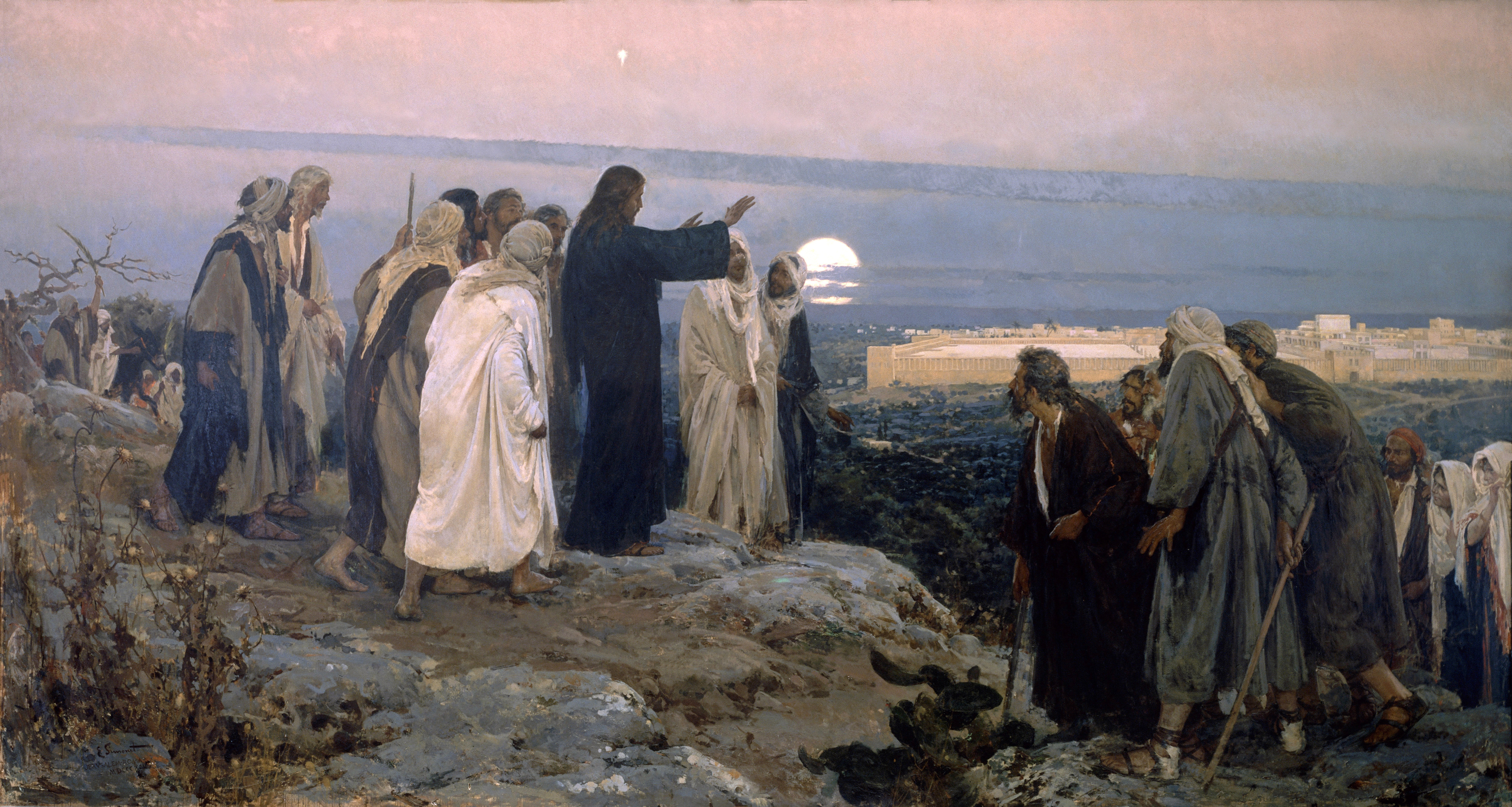
He wept over it
Enrique Simonet, 1892

Listening to people lately has helped me collect a few of the assumptions I often share when people want some spiritual direction about what to do with what they feel and how they are acting. When you only have your own impulses and a lot of societal pressure to work with, things can get confusing – and painful. So here are five things about Jesus that I think should inform how we have a dialogue about sexual behavior (among other things, of course). These five things will not solve everyone’s problems, and I’m not speaking from a place that has been processed by the leaders of the church, but I hope to name some basic things that guide life in Jesus and that apply to how we continue the dialogue about sexuality.

1) Jesus was not organized by sex.

We tend to be. I am often loathe to say it when I am listening to someone struggling with how they are going to have sex, but it has to be part of the process: I don’t think Jesus cares that much whether we have sex at all. He obviously thinks there are more important things in life. Paul’s logic leans toward seeing sex as a distraction to joy; it certainly is not the source of all joy. Some people take that fact to be a prescription. I just see it as a reality that should inform my reality.

2) Jesus did not exercise his rights, much the contrary.

We are tempted to think gaining and asserting our rights is a solution for most things. In this era, feeling justified about where one falls on the spectrum of sexual orientation, or justified about indentifying as, for instance, queer or pansexual is something of a crisis for a lot of people. But human rights are not a basis for salvation. God did not exercise God’s rights, quite pointedly, when submitting to being a human and then a slave to humans. Paul boasts of giving up his rights so he can have the experience of being free from them and having a larger purpose. Rights are important within oppressive contexts, which are most contexts. But having freedom in Christ is more important than having it granted by the powers that don’t follow Jesus.

3) Jesus’ resurrection proved that he was, surprisingly, on the right side of history.

We are tempted to suspect that Jesus might be old-fashioned. But being on the right side of human history is not a Christian concern. If there is anything we have always been on, it’s the wrong side of history – at least a view of history based on humankind’s capacity to get it all right in the end. We’re participants with everyone else, but our view is based on God’s capacity to bring it all to right in the end. Jesus showed up the foolishness of human understanding concerning how one’s personal history works out by rising from the dead. Paul clearly teaches that we are already living in the first days of our eternity. Our participation in history will not define us, but God’s participation in it already has. The world may be evolving in a certain direction without God, but we are moving in another with Jesus.

4) Jesus is an outcast; he is not just kind to outcasts.

We tend to think love is being nice to people others are not nice to, since that is certainly part of it. But people who see the world from a position of power often feel that their best love is shown by their kindness to outcasts. They want to include people in the empire where everyone has a bit of the police and rescue squad embedded in their character. Their empire will save the world (like the U.S. did in Iraq). Having that outlook makes it difficult to follow Jesus — because Jesus is not just kind to outcasts, he actually is one. We are enjoined by Paul and the writer of Hebrews to embrace being the “scum of the earth” so we can embrace our dependence on God, not rely on our own power or the power the godless domination system deigns to give us. This condition does not mean we are not kind to outcasts but it does change what we think kindness is: more solidarity than inclusion.

5) Jesus offered an open, positive approach and got killed.

We tend to save ourselves with avoidance. Even so, I think we, and many other believers, have overcome that and have been practicing an open, positive approach to the dialogue on sexuality (and sexual morality). That openness may not be noticed or even welcomed by someone bent on making us look bad. But take heart, a quick scan of the gospels will show Jesus offering the bread of life and people accusing him of being demon possessed and of trying to overthrow the government. Paul and John appear to feel they are getting treated the same way. If you are doing the best you can to not let truth kill or love lie, it still may not be enough to satisfy some people. I think we should suffer not being enough, not write unsatisfied people off, and keep serving. Our imperfection is no surprise. If we have trouble dealing with each other that seems normal — it can’t be easy for Jesus to deal with me, either. Besides, none of us knows everything we think we know, so someone’s dissatisfaction with us may have something to teach us.

Summing up big thoughts in little paragraphs is never enough. Each of the five things above probably deserves the question, “But what about…?” I am just going for underlying assumptions, not trying to figure out all their applications. But we need starting points for making decisions. In all the dialogue about sexuality and morality, there are a lot of “”But what abouts…?” to work though. I pray that we continue to be a safe place in Christ to explore them.

More dialogue:

The both/and of our ongoing dialogue of love

Dialogue, Rights and Why It Is Hard to Build a Safe Place (1999)

The difference between acceptance and agreement

New birth through conflict

I still want to talk

Wendell Berry: identity, autonomy, privacy, competition

We had a winter wedding and draped the sterile “sanctuary” in ivy filched from front lawns all over town and made into garlands by loving friends. We thus began our somewhat-ignorant stumble into fidelity. On the occasion of our anniversary this week, my very-deep wife found an essay by Wendell Berry that eloquently summarizes much of what we instinctively discovered and practiced. What she focused on was Berry’s piece of wisdom that we have found to be true:

“No matter how much one may love the world as a whole, one can live fully in it only by living responsibly in some small part of it.” We have practiced that in marriage, family, church and city.

The essay she quoted was written in 1977 as part of his book: The Unsettling of America: Culture and Agriculture. Berry wrote his prophetic book as the American Empire flowered and turned to fruit, and as the society began to democratize and monetize everything. If you are a Christian who longs to be a humble creature, you might like to read it all: [link].

For today I offer you two long quotes from it that seem to go together to me. Berry makes important points about topics we have been exploring for a few years as a Circle of Hope. He is writing at a time when the adoption of the concept of “identity” and other new definitions are beginning to bud. By our time we have eaten the pie.

“The so-called identity crisis, for instance, is a disease that seems to have become prevalent after the disconnection of body and soul and the other piecemealings of the modern period. One’s “identity” is apparently the immaterial part of one’s being–also known as psyche, soul, spirit, self, mind, etc. The dividing of this principle from the body and from any particular worldly locality would seem reason enough for a crisis. Treatment, it might be thought, would logically consist in the restoration of these connections: the lost identity would find itself by recognizing physical landmarks, by connecting itself responsibly to practical circumstances; it would learn to stay put in the body to which it belongs and in the place to which preference or history or accident has brought it; it would, in short, find itself in finding its work. But “finding yourself,” the pseudo-ritual by which the identity crisis is supposed to be resolved, makes use of no such immediate references. Leaving aside the obvious, and ancient, realities of doubt and self-doubt, as well as the authentic madness that is often the result of cultural disintegration, it seems likely that the identity crisis has become a sort of social myth, a genre of self-indulgence. It can be an excuse for irresponsibility or a fashionable mode of self-dramatization. It is the easiest form of self-flattery–a way to construe procrastination as a virtue–based on the romantic assumption that “who I really am” is better in some fundamental way than the available evidence proves.

The fashionable cure for this condition, if I understand the lore of it correctly has nothing to do with the assumption of responsibilities or the renewal of connections. The cure is “autonomy,” another mythical condition, suggesting that the self can be self-determining and independent without regard for any determining circumstance or any of the obvious dependences. This seems little more than a jargon term for indifference to the opinions and feelings of other people. There is, in practice, no such thing as autonomy. Practically, there is only a distinction between responsible and irresponsible dependence. Inevitably failing this impossible standard of autonomy, the modern self-seeker becomes a tourist of cures, submitting his quest to the guidance of one guru after another. The “cure” thus preserves the disease….”

Wendell Berry

Berry goes on to apply his thoughts on identity and autonomy to marriage. He has a lot to say to us in a time when single parenthood or parenthood by less-committed cohabitors is common:

“…Failing, as they cannot help but fail, to be each other’s all, the husband and wife become each other’s only. The sacrament of sexual union, which in the time of the household was a communion of workmates, and afterward tried to be a lovers’ paradise, has now become a kind of marketplace in which husband and wife represent each other as sexual property. Competitiveness and jealousy, imperfectly sweetened and disguised by the illusions of courtship, now become governing principles, and they work to isolate the couple inside their marriage. Marriage becomes a capsule of sexual fate. The man must look on other men, and the woman on other women, as threats. This seems to have become particularly damaging to women; because of the progressive degeneration and isolation of their “role,” their worldly stock in trade has increasingly had to be “their” men. In the isolation of the resulting sexual “privacy,” the disintegration of the community begins. The energy that is the most convivial and unifying loses its communal forms and becomes divisive. This dispersal was nowhere more poignantly exemplified than in the replacement of the old ring dances, in which all couples danced together, by the so-called ballroom dancing, in which each couple dances alone. A significant part of the etiquette of ballroom dancing is, or was, that the exchange of partners was accomplished by a “trade.” It is no accident that this capitalization of love and marriage was followed by a divorce epidemic–and by fashions of dancing in which each one of the dancers moves alone.”

Identity, autonomy, privacy, and competition have come to “encapsulate” most of the people we know. They are concepts that form new sanctuaries and they can’t be disguised by draping the ivy chains of our Christianity over them.

May you have some time this Advent, away from the monetization of our holy-days, to do a ring dance, to spend some time in the wilderness rediscovering how you are a much-loved creature, and to celebrate your responsible dependence

  • on God (who gives you yourself and gives himself to you in Jesus),
  • on your spouse (if you are given one) and
  • on your community (which you have been given).

We are the sanctuary in which God’s Spirit dwells. During Advent, as we remember how God comes in to our creatureliness in Jesus, it is a good time to remember how that same Spirit makes us God’s dwelling place as a people in our own time and place. This is also a good verse for a Christmas card: “Do you not know that you are God’s temple and that God’s Spirit dwells in you? If anyone destroys God’s temple, God will destroy that person. For God’s temple is holy, and you are that temple.  Do not deceive yourselves. If you think that you are wise in this age, you should become fools so that you may become wise.  For the wisdom of this world is foolishness with God” (1 Corinthians 3:16-18).