For me, Advent has a lot of layers (like my December wardrobe!). Maybe the layer I need the most is the personal one: the Advent of Jesus to me, Jesus coming to be incarnate in my little life.
The other day, after I woke up with some threatening congestion, I stumbled downstairs in the dark and finally made it to my chair to pray. I had been feeling what one of my friends called “a recession” for a couple of days –not quite a depression, and I was letting some of my anxieties get the best of me.
In the middle of all that unpleasant stuff, I had such a sweet, little experience of Advent, I thought I’d share it with you, in case you also feel like you are stumbling around in the dark on these darkest days of the year in what feels like a dark time of the world.
I was looking around my room and seized upon a flaw in one of the walls, lamenting that the contractor had done a poor job. Suddenly, it came upon me how wonderful it was to have this warm room in which to pray! It was a strangely instant turnaround. It felt like the Holy Spirit had whipped off the emotional bag that was over my head and showed me the joy that was in the very same room I had been criticizing! Just as suddenly, two Christmas carol lyrics leapt into my mind and I meditated on them for a long time.
The first song centers on a quote from the John the Baptist’s father, Zechariah, as he was prophesying over his child:
And thou, child, shalt be called the prophet of the Highest: for thou shalt go before the face of the Lord to prepare his ways; To give knowledge of salvation unto his people by the remission of their sins, Through the tender mercy of our God; whereby the dayspring from on high hath visited us, To give light to them that sit in darkness and in the shadow of death, to guide our feet into the way of peace. — Luke 1:76-79 (KJV)
The Dayspring visited me in the time of my impending seasonal affect disorder and lit up my darkness. My troubled way was guided into peace. So I am writing with this song in mind for me and for you
O come, Thou Dayspring, come and cheer Our spirits by Thine advent here Disperse the gloomy clouds of night And death’s dark shadows put to flight
Rejoice! Rejoice! Emmanuel Shall come to thee, O Israel [Sweet in Latin!]
Like the hem of a garment
Another lyric quickly came to my mind, since my thoughts are usually occupied by lyrics. It is a reference to a prophecy by Malachi, collected in the last book of the Old Testament. The old Christmas hymns come from writers steeped in the King James Bible, which is quite beautiful.
For, behold, the day cometh, that shall burn as an oven; and all the proud, yea, and all that do wickedly, shall be stubble: and the day that cometh shall burn them up, saith the Lord of hosts, that it shall leave them neither root nor branch.
But unto you that fear my name shall the Sun of righteousness arise with healing in his wings; and ye shall go forth, and grow up as calves of the stall.
And ye shall tread down the wicked; for they shall be ashes under the soles of your feet in the day that I shall do this, saith the Lord of hosts. — Malachi 4:1-3 (KJV)
The Sun of righteousness rose in my room with healing in his wings. Like the hymn writer, Charles Wesley, I’m talking about Jesus. Malachi has a broader metaphor. His “Sun” is like God moving through the heavens, the fringes (or “wings”) of his long flowing garment spreading the blessings of life to farmers luxuriating in mild spring sunshine and gentle rains that restore parched ground and fatten starving calves. I woke up to the dawn and felt like singing with Hark the Herald Angels sing!
Hail the heav’nly Prince of Peace! Hail the Sun of Righteousness! Light and life to all He brings, Ris’n with healing in His wings. [Brits!]
It is so good to have Advent again because I need the advent of Jesus in my shadeable little world.
I hope any dark clouds you are experiencing soon pass as the Dayspring drives them away. May the Sun of righteousness rise again where you are seated and convince you to reach out, touch the hem of his garment, and be healed.
I had another Disney experience last week. Someone heard I was in Florida and said something like, “You’re kidding! Rod and Gwen do not seem like Disney people.” I assure you, they are right. But I sure met a lot of “Disney people” while I was away. One nice family from Kent had a plan for ten days in the parks! Ouch!
I do not go to Disney for Disney. I go for five-year olds. We committed to take each grandchild to Disney when they turned five and I have not regretted that decision for one minute. I just got back from a trip with the half-Elsa and half-Minnie pictured below. This is the same birthday girl who was jumping with delight to see Elsa on her Festival of Fantasy parade float and whose birthday badge was spotted by her hero, who then mouthed, “Happy birthday” right at her! Papa got choked up.
Taken with my own Iphone at lunch.
I always learn a lot on my “field work” excursions out of my blue, Northeast bubble (where it is quite a bit colder, btw). This trip was no different. When I was not thinking about where to find restrooms in the Magic Kingdom, I was in wonder that this many people have enough money to do the wildly expensive Disney experience.
The economy did not send people to Disney
My new, unexpected, best pundit friend, David Brooks, recently gave me some reasons for why the parks near Orlando are so crowded. He says, “We’re enjoying one of the best economies of our lifetime. The G.D.P. is growing at about 3.5 percent a year, which is about a point faster than many experts thought possible. We’re in the middle of the second-longest recovery in American history… If you were born in 1975, you’ve seen the U.S. economy triple in size over the course of your lifetime. The gains are finally being widely shared, even by the least skilled….The median usual weekly earnings for workers who didn’t complete high school shot up by 6.5 percent over the past year.”
The “recovery” should be making people feel great, right? Bill Clinton was famous for having a motto that helped him win the White House: “It’s the economy, stupid.” He wanted to remember to maintain his personal sell out to capitalist bondage as he was helping to teach our children to sell their souls as well. His winning strategy has been key to all the political playbooks ever since. As a result, we are up to our necks in economic microdata and even prominent Evangelicals defend Trump’s inaction on the Khashoggi murder by suggesting the country needs to protect its business deals with the Saudi’s other magic kingdom rather than protest assassinations!
But Brooks accurately notes that the economy is hardly what normal people care about the most, Clinton notwithstanding. A few minutes on the bus to Disney will prove that people will spend whatever it takes to get what the economy has ruined: relationships. Disney has discovered how to package up the relationships people want and sell them to us. I think we might have an experience similar to the day we bought at a Disney park at Fern Hill Park. But it was exciting to have my little Elsa creating the “snow” (so she said) that Disney Hollywood pumped out for the “holiday” show. We need to be together.
Money is not, again, making us happy or holy
People have more money, for the moment, but they are far from happy. The economy won’t make you happy! Jesus did not add “Stupid!” But I suppose he could have. Because we humans, in general, have a history of being rather stupid when it comes to what we think will save us. The U.S. Empire promised our big, fat, rapacious, world-dominating economy would save us. But it seems Trump has finally convinced many people such a promise is as faulty as they suspected.
Brooks notes that “about 60 percent of Americans are dissatisfied with the way things are going in this country. Researchers with the Gallup-Sharecare Well-Being Index interviewed 160,000 adults in 2017 to ask about their financial security, social relationships, sense of purpose and connectedness to community. Last year turned out to be the worst year for well-being of any since the study began 10 years ago. As the recovery has advanced, people’s faith in capitalism has actually declined, especially among the young. Only 45 percent of those between 18 and 29 see capitalism positively, a lower rate than in 2010, when the country was climbing out of the Great Recession.” That’s not a big surprise: college debt, gig economy, unpaid internships, hugely expensive health care, high housing costs, tax cuts for the rich – Thanks “economy!”
A solitary worker at an e-commerce company’s distribution warehouse in Pennsylvania. — Sam Hodgson for The New York Times
The crisis we feel is not just the economy (I will not add the contemptuous “stupid.” and if you hear it in your brain, you should resist). The bigger problem is the crisis of connection. The following has become common knowledge (except, maybe, in Congress). Brooks says, “People, especially in the middle- and working-class slices of society, are less likely to volunteer in their community, less likely to go to church, less likely to know their neighbors, less likely to be married than they were at any time over the past several decades. In short, they have fewer resources to help them ride the creative destruction that is ever-present in a market economy.” That’s the crisis.
“And they are dying.” Last week, “the Centers for Disease Control and Prevention reported that life expectancy in the United States declined for the third straight year. This is an absolutely stunning trend. In affluent, well-connected societies, life expectancies rise almost as a matter of course. The last time the American mortality rate fell for three straight years was 1915-1918, during World War I and the flu pandemic, which took 675,000 American lives. And yet here we are — a straight-up social catastrophe.” It is a crisis of caring and sharing, led by the most immoral president ever and his collaborating Senate, characterized by a flood of opioids, guns and video games ready for purchase by eager teenagers.
The economy can’t sell us a solution to the crisis
Circle of Hope was designed as an antidote to the sociological, psychological and spiritual decay that even pundits are starting to talk about. Just call us a “tribe of covenant partners in Christ” and you can see, in every rarely-used word in that phrase, that we supply quite an alternative. As Brooks notes, many young people are bereft of the support structures they need to persevere in school and get the skills to help them survive — we provide them as a matter of course. The natural, organic system of our church provides the so-called “soft skills” that Brooks says the economy can’t locate: leadership, communication and collaboration. The society is awash in technical capacity but people can’t bring themselves to answer personal email (I know, I write them!). We can figure out how to program our phone-app-run thermostats but rarely listen to our voicemail, if anyone still records one. We are sold a lot of ways to connect, but many in the society are having a terrible time getting connected.
Brooks concludes by saying, “Conservatives were wrong to think that economic growth would lead to healthy families and communities all by itself. Moderate Democrats were wrong to think it was sufficient to maximize growth and then address inequalities with transfer payments. The progressives are wrong to think life would be better if we just made our political economy look more like Denmark’s. The Danes and the Swedes take for granted a cohesive social fabric [that hygge] that simply does not exist here.” The country is experiencing a lot of wrongheaded stuff! We all need a “cohesive social fabric” — but the “economy,” as presently dominated, won’t give it to us even if we fight for it, mainly because it is not interested in cohesion, society or even fabric, unless it is being sold by the bolt.
We know all that. We are among those people who are more alone than ever, as well, of course. We struggle to know our anonymous neighbors and have a tough time “volunteering” for our own church and sharing with our own covenant partners in Christ! We are not immune to the social catastrophe the “economy” continues to exacerbate. Lord save us! — the “economy” is dithering about whether it should sacrifice profits to save the world from climate change disaster!! We know all this and we are all this, to a degree. But we are also bravely on the front lines with whatever gifts we have to build an alternative.
OK, I was on the “front lines” in Orlando last week. The big disaster I faced was when they cancelled the last, giant show they had planned for 3000 of us, or so, because of technical difficulties. But, in the middle of waiting for that catastrophe to be announced by a pre-recorded message, I played a lot of rock/paper/scissors, with a giggling five-year-old. It’s not the economy, it’s the relationships. It is not the money, it is the love. It is not the magic kingdom of the American dream, it is the kingdom of God represented by normal people filled with the Spirit. Those truths are easier to hang on to when a child is hanging on to your hand or a cell mate is hanging on to their faith for dear life in your living room. There is an alternative being created in us every day.
I have been doing some thinking about technology again in prepration for the seminarians cohort meeting next Monday. We are inviting everyone to do some theology around the question: Should I buy the Playstation, Iphone, AI device for Christmas?
She says, “The people who are closest to a thing are often the most wary of it. Technologists know how phones really work, and many have decided they don’t want their own children anywhere near them. A wariness that has been slowly brewing is turning into a region wide consensus: The benefits of screens as a learning tool are overblown, and the risks for addiction and stunting development seem high. The debate in Silicon Valley now is about how much exposure to phones is O.K.”
Christians have often been resistant when it comes to technological advances. Many of the people in our church, Circle of Hope, come from Mennonite stock and have relatives or acquaintances who are Amish. The Amish are still trying to keep progress stalled at the pre-industrial level! I admire their stubbornness. But the cool Anabaptists I know are tired of legalistic ancestors and feel queasy about making too many rules that will stifle their own children like they were stifled. So the debate about information and communication technology gets them coming and going. They have an instinct for avoiding the temptations for the world, but they have no little revulsion for overdoing avoidance.
Sometimes I think they use their resistance to overdoing avoidance to avoid making decisions that might save their kids. They don’t want to be legalistic, so they don’t do anything to guide the family. So their poor, impressionable kids are rolled over by the tsunami of technology without much guidance, much less theology. So the wave consumes their imaginations and they adapt to the worldview stories that justify every new relationship with a machine that comes on the market.
Tech inventors are keeping their kids away from screens
The experts from Silicon valley are beginning to resist the technology onslaught for the sake of their children. Just listen to these quotes.
“Doing no screen time is almost easier than doing a little,” said Kristin Stecher, a former social computing researcher married to a Facebook engineer. “If my kids do get it at all, they just want it more.”
Some of the people who built video programs are now horrified by how many places a child can now watch a video. Asked about limiting screen time for children, Hunter Walk, a venture capitalist who for years directed product for YouTube at Google, sent a photo of a potty training toilet with an iPad attached and wrote: “Hashtag ‘products we didn’t buy.’”
Athena Chavarria, who worked as an executive assistant at Facebook and is now at Mark Zuckerberg’s philanthropic arm, the Chan Zuckerberg Initiative, said: “I am convinced the devil lives in our phones and is wreaking havoc on our children.”
Chris Anderson, the former editor of Wired and now the chief executive of a robotics and drone company said about screens, “On the scale between candy and crack cocaine, it’s closer to crack cocaine.” Technologists building these products and writers observing the tech revolution were naïve, he said. “We thought we could control it,” Mr. Anderson said. “And this is beyond our power to control. This is going straight to the pleasure centers of the developing brain. This is beyond our capacity as regular parents to understand.”
Those who have exposed their children to screens try to talk them out of addiction by explaining how the tech works. John Lilly, a Silicon Valley-based venture capitalist with Greylock Partners and the former C.E.O. of Mozilla, said he tries to help his 13-year-old son understand that he is being manipulated by those who built the technology. “I try to tell him somebody wrote code to make you feel this way — I’m trying to help him understand how things are made, the values that are going into things and what people are doing to create that feeling,” Mr. Lilly said. “And he’s like, ‘I just want to spend my 20 bucks to get my Fortnite skins.'”
I think we all know by now that online platforms, especially the games, are designed to be addictive. That’s how the inventors profit, by keeping us engaged and selling us virtual products. In case you didn’t know that, it’s no secret
I did not write this post to solve the problems we are all confronting. But I do think we Jesus-followers have the perennial solutions:.
A view of who we are and who God is appropriately contradicts the narratives the world offers.
Dialogue, like this, and like our meeting to do theology, helps break the power of manipulative lies that hook us into a track we later regret.
Questioning the strategies of our spiritual ancestors and having the courage to resist and restore in our own ways allows us the space to make decisions that have some discernment.
We do not need to bend the knee to whatever powerful force comes beaming into family life demanding we organize around it. Like many tech experts, we’d better figure out just what we are going to do about the invasion very soon, since the powers are grooming our kids for future profiteering and shaping their brains and their loves as they do it.
One of the best things my former church tried was their Way of Jesus site where we collected resources for people developing faith from their first steps to their maturity.
The Way of Jesus follows a faith development model which reflects the wonderful contributions of Piaget, Erickson and Kohlberg to our understanding of how humans naturally develop. There is a spiritual development process that moves along with our biological and psychological growth. We are all on a wonder-filled journey at our own pace. This reality has only become more interesting as I have aged and I have been eager to find the right metaphors in order to teach it. A few years ago we decided that the the ancient symbols of Earth, Wind, Fire, and Water encapsulate, in an organic way, the stages of spiritual development.
A lot is made of the stages of human, biological/psychological development, but less is made of the spiritual development that accompanies those stages. James Fowler did some great work in the 1980’s to apply Piaget’s, Erickson’s and others’ work to spiritual development. These days, the hard edges of these geniuses’ definitions are being softened. Feminist thinkers and non-western thinkers add the sense that life is more like a spiral than a straight line. I can go with them. Janet Hagberg’s works (especially one of my favorites: Real Power) make these stages applicable to people leading in everyday life. I have gone with her, ever since I first saw her present her (then new) ideas for the first time.
As a result of learning how to soften and broaden the stages of spiritual development, I am fond of relating to people according to all their stages of development at the same time. We still have the baby, the toddler, the elementary kid, and especially the adolescent and early twentysomething in us. That’s why we might yell, “Stop being such a baby!” even as we all have the first senses of being fully comfortable in the ocean of grace in which we’re swimming. That latter fact is why we might say, “That baby’s just a little old man!” We need to keep growing, but it does not serve us to despise where we are, despise the past, or fear the future. All things work together for good to those who love God and are called according to his purpose in Jesus Christ.
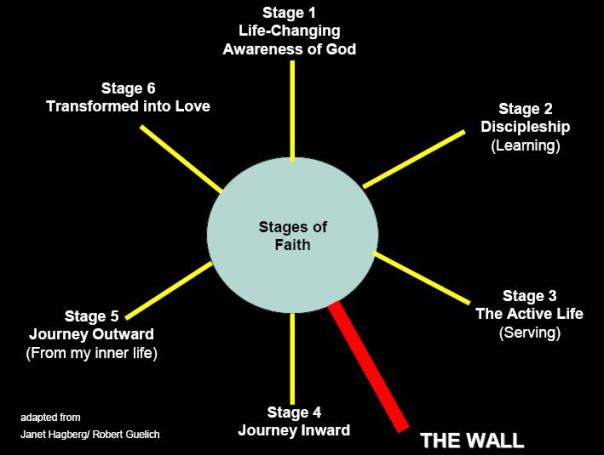
The stages of faith have become common thinking among us, as a church. A version of this chart below is part of our Children’s Plan.
Stage 0/1: The rise of imagination
Earth — infants, toddlers, preschool
Young children have a changing, growing and dynamic faith. It’s marked by the rise of imagination. A young child does not have the kind of logic and language that makes possible or necessary the questioning of their perceptions or fantasies. Their minds are “religiously pregnant,” you might say. It is striking how many times experiences and images from before a child is six have powerful and long-lasting effects on their life of faith, both positive and negative.
How we love God and others will be colored by how we attached to our parents or other significant caregivers. I know that one of my images for God is my Grandmother coming clear from another town with broth for me when I was imprisoned in my room in the dark, sick with measles. She spooned the broth into my mouth and I can still remember the tenderness and wonder. It still seems quite supernatural.
Stage Two: Making meaning
Earth — school age
Elementary school children usually like stories and tend to be preoccupied with rules (especially those they violate). They are developing ways to make sense of the world and deal with it. They can criticize and evaluate their previous stage of imagination and fantasy. The gift of this stage is narrative. The child now can form and re-tell powerful stories that grasp his or her experiences of meaning. There is a quality of literalness about this. The child is not yet ready to step outside the stories and reflect upon their meanings. They take symbols and myths pretty much at face value, though they may be touched or moved by them at a deeper level. The faith of a few people remains at this level all their lives.
I have often told the story of my personal miracle at this stage that basically sold me on faith in God. For others, this is the Sunday School era where they learn the ways of God and their church. How a church tells their stories: as rules and principles or as loving relationship may color a child’s understanding the rest of her life. Jesus has often been reduced to a story or a set of rules and you can see arrested development in the ways of many churches.
Adults stuck in stage one or two, the “earth” stage, are usually self-centered and often find themselves in trouble due to their unprincipled living. They are the “You’ll go to hell Christians.” If they do end up maturing to the next stage in adulthood, it often occurs in a very dramatic way. Our “Way of Jesus” metaphor acknowledges that a person’s natural faith development may be like a child’s until they meet Jesus in their twenties or fifties. Not only do we reach stages of life which begin with baby steps, some of us take first steps of faith when we are older.
Stage Three: Forming identity
Wind — adolescence
This stage typically begins around age 12 or 13. It’s marked by what Piaget calls formal “operational thinking” which means we now can think and feel about our own thoughts and feelings or “mentalize.”
Now is the time when a person forms a sense of identity, and is deeply concerned about the evaluations and feedback from significant other people in his or her life. They pull together their valued images and convictions and think of themselves as themselves, albeit insecurely.
One of the hallmarks of this stage is how teenagers often compose images of God as extensions of interpersonal relationships. God is often experienced as Friend, Companion, and Personal Reality, in relationship in which I’m known deeply and valued.
I think the true religious hunger of adolescence is to have a God who knows me and values me deeply, and can be a kind of guarantor of my identity and worth in a world where I’m struggling to find who I can be. That’s why my youth director was so valuable. My parents were not so sure about my identity as a Christian; they were much more interested in raising a capitalist. But my youth director affirmed the stirrings of the Spirit in me and encouraged my differentiation.
People can get stuck in this stage, too. They probably rely on some sort of institution (such as a church) to give them stability. They become attached to the forms of their religion and their leaders and get extremely upset when these are called into question once they are set. A good example is how upset Catholics have been since the abuse scandals surfaced a decade ago. In 2007 they were 24% of the population, in 2016 they we 18% — that’s 20 million less adherents!
At any of the stages from two on you can find adults whose faith is best described by one of them. Thus Stage Three, the Wind stage when we take first steps in the Spirit, can be a final adult destination. Many people, in churches and out, can be best described by faith that essentially took form when they were teenagers. So you can see how Circle of Hope is a new narrative for many people. For some, it literally hurts to be with us we seem so out of order. We tell them to leave their precious memories of church, but that teen faith is still strong. Some people are too afraid, or stubborn like a teenager, and can’t betray it.
Stage Four: Reflective Faith
Fire — early adulthood
Stage Four, for those who develop it, is a time in which a person is pushed out of, or steps out of, the circle of interpersonal relationships and principles that have sustained his or her life up to that point. Now comes the burden of reflecting upon the self as separate from the groups and the shared world view that defined them. For many of us: You move to Philadelphia and see what happens.
We don’t know who discovered water but we know it wasn’t fish. The person in Stage Three is like the fish sustained by the water. To enter Stage Four means to spring out of the fish tank and begin to reflect upon the water. Perhaps that feels like out of the frying pan and into the fire! In therapy this stage often means looking at your “script” and acting outside of it, making a choice. In marriage, it may mean getting out of the power struggle, uniting to beat our relational habits, and writing the new, loving narrative we choose. I often admire my clients’ rebellion against the narrative or structure that has throttled their development. Jesus was super mad at the Pharisees for doing the throttling – he wanted to kindle a fire.
This is the tough stage, often begun in young adulthood, when people start seeing outside “the box” and realizing there are other “boxes.” They begin to critically examine their beliefs on their own and often become disillusioned with their former faith. Ironically, the Stage 3 people sometimes think the Stage 4 people have become “backsliders” when, in reality, they have moved forward. The stage four people may think they have lost their faith, when they have just grown up. Those who break out of the previous stage usually do so when they start seriously questioning things on their own. A lot of the time, this stage ends up being very non-religious and some people stay that way permanently. Some throw out the baby Jesus with the bathwater of their changes.
I think my holy dissatisfaction turned to holy differentiation. But it wasn’t without some strange days. At this stage I kind of blasted out of a very safe cocoon in my mid thirties. Ultimately, the process led me to Philadelphia and the fun I have been having ever since.
Many people don’t complete this transition, but get caught between three and four. They come up against “the wall” and don’t get farther. We may be forced over the wall when we lose a job or a marriage or our childhood faith. Sometimes people stay on an endless loop of the questions that inhibit their next steps. There is often a lot of concern about “Where do I stop and you begin? Where does the group I can belong to with conviction and authenticity end and other groups begin?” We want to fit authentically where we are, according to who we’ve become. It is not easy to find such a place. We realize we’ll have to build it.
Stage Five: Connective Faith
Fire — middle adulthood
Sometime around 35 or 40 or beyond, some people undergo a change to a more conjunctive faith, which is “adult” faith. What Stage Four worked so hard to get clear and clean in terms of boundaries and affiliation, Stage Five makes more permeable and porous. As we move into this stage, we begin to recognize that our unconscious is relative and deep, likewise the universe is huge. We become comfortable with the fact that much of our behavior is shaped by dimensions of self and God into which we are just dipping our toes. There is a deepened readiness for a relationship to God that includes God’s mystery and unavailability and strangeness as well as God’s closeness and clarity. We are more likely than before to love God for who God is rather than for who we are.
Stage Five is also a time when a person is also ready to look deeply into the social unconscious — into those myths, taboos and standards we took in with our mother’s milk which have powerfully shaped our behavior and reactions. We’re ready and able to re-examine those, which means we’re ready for a new kind of intimacy with persons and groups that are different from ourselves. We are ready for allegiances beyond our tribal gods and our tribal taboos. Stage Five is a period when one is alive to paradox. One understands that truth has many dimensions which have to be held together in a blessed tension. You can see that, paradoxically, ones needs a lot of water to sustain this fire.
Stage Six: Embraced and Embracing Faith
Water — adulthood
We all have this faith planted in us like a mustard seed. Whether we get to some idealized maturity, we have all known what the water stage is all about since we were babies. In a sense I think we can describe this stage as one in which we radically live as though the Kingdom of God were already a fact, since it is. We experience a shift from the self as the center of experience. Now our center becomes our participation in God, our ultimate reality. We’re at home in the creation, in that great commonwealth of being in Christ.
On the one hand, we experience people at this stage as being more lucid and simple than we are, and on the other hand as intensely liberating, sometimes even subversive in their freedom. Think of Martin Luther King, Jr. in the last years of his life, or Thomas Merton, Mother Teresa of Calcutta. James Fowler loved Dag Hammerskjold and Dietrich Bonhoeffer in the last years of his imprisonment. We collect these great examples of people who demonstrate how to swim freely in grace in our The Transhistorical Body blog.
These are Jesus followers who, in a sense, have loosened the hold their self has on them for the sake of affirming God. And yet in affirming God they become vibrant and powerful selves. They have a quality of relevant irrelevance. They have lost their lives and found them. Their “subversiveness” shows us our compromises for what they are.
God be with you in your development!
If you got through all of this, I hope it affirmed where you are right now and inspired you to hope in your future. We are all growing. In a couple of months, I will be sixty-five, when our society provides an arbitrary line over which I can cross and become “old.” On the one hand, I already feel increasing, blue-ish freedom. On the other hand, I feel like a baby toddling into the unknown, wondering if my mother is looking at me as I run toward the street. It is the transitions that get us. We can feel them as exciting baby steps or struggle with them as the end of something beautiful. Development can be scary or it can be the beautiful way we deepen our faith. Most of the time it is both.
I hope this very brief rendition of a subject so many have explained so well helps you see where you are and where you want to go — there is a path, even if you can’t really see it right now. You are not alone or odd. There is hope for all of us.
I also gave this to you to lift up the idea that you are carrying all your selves from the past. They complete, inform, and undergird who you are becoming. They are not bad; they are part of you. Their pains and possibilities are still yours. I think you need to care for those many selves and love them and take them with you into your bright future.
Anxiety is an epidemic. Why don’t you try this O.P.E.N. prayer right now? It is a prayer of opening our clenched fists and our knotted hearts to the healing, hopeful love of God.
Why does it seem like so many people are anxious? Some researchers say an increase in reporting issues with anxiety is due to greater access to treatment. So an actual increase in anxiety may not be proven yet. But there certainly has been a lot of talk about anxiety in the past few years. And one researcher, among many, says there are common reasons people report more anxiety now than in the past.
The United States is breeding anxious people:
Society has shifted. Kids are set for “extrinsic goals, such as materialism and status and away from intrinsic goals, such as community, meaning in life, and affiliation. Motivations are drifting away from the community and onto the individual.”
More people are living alone. Some people like to live alone. But many more are forced to live alone — and loneliness increases anxiety. In 1960 under 7 percent of U.S. adults lived alone; by 2017, that figure had soared to well over 33%.
We live in a chemical bath. Nobody knows just what is going to happen to us as a result of constant exposure to chemicals. Studies suggest that the cocktail of plastics and other pollutants children drink daily may contribute to their future anxiety.
The introduction of social media platforms changed things. The onslaught of social media has changed relationship structures. Studies show, all over the world, that the more one uses it, the more likely they are to be depressed and anxious.
Life, in general, seems more stressful. Are jobs more stressful? Is commuting to blame? When we tell kids that they can “achieve anything if they try hard enough,” are we setting them up to fail? Is our self image being driven into the floor by the constant bombardment on our senses of perfectly filtered, digitally altered models? Has capitalism shifted our attention to vastly unobtainable personal desires, leaving us with a gaping chasm we know we can never fill? Climate change, nuclear apocalypse, Ebola, flesh-eating viruses, antibiotic resistance, ever-growing economic inequality, dictators, fake news…the list is endless.
Then we start talking about all these things on all our media, and the reverberations amplify our anxiety!
Last Saturday at the thirtysomething retreat, we boldly talked about the anxiety-decade. If you are thirtysomething, a naturally challenging time of life is happening when the world itself provokes anxiety
So I offered a prayer that might help us find some peace. This outline is commonly used and I adapted it for our purposes.
O.P.E.N. to your Newness — the true you in Jesus
The next time you find yourself over-thinking past situations or feeling overwhelmed by life’s stresses, try this prayer that leads you to cooperate with God’s compassion and restore your attention to the present moment.
Observe
Close your eyes and take a deep breath. Notice how your body feels—tension in the stomach or heaviness in the shoulders, for example. Then notice the thoughts you’re thinking in the moment or are dwelling on from the past, and name them, such as, worrying, fearing, replaying, or planning.
When we notice where our bodies are carrying stress, we can focus our attention and relax our body parts. When we observe our thoughts, we’re able to choose which to believe and which to let pass, which are condemnation and which are freedom, which come from anxiety and which come from love. What are knee jerk reactions of your old self, what are death-defying traits of the new you in Christ?
We’re going to try it in a minute, so this is just an overview to get ready.
Peace
Now that you have identified the stress or seen the battlefield from a helpful perspective, let’s find peace. When you are ready, invite peace to your body and mind by saying things like, I am deeply hurt and it is okay to feel the way I do. (Receive comforting words to ease your distress about a specific situation or feeling).
Some other sentences that may deepen you peace: Even if other people judge me, I don’t have to judge myself. What other people say and do is about them, not me. I am angry but angry is not me. Jesus, guard my heart.
Cooperate with the peace of God.
Enjoy
Take a deep breath and take a moment to sit in the calmness of mind and body. Dwell in goodness. If you are using the Bible as part of this process (as I suggest below), enjoy the words or enjoy the pictures the words bring to mind.
Newness
Say to yourself: The moment has passed and now I am at peace. I am new in Christ. The God of peace is with me.
Let the goodness rise in you. More times than not, returning to the present moment — in which you can attend to yourself and to God, is an anchor, a solace in the midst of chaos. You can always come back to the place where you meet Jesus in the here and now.
At the retreat, we used a familiar portion of Philippians 4 which is a comfort of millions of people around the world. It could be read in an anxiety-provoking way: If I am worrying, I should not be. My heart is unguarded, so something terrible is going to happen to me. I can’t think straight, my mind races too much to dwell on something good. I am so inconsistent, God must not be with me. I can’t do it right, so I should give up.
Much of the Christianity in the U.S. runs according to the anxiety-provoking ways of the U.S. But I don’t think Paul, much less God, calls us to anything but the basic peace of Christ, moment by moment, forever. We kept affirming this : God is for me, in this moment and the next. Memorize that line so it is ready to recall when you need it — like when the police stop you, when the baby is crying inexplicably, when your husband is late, when the doctor’s diagnosis is iffy, when there is a midterm election, when you don’t know why you feel so fearful.
Why don’t you try this O.P.E.N. prayer right now? It is a prayer of opening our clenched fists and our knotted hearts to the healing, hopeful love of God. You wouldn’t have to use the Bible to do it . But Philippians 4 enriches the process.
Observe – Note your body and thoughts. Let the tight parts of your body relax. Choose the thoughts you need to hold on to and let the others go.
The Lord is near. Do not worry about anything, but in everything by prayer and supplication with thanksgiving let your requests be made known to God.
Peace – Invite peace into your body and mind by saying the honest truth about you and God
And the peace of God, which surpasses all understanding, will guard your hearts and your minds in Christ Jesus.
Enjoy – Breathe. Take a moment to sit in the calmness of mind and body. Dwell in goodness.
Finally, beloved, whatever is true, whatever is honorable, whatever is just, whatever is pure, whatever is pleasing, whatever is commendable, if there is any excellence and if there is anything worthy of praise, think about these things.
Newness – Let the goodness rise in you. Be anchored.
Keep on doing the things that you have learned and received and heard and seen in me, and the God of peace will be with you. — Philippians 4:5-9
It would be great to hear about how you experienced this prayer!
Babies are being born in my circles of the church. They are bundles of disruption who demand their parents and those who love them abandon most self-oriented pursuits. They insist we honor what else really matters: weaving community.
The community helping babies thrive in South Sudan
Community makes regular people ambitious
I have followed my dreams and ambitions my whole adulthood, and I am sure I have been led by God to do so. But the Lord also taught me, early on, that family and friendship — the basic, personal relationships that pull us to develop community, provide a home for the love that keeps my ambitions humming. The momentary revelations of love remind us we are alive.
Here’s an example of a moment. When I was a child I would shake my hands with glee when I was excited – my family never forgot it. (One of my grandchildren paddled their belly with similar enthusiasm – and probably still does when no one is looking). When my younger sister was brought home from the hospital, I was about 2 ½. I was standing in the driveway jumping up and down and shaking my hands with glee — so eager to meet her! No one ever forgot my joy – or the wild way I showed it! It was one of those moments people love to recall — a moment when love and joy ruled the family. I suppose we keep going to meetings of the church because, so often, something happens that reminds us that God is with us and love is possible — joy and love rule the family of God.
In the U.S. society, we are so overrun by philosophies of autonomy and individualism we spend all our time mastering them at the expense of weaving the fabric of community together. It’s not that both movements aren’t important. Individuals make up the community and communities make individuals — they always run in tandem. But it is easy to see that individual pursuits often overshadow making relationships.
One example of the overshadow is how often people wait to get married until they have settled their careers. “Millennial men and women are more concerned with establishing their own lives before agreeing to share them with a partner” (Cosmo). Likewise, once those thirtysomethings are having children, the pursuits of their individual families often remove them from their extended family, much more do those pursuits remove them from the life of the church or neighborhood. Very busy people often become very successful in the economy at the expense of their community; this is an old story now.
Weaving individuals into community is a Bible theme
Balancing our God-given uniqueness with the weaving of community is one of the major themes of the Bible from start to finish. It is a basic story about love. The story about Joseph and his brothers is a great example. The fabric that makes up Joseph’s “coat of many colors” is desecrated by his brothers. But it is his understanding and leadership skills, combined with his capacity to forgive, which saves his family and supplies the strong ties that will keep God’s people together in Egypt. The next big story is about Moses and the themes are similar. Just as the social fabric of Israel is unraveling in slavery, God commissions the uniquely gifted Moses to lead the people into their own country. Over many years on their heroic journey, they learn to weave the fabric of authentic community. The unique vision of Israel and their authentic community go together, or there is no promised land.
A good way to see God’s people weaving community is in the Ten Commandments Moses delivered from the mountain. One way to look at these famous sayings is that they install disruptions to individual ambition and personal glory in honor of maintaining community ties. They are all about honor, which is the foundation of life in community. When we honor God and have no other gods, we love the Lord with all our heart, soul mind and strength; we devote our energy to the innate desire of all creation for communion with the Creator. The obvious extension of that honor is to love one’s neighbor as oneself.
As the list of commands are completed, they enjoin us to honor our parents — being trained to give fundamental respect to others by giving respect to the community who formed us. We are called to honor the Sabbath — to cease our self-directed work and honor who we are and the community that shapes us. The rest of the commandments honor individual rights: to life, to marriage, to property, to honest public affairs and to individuality. The communal fabric is sustained if we have respect for the individual. The individual is sustained if we weave a supportive communal fabric which supports them.
For all my life, people in the United States (and other societies) have been having quite a contest about whether they will be subject to these principles. With all our capacity to be autonomous and an acceleration in our preoccupation with individual rights and the technology to exercise them, we are all experiencing a dangerous unraveling, it is even hard for the church to hold together.
Healthy ambitions spring from extravagant honor
When I am counseling couples, especially before they are married, I often end up using an old metaphor to make a point about honor. If we want to stick together, we all need to “doff our hats” to one another, like a chevalier greeting a lady, or a lady curtsying to another. Such courteous behavior used to be common and it made sense.
It is easy to see the flaws in any society, but most of them have something quite brilliant built in, too. In the 16 and 1700’s the nobility of Europe were trying to hold on to their power in the face of the pressure of individualism and democracy, not to mention capitalism (individualism on steroids). Back then, they developed systems of rank and honored people according to their rank with great expressions of courtesy, which they thought hearkened back to better days. So Alexander Dumas wrote The Three Musketeers in 1844, looking back to 1625, when d’Artagnan was learning the elaborate ways of courtesy. Movies ensued and so we all know about it. Try this one you’ve never seen at ~24:45:
I often tell marrying couples to figure out how to express that great clause in the great Romans 12: “Outdo one another in showing honor” (ESV) – “prefer” one another, “take delight” in honoring the other, “eagerly,” “excelling” at it. If you want to be ambitious, be ambitious about that. When your mate enters the room, bow before them as if they were really something. If you are wearing a hat, ceremonially, sincerely, let it sweep the floor before them. At least put down your phone for a second and look them in the eye!
Honor is the foundation of community. It is the practical expression of our love for God. When the Ten Commandments says “Honor,” it does not mean “obey” and it does not merely mean “respect;” it certainly cannot be reduced to “sending thoughts and prayers.” Honor is profound regard for the innate value of others before God. It is the life of Christ bowing before sinful humanity with forgiveness and self-sacrifice and then Jesus trusting his followers with his own Spirit. Honor is Joseph finding that his uniqueness is valuable for the preservation of his community even after they had left it unrecognized and squandered it. It is Moses taking on a job he does not want for the sake of the people.
This month, all sorts of things have happened to me and those I love that reveal how important community is. As a result, the fabric of our community has been strengthened. When the baby is born, when the wedding happens, when people change, when we find ourselves in a funeral, we are reminded that our individual pursuits happen within a community. When people die alone (and they increasingly do) it shows how unraveled we have become. God, in Christ, has made us the alternative to dying in general and dying alone in particular. To be that alternative, start with the easy stuff and recalibrate your schedule, if it needs it, to honor our community. Weave the fabric. Your unique contribution is crucial.
If you let yourself do this, be sure you have spent time being prepared by God before you leave the house, because that kind of love can take over your life. You might be drawn to honor each person you meet, not just your mate or friend, with at least a doff of your hat. You might even smile at people who think their headphones make them invisible, untouchable and safe from alarming contact with other humans. You might risk talking to the needy. You might ignore the resentments you think have made a boundary between you and someone. We need to keep weaving, since we all know how fast things can unravel! Often, the weaving is stretched thin just in time for the baby to be born and remind us just how much those relationships mean to us and to the world.
My parents did me a great favor when I was a kid, they sent me and my sister to a pretty horrible Baptist Church across the street from Chino High School. I do not know why that was their pick. I do not remember one word from them about why we were there. But even though they never darkened the door unless I was in some kind of performance, one of them usually got up and took us to Sunday school. Usually we even “stayed for church” because we found it quite amusing.
I found out later they had been very burned by a nasty church split when they were first married and it soured them on Jesus and the whole church thing. That is a sad, often-repeated story — repeated by others of course, my parents guarded their own soul-wounds religiously. There are a few things my parents did not give me that can still burn me if I blow on the embers. But there is one thing they gave me that was inestimably more valuable than they expected: the church.
Protecting kids from the church
Being raised in a family where mom and dad were visibly not Christians and where Jesus was only mentioned in relation to a curse, I have repeatedly felt the need for more education when it comes to what it feels like to have Christian parents. Over and over, I run into thirtysomethings who want to make sure their kids are not bored in church, who are channeling their own bad experience of being obligated to something their clueless parents perpetrated on them, or who have been wounded in many ways they are afraid their kids will experience. I keep listening because I have so little natural empathy, since my recollection of the church at which I was dropped off is that it was about a hundred times worse than anything Circle of Hope could fall into. Yet it was in that very imperfect, even unorthodox and sometimes damaging community that I met Jesus at a very early age. I can’t imagine why they think depriving their children of the community in which they will learn faith, or even protecting them from it, is a good strategy.
Most parents I know act like school is inviolable, since getting into better schools on the basis of your past record is supposedly going to give you your best life. If they sign up their child for a sports team it is a covenant they must keep, so no matter when the game is or where it happens, the child must be there. Dance, musical instrument, tae kwon do, all sorts of enrichment activities fill up most of the week and the activity schedules dictate what is happening in the family. It all looks very religious to me. But if the church seems demanding, that’s an obligation that feels intolerable! There are a lot of reasons for that feeling and please know that I understand plenty of people have never felt it. But I keep running into it, which leads me to my main purpose for writing.
Don’t deprive the child of their church
As a follower of Jesus and as a person with my unique experience, I say that the best thing you can do for your child is give them a church. They need to grow up in an environment where they can learn faith. Here are my reasons for saying that, for now:
1) Your family is not enough
I have acquaintances who rely on their parents in Lancaster to come in and sit with their children while they do something together (and it is rare they do something as a result). They are on their way to isolating their kids in their nuclear family instead of training them to live in the extended family of the church. They undermine the sense that the church is a family in Christ by refusing to let it happen. They can’t even work out a mutual babysitting arrangement. I think that is a very practical way they deny Jesus his demand that he be more important than the family from which they came. Their children will likely keep their distance from Jesus and the church, too. Children need to be raised in a village and Jesus should be the leader of it. It is short-sighted parenting to think you have everything your child needs in the “relative” category. They need to be born into the body of Christ and surrounded with the grace of God, first and foremost.
2) Culture matters
What is my identity? In Western culture that has become a standard question children need to answer. Queer theorists may talk us out of this before long, but until then children must decide: male/female, gay/straight, what color, what place among the school cliques, even what political stripe. The place they get their Christian character is certainly in your family, but it is actualized in the church. If they never feel like they are part of an alternative community centered on Christ, they will probably join another community that is centered on themselves, or some identity they have adopted.
Making the community of the church is a parental top priority — at least if they want to raise children who can live life with Jesus. I am often amazed at what parents will give their children over to while they lightly visit a church, one they may not even claim as their own. What kind of child will come of that? Will they join the Fortnight community or Eagles Nation?
3) Lifetime assumptions form early on.
What is the meaning of life? That question will eventually be asked by your child. Even if they have consistent, loving Christian parents, they will still have to ask the question and get a decent answer for themselves (or get used to their despair). I thank God Mrs. Elrod often drove out to get me for Sunday school when my parents were indisposed or sick of it all (I can’t remember which caused her to appear). Sunday school was not that great, but Mrs. Elrod making me feel worthy of her effort, her undeserved service, made an indelible impression. I still remember what her front seat feels like! Her behavior spoke to me in deeper ways than her lessons. Children need a lot of opportunity to pick up grace assumptions in the church and plenty of acceptance as they mull them over.
4) It is your duty as a parent
I have already said this, but I wanted it to have its own bullet. Building the church is the responsibility of everyone who follows Jesus. We are, by our redeemed nature, bricks in the temple of the Holy Spirit. Each of us have value and cannot be replaced. The energy we bring to the redemption project of Jesus is multiplied far beyond our personal efforts by God and by the community we tend. In these times especially, children need to learn community, since they are being trained to sit alone in front of a screen all day, among other things. It is your duty as a parent to give them a chance to be saved from whatever they presently face and what will come. That salvation will come from a deeper place than just a resilient capacity to have their own mind. They will need the strength of a loving, Spirit-filled community to help them
5) You child needs to see mom and dad follow Jesus.
It is great when a child is teachable. But I think they mostly they get what is caught, not taught. Some people think they are wrecking their family because mom goes to her cell meeting once a week and dad puts the kids to bed. I think it would be fine to tell your two year old, “Mama is going to build the church. I follow Jesus and I hope you will too, one day. I am going to make sure I build you a strong community so you can become your true self. There is nothing more important to me than following Jesus. He is the source of all the love I have for you.” I think it is good for a child to know that the family is moving according to something outside the family — namely Jesus is leading them. If Jesus is not making the family, what will the child learn about who makes family? And if they ever read the Bible, what will they make of Ephesians 3?
Start now, even if you don’t have children yet
If the church is not good enough, reform it for the sake of your children, don’t leave it up to someone else. If you end up in a place where there is no church, make one; it is the vehicle for the work of Jesus in the world and your children need it. If you feel overwhelmed and want to hole up in your house with your shower gifts for four years until the baby releases their grip on you, have some vision, that child needs a healthy Christian parent, not merely a servant of their desires. The best time for the child to have a church is when they are 5-8 and forming some very important foundations for their later days. Make sure they have one. If your friend just had a baby and you can’t figure out what to do for them, give their baby a church, for Christ’s sake! I know people use that as a curse, so I am being cute, but it means “on account of Jesus” or “in light of the purpose of Christ.” We’re working with Jesus to prepare the way for the baby to walk into fullness of life when we build her a church.
I am happy Faith Breunle, Charlie Brake and Paul Woodward were around when I was in Jr High to demonstrate to me that Christians existed in the real world. To be honest, they were not that great of teachers or examples, as I look back. But periodically, I met up with their heart – the one that motivated them to keep making this crazy little church to which my unbelieving parents attached me. They opened up my imagination for what I might become and build. By most objective observation, what they were doing was very ineffective. But that ineffective thing was very effective when it came to me. I don’t think Jesus needs a great church. The little church in Chino created and lived in an environment where Jesus was assumed and honored. I wandered into that. They probably thought I was a weird kid, coming from those heathen parents, and all. I’m still a weird kid, only I know Jesus and that has made my life possible.
Maybe your kids won’t all be uniformly faithful. Trust cannot be coerced, can it? But I wouldn’t expect them to know Jesus if they don’t hang out around him. He’s in the body of Christ. It is being built all the time in every era with every new follower. If for no other reason, build it for your kids, for Christ’s sake!
A week of praying through times of transition at Circle of Hope Daily Prayer :: WATER last week was very good for me. I am in one of those transitions. You might be aware of it, since Circle of Hope sent me into it when they declared a transition of the whole church into our “second act” a couple of years ago. I thought I kind of knew where I was going, but there has been more development and change than I imagined!
The well-watered schedule
As a church we bought a new building, created new businesses, multiplied a new congregation, bid good-bye to significant partners, developed a new kind of pastors team and solidified a mostly-new leadership team. I was in the middle of all those changes. As a result of them, it seems to me, we are pulsing on the edges of our two-handed outreach: compassion and disciple-making. In a societal environment in which Jesus is not too popular right now, it is amazing how many people have made a brand-new relationship with the risen Lord this year!
Personally, I found myself jumping in and out of the problems that development causes. Nobody knows what a “development pastor” really does, since nobody else is one. But I quickly found out as my assignment came into play. I had plenty to do with mentoring, developing our crucial leadership team, helping with the practicalities of businesses, buildings and staff, and working out new teaching and communication (and there is more, I realized as I was making this list). I was supposed to work less hours but that did not immediately pan out.
Now that I am entering the last year of my term, I realize I have also been learning how to get smaller and let go, as I knew was my trajectory from the beginning.
Dead wood
That learning brings me to the Daily Prayer entry that really hit me last week. It was on “creative relinquishment.” I even enjoyed the extension of the Lord’s metaphor about him being the vine and we the branches to include considering what has become dead wood and what is sprouting on our branch. “One of the challenges of living in concert with the creativity of God is how to attend to present passions while releasing those tasks that are completed. How can we honor the past that we carry with us while not letting it define the future? How can we live in a well-ordered psychological house without accumulating too much stuff in the basement? Life in the Spirit is a flow of engagement and release, of attachment and detachment, of commitment and relinquishment…. As we listen to God’s creative beckoning, we need to ask, ‘What must I release, in order to make way for what is calling now?’”
Unlike many people, I suspect, I actually did the prayer exercises that were suggested. Don’t get me wrong, I often avoid spending my precious time on spiritual exercises and my self-importance often has the same bad effect yours does on you. But I am in a time of life when I need to figure out what is the best next step for me. So I did some exercises. The question that I’ve been pondering ever since is: What is the “dead” wood on my branch of the vine? I was glad to be reminded that, in the Lord’s ecosystem, when a seed falls into the earth and “dies” it rises to new life and bears much fruit (John 12:24). So dead wood is not “bad” wood. I may be getting old, but I am hardly dead yet. Even though people persist in asking me, “How is retirement?”, that does not mean the Lord has retired me. “Creative relinquishment happens in the context of resurrection and eternal life, not in a realm of scarcity and decline.”
Possible sprouts
As I am looking back on my recent history, I am happy we decided to go the route of “creative relinquishment” of our first act as we patiently and relatively consciously moved into our second. Although our risky behavior and unexpected changes have upended us a bit, lately, I think we are poised for deeper and more effective ministry than ever. I am also happy the church trusted me to be productive through a transition rather than just cutting me loose to see what happened. I expect to keep being helpful. And I have personally been inching toward clarity about where God is leading me next as part of our body.
Here is how clarity happens for me, and maybe for you. Last weekend Gwen and I were with dear friends who are a little older than us. They helped to create an atmosphere where deep thinking is welcomed. I began to see where some activities that have been very dear to me in my life are about done. I am not “dead to them” like I am sick from them or of them, but they are withering. They are decreasing so new things can sprout – sort of like the forest outside my window right now, whose floor is littered with toppled trees feeding the saplings right next to them. We watched a new movie together called The Wife, with Glenn Close, and it aroused even more of what I had been thinking. She has such an urge to give her gift of writing. It was interesting to see trees topple in mysterious ways to offer her a new blank page. My blank page is beginning to get a few sentences and that gives me hope for how the Lord is leading each of us, you included, as we keep listening. Let’s pray.


 Some of the people who built video programs are now horrified by how many places a child can now watch a video. Asked about limiting screen time for children, Hunter Walk, a venture capitalist who for years directed product for YouTube at Google, sent a photo of a potty training toilet with an iPad attached and wrote: “Hashtag ‘products we didn’t buy.’”


 My parents did me a great favor when I was a kid, they sent me and my sister to a pretty horrible Baptist Church across the street from Chino High School. I do not know why that was their pick. I do not remember one word from them about why we were there. But even though they never darkened the door unless I was in some kind of performance, one of them usually got up and took us to Sunday school. Usually we even “stayed for church” because we found it quite amusing.

