Category Archives: A life in the Spirit

Have an Epiphany: God enters your weakness in Jesus

An armor-plated fig-leaf is still a fig leaf. And most of us just wish our fig leaves were armor plated, so we continue to hide behind tough-talking people who make vain promises of saving us from our weakness.

If you don’t get what “fig leaf” means, it refers to the story of Adam and Eve in Genesis 3 after they have eaten the forbidden fruit and feel ashamed of their broken relationship with God. They begin to vainly hide their naked shame by making clothes out of fig leaves.

Americans hide in a garden of power

Image result for adam fig leafIf you are a Jesus-follower who lives in the United States, you need to admit some things about your fig leaves. I think one of the main things we need to admit, just to get to square one of faith, is we think America is square one of the world. That sense of reality comes with some godless assumptions about power.

For instance, your reaction to Trump’s assassination of General Soleimani probably begins with power: 1) You’re glad God took out the evil general through his agents so lives would be saved and your children would be safe from Iranians. 2) You’re furious and are trying to find the lever that ejects Trump so lives will be saved and your children will be safe. Getting and exercising power is the go-to solution for Americans. We’re always declaring our independence in one way or another. We accept the violence that protects us. We crave power to protect our chosen lifestyle. The power to choose is super important to us.

I think democratic government is better than variations on totalitarianism. But I have no illusion that democracy equals godliness. And I know arguing about that all day is sewing fig leaves. The arguing is the illusion that someone knows like God knows. The arguing  reveals the assumption it is really important to get things right, since we run the world. Twitter and other social media is a daily example of this preoccupation.

As far as I can tell, the general Christian dream in America is power: miracle, organizing, argument, all loving and truthing done expertly and effectively. So we despise our weakness: no miracles, divided, voiceless. We look at our leaders and ourselves with unabashed criticism or resolute lack of criticism. We despise ourselves or we despise useless despising.

I think we should admit we are armor-plating our fig leaves. We live in an environment in which a deranged president has enablers who defend his right to order an assassination with a drone. We may argue or refuse to argue. But ultimately we generally swallow the reality and conform to it, fashioning our own defense system and thinking it makes similar sense to the giant defense system in which we live.
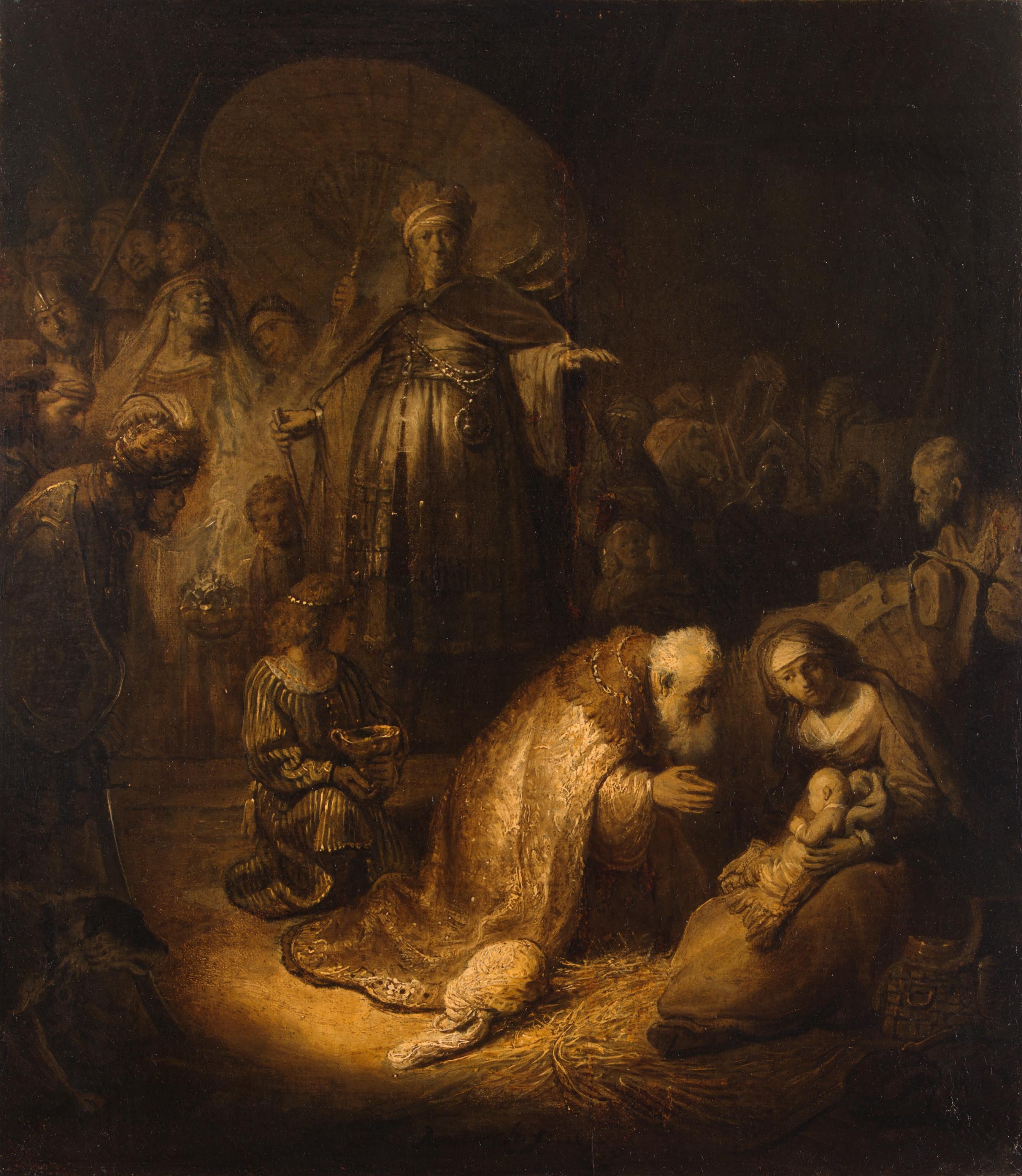
magi bowing in weakness
My pastor used this Rembrandt painting last night to help us see the powerful bending low to connect with truth and love.

Epiphany invites us back into weakness

Epiphany gives us a chance to get naked with God again. If you read the Genesis passage, it says, “They heard the sound of the Lord God walking in the garden at the time of the evening breeze.” If you are listening today, you can hear God in the garden again by looking through the Jesus lens. See God born in Jesus and see Jesus launched into His mission of redemption as he is revealed in his baptism. [More explanation of Epiphany, here].

In reaction to the most recent atrocity in Iraq we are tempted to swallow and emulate, people are coming out of the woodwork to try to say something else. For instance, one of Shane’s buddies, also a grad of Eastern, says on Twitter: “Having seen through Herod’s scheme to cling to power through lies, violence & false piety, the magi went home by another way. Like them we pray in this season for a better way home to wholeness, to justice, to peace.”Jonathan Wilson-Hartgrove

There is a better way home. God keeps trying to show us. We need to keep looking.

Here is the un-American way the teachers in the Bible keep trying to get on our screens with this better way: Our weakness is our strength. Epiphany is the celebration of this reality. The “manifestation” or “epiphany’ of God with us is a baby in the stable behind the inn on a side street in a village. The manifestation of God is the Messiah coming up from his baptism in a muddy, desert river in a territory on the outskirts of the Empire. The body of Christ being manifested in the world is our  struggling, underfunded congregations with their fragile idealism and sometimes inept leaders; it is the compilation of all our cells which have meetings their members struggle to attend; it is this  pathetic blog and many other wonderful things people have little time to read.

I think all that is wonderful. The epiphany of God is a wonder, again and again.

Jesus is baptized in the Jordan River by John by David Zelenka (2005)

We have another way home

The apostle Paul tried to teach the power-hungry Corinthians what he had learned about the wonder of God being a human and being manifest in Jesus-followers:

“[God] said to me, ‘My grace is sufficient for you, for power is made perfect in weakness.’ So, I will boast all the more gladly of my weaknesses, so that the power of Christ may dwell in me. Therefore I am content with weaknesses, insults, hardships, persecutions, and calamities for the sake of Christ; for whenever I am weak, then I am strong” (2 Corinthians 12:9-10).

Pretending we are not weak or pretentiously defending ourselves as if we can save ourselves or others from being weak is a human problem, and it is certainly an American one. Many American Christians have even fashioned a Christianity devoted to power in the image of the Declaration of Independence!

But, as Paul Tournier says in The Strong and the Weak,

“All people are, in fact, weak. All are weak because all are afraid. They are afraid of being trampled underfoot. They are all afraid of their inner weakness being discovered. They all have secret faults; they all have a bad conscience on account of certain acts which they would like to keep covered up. They are all afraid of other people and of God, of themselves, of life and of death.”

Into that weakness God came in Jesus. Not only was God born as a baby, Jesus entered into our sin and death, the main fears that keep us frantically reaching for the forbidden fruit and endlessly inventing ways to keep ourselves defended.

Epiphany celebrates the other way home Jesus has provided. It reminds us that the weak attempts at faith we criticize are actually wonders. I hope this holiday encourages you to look at your weakness (and ours) and see it as the canvas on which God is painting truth and love that is way beyond what our naked eye might see. I hope Epiphany allows you some space to admit that, contrary to most of what America teaches you, you are just like the rest of us: afraid and so weak, and so in need of the Savior who makes us strong like God is strong, not weak like assassins are strong in their armor-plated fig leaves.

8 ways to work with your limitations

Image result for michael phelps 2008"

In 2008 Michael Phelps published No Limits: The Will to Succeed. Here is a quote:

So many people along the way, whatever it is you aspire to do, will tell you it can’t be done. But all it takes is imagination. You dream. you plan, you reach. There will be obstacles. There will be doubters. There will be mistakes. But with hard work, with belief, with confidence and trust in yourself and those around you there are NO LIMITS.

That mentality certainly paid off! He is the most medaled Olympian of all time. Plus, he makes about $9 million a year, even today, at 34 years old.

But there was another side to the great athlete. After each Olympics he experienced a major episode of the general pattern of his life. After the 2004 Olympics he experienced a major depression for the first time, and that year he also got his first DUI. After 2008 he was photographed smoking marijuana.  He said about that much later, “It would be just me self-medicating myself, basically daily, to try to fix whatever it was I was trying to run from.” After he retired the first time after 2012 he considered killing himself. He finally sought treatment. Now, he says he has learned it is, “Ok to not be OK.” He agrees that while mental illness still “has a stigma around it,” things are beginning to improve.  “I think people actually finally understand it is real. People are talking about it and I think this is the only way that it can change.”

Americans are a “no limits” and “freedom” society. We all seem to want to grasp the first quotes from Phelps and ignore the realities of the second set. Many Christians are the worst examples of denying any kind of limitations, because they think it would deny God’s sovereignty and the power of the Holy Spirit to do so. The only limitations many Christians  acknowledge are due to their own poor faith.

I think many people have given up their faith altogether because it just wasn’t working out as perfectly as they were promised. Their loss is especially tragic during Advent when we see God purposely limiting herself to become Jesus to join us in the limitations of being human and then demonstrating the fullness of being resurrected humans.

Working within limitations

While we all dream of having ultimate freedom to be and do anything and everything we want, the hard truth of the matter is that we all face some limitations, large or small. Limitations may be things you’ve dealt with all your life, or they may come upon you suddenly through an accident or change of circumstances. The older one gets, the more real limitations become, as I well know.

Limitations are not the same as a jail sentence. Phelps obviously perfected his swimming within the limits of a regulation-sized pool and mastered various prescribed strokes. Even in art, where complete freedom can be glorious and expansive, sometimes the most innovative ideas come from solving a problem. Having boundaries forces us to use our resources in imaginative ways, and a limitation viewed as a challenge can inspire us to create something completely unexpected.

Limitations can take many different shapes. The most obvious are health or physical disabilities and limited financial means. Others are limited time or energy; lack of skills, knowledge or credentials; and reduced opportunities due to age, gender and/or racial bias or economic background. A change in status due to divorce or job loss can also be a limiting factor.

We also experience “perceived” limitations. Feelings such as fear, self-doubt, feeling you’re not good enough live in our minds, but can stop us just as effectively as physical limitations. No doubt we all had an experience in our childhood where someone told us we were a quitter or bad at math or would never amount to anything that imprinted itself on our psyche and kept us from achieving our potential, at least for awhile.

But limitations can be overcome, or at least stretched, and you can probably find numerous examples of people in your own life who have done so — maybe even yourself. Here are a couple of famous examples:

  • Irish painter Christy Brown, born with cerebral palsy, painted with the only limb over which he had control. His story is told in the film My Left Foot.
  • Oprah Winfrey, a woman of color who grew up with poverty and abuse, is one of the richest and most successful people in the world.
paul's limitations
Paul in prison

Gently push the boundaries

So, what can you do to push back your limitations? Paul told the Philippians, “I can do all things through him who strengthens me” (Philippians 4:13). One of the main things Paul thought he could do was face his present prison sentence and possible execution. He wrote one of the most encouraging and beloved books of the New Testament while under the extreme limitations of house arrest by the ruthless Romans! People from the U.S. empire often have expectations commensurate with their own ruthless society, so they might totally mistake Paul’s “I can do all things” for Michael Phelps’ “There are NO LIMITS.”

Contrary to a lot of American sensibilities, we all have boundaries to what we can do. I Believe I Can Fly is still kind of silly. If we can’t handle our limitations, we are Michael Phelps needing a hit.

But we can do all the things God calls us to accomplish with the strength we are given. Here are eight practical things to think and do if we want to gently explore the far reaches of our limitations with hope, not perfectionism, both as individuals and as the body of Christ.

  1. Be realistic about who you are and what you can do. You can accomplish more by accepting your limitations and starting from there, rather than depleting your energy wishing you were somewhere else. Self-pity and giving up are the biggest obstacles you’ll face.

As a church, we need to be realistic about who we are and what we can do. That’s why we map our future together and try to discern just how far we can go with what we have been given.

  1. When you feel limited by your circumstances, come up with as many alternatives or options as possible. Be imaginative. In the brainstorming process, you’ll open up new possibilities for yourself that you wouldn’t have thought of otherwise.

As a whole church, a team or a cell, we keep the dialogue about where we are and where we are going fresh, so we can imagine with God. We should always have a Plan B (and C,D, etc) when we are committing to a course of action.

  1. Challenge your limiters. If you were given only 3 colors to paint with, what would you do with them? Keep pushing the envelope. Make it a chance to play, not a reason to diminish yourself or your abilities. Boundaries give us something to push against. While those boundaries may sometimes be constricting, they can force us to be more focused and productive than we might be without them.

In the church, we need to be grateful for what we have, not listen to the critics (inside and out) who try to damn us for all we are not. We are saved, not flawless.

  1. Change your expectations, or let them go altogether. Sometimes, when you try something you don’t think you’re good at, you can release your expectations and just go for it.

As a church, I think we are pretty good at this, since we love it when people try things and honor people when they fail. We know we are a miracle; we live by grace. We are not merely the predictable outcome of our own efforts.

  1. Value the talents and abilities you do have, and leverage them. We all have different strengths and weaknesses. The gifts you have may not be the ones your family or friends value. Understand your own value, rather than restricting yourself  to other people’s expectations, and use your gifts fully.

I also think our church is pretty good at this. Even among the society of churches, we allow ourselves to be our alternative selves, without worrying too much about how others look at us.

  1. Use your limitations to help you focus and use your resources efficiently. If you have $20 to pay for groceries for the week, you’ll think more carefully about what to buy than if you had an unlimited amount. Alternatively, you might starve yourself for fear of scarcity. Efficiency is about determination to meet a goal (like surviving, in this example!); it should not be about being a well-oiled cog in the machine of someone else’s unrevealed goal.

 As a church we are always walking this balance, too! We seem to err on the side of risk and it often pays dividends. When we bought 2007 Frankford Ave, it seemed like a huge investment, but it has paid off repeatedly in saved lives and social action.

  1. Do what you can when you can. Modify or adjust your dreams to suit your own parameters, not according to how it’s “supposed” to be done. Every path to fullness is unique. That doesn’t mean we can’t learn from each other, but we’ll have to apply what we learn uniquely.

As a church we are into this mentality. I think we are mostly committed to not really knowing how everything is supposed to be done. That way, we have freedom to trust God to use what we express. No small seed of faith is planted fruitlessly.

  1. If your limitation comes upon you suddenly, through accident, trauma or loss, be sure to deal with the grief and all the other feelings, so that you can move on.

As a church we do so much for each other as cells, we often provide a safe place for people to experience calamity. We welcomed Circle Counseling as a partner from the very beginning of our mission to help us face what has come upon us.

Challenging our limitations can be scary. We’ll feel discouraged at times. But if you feel drawn to doing something despite the challenges, your successes will be that much sweeter. Giving up can lead to boredom or depression or that great denial of our true selves Phelps described.

I don’t know anyone who’s ever regretted trying. Paul also wrote this to the Philippians: I press on toward the goal to win the prize for which God has called me heavenward in Christ Jesus. He thought pressing on was his re-birthright, not some pressure-filled obligation. He pressed on because he was saved, not because he needed to succeed at being saved. He could press on even if he was in jail!

We always have a choice because we are chosen. God reached into our limitations in Jesus so they would not stop us. The Lord is such an inspiration that billions of people now follow Jesus all over the world. Jesus handled his limitations with love and demonstrated achievement so deep and high that we are all inspired to believe we can follow him with our own variation of his example.

Turning: The basic skill of spiritual survival and growth

Turning is the essential soul-behavior we are all learning if we are still growing in faith and spiritual capacity.

Image result for shaker dance"
Shaker round dance

I’ve come to believe the Shakers were teaching the lesson of turning and dancing it out when they used the song that became their famous contribution to American folk music.

’Tis the gift to be simple, ’tis the gift to be free
’Tis the gift to come down where we ought to be,
And when we find ourselves in the place just right,
’Twill be in the valley of love and delight.
When true simplicity is gained,
To bow and to bend we shan’t be ashamed,
To turn, turn will be our delight,
Till by turning, turning we come ’round right. — Shaker song written and composed in 1848, generally attributed to Elder Joseph Brackett from Alfred Shaker Village.

[Judy Collins sings it] [Aaron Copeland dramatizes it]

It is hard to say exactly what Elder Joseph had in mind as he wrote the song. But it was probably the Bible. In the Darby version, Luke 11:34 says:

“The lamp of the body is thine eye: when thine eye is simple, thy whole body also is light; but when it is wicked, thy body also is dark.”

The goal is to be “simple,” to “turn ’round right.” So in Proverbs 20:27 the NRSV translates: “The human spirit is the lamp of the Lord, searching every inmost part.” Call that spirit “conscience,” or our “moral sense,” or the “person,” it is the part of us which discerns spiritual realities, distinguishes right from wrong, and perceives the light of God by which we find our way. If we have an eye for that light, if we can see it, if our perception is not bent, then wholeness is our destiny, then we are a healthy human. Otherwise, we are divided within and consumed by our own complexity as well as the myriad neon lights of the world’s attractions. To live in the light of the God-lit lamp of our spirit, we need to turn from the dark and into the light.

It is hard to “turn ’round right”

I am honored to explore many souls with people who are turning into the light. They all have a lamp and many of them want it to be lit by God. All of them are having a difficult time turning. Like me, they have a demanding voice nattering in the ear of their souls which can preoccupy them with lessons from the dark. They don’t like it, but the narrative seems very familiar. And much of the teaching bombarding them tells them the dark is just who they are, it is where they belong and there is no one but them to “lighten up.” That is discouraging.

But the Bible encourages us to see things through the unalloyed lens of our love relationships with God. At the very beginning of John’s mysterious revelation, the subject is turning: “Then I turned to see the voice that was speaking with me. And having turned I saw seven golden lampstands…” (Revelation 1:12).

And even though Jesus had to tell his right-hand man he was going to go through a dark time, the Lord was sure he could turn,

“Simon, Simon, listen! Satan has obtained permission to sift all of you like wheat,  but I have prayed for you that your own faith may not fail; and you, when once you have turned back, strengthen your brothers.”  And he said to him, “Lord, I am ready to go with you to prison and to death!” Jesus said, “I tell you, Peter, the cock will not crow this day, until you have denied three times that you know me.” (Luke 22:31-4)

In the famous story of the prodigal son, the younger son comes to see his situation and turns home. The longing of the father causes him to turn his eyes toward the road. The older son turns his head to see what the music is all about and his father pleads with him to turn toward a new perspective. I think one of the basic skills of opening to grace and truth is turning until we “turn ’round right.” Turning is cooperating with our true selves on the dancefloor of love.

Image result for two screen method"

The two-screen method of turning

Last spring I enjoyed a CAPS workshop with Dr. Scott Symington. He taught a metaphor he has been teaching his clients about turning. He calls it his “two screen method.” His idea is right there in the Bible, but his metaphor is well-tuned for people who relate to screens all day. See if it helps you to turn.

Imagine your internal world as a media room with two screens. All possible thoughts, feelings, and physical sensations show up in this room on one of two screens. Your chair is facing the primary or front screen. This is where positive and life-giving thoughts, feelings, and images show up. It’s the home of joy, contentment, and connection. It’s looking into the face of a loved one, attending to the present moment, being in the flow at work, laughing with a friend, feeling spiritually connected, and expressing the best parts of who you are. It’s all the inner activity that gives you a sense of well-being. When you say to yourself, “Today is a good day,” it’s a sign you’ve been connected to the front screen. Consciously or unconsciously, we’re all trying to stay connected to the front screen.

The challenge is, off to the side is another screen competing for your attention. This is the place where the threats, fears, anxieties, unhealthy temptations, and potentially destructive thoughts and feelings show up. You will be in a conversation, on the way to work, or trying to sleep when suddenly the side screen lights up and your internal eyes reflexively swivel over to take a look. Scrolling across the screen, there’s an anxious thought or unsettling image.

If you sit there and watch the side screen for too long, you risk locking into it like a kid with a video game. It doesn’t take much exposure before you get caught up in the worries or seduced by the destructive urge or mood. This happens because the side screen uses your preoccupied attention and reactivity as an energy source. Under the spotlight of attention, the destructive mood or anxious feeling intensifies. The images become more colorful and pronounced. The sound gets louder. Before long the side screen is an IMAX with Dolby surround sound, and you don’t feel you can or want to turn back to the front screen.

Image result for home dog squirrel gif"Let’s be clear. We can’t control what shows up on the side screen. Nor can we control the reflexive swivel of our attention when the unwanted thoughts and feelings first come into awareness. You will suddenly find yourself gazing at an anxious idea or depressive image scrolling across the screen. It’s what you do next that’s important.


You’ll be tempted to watch, analyze, debate, fight, or run from the thoughts, feelings, and physical sensations announcing themselves on the side screen. All these responses may be natural, but they keep the side screen shining brightly. The more you try to avoid or resist an anxious feeling, the stronger it becomes. The longer you study the worry or entertain memories of past failures, the more anxious and down you’ll feel—and so on.

Turning from the side screen

To be free—to get the relief you’re seeking—you need to relate to the side screen in a new way that deprives it of your attention and reactivity. If you remove the spotlight of attention and purge the system of reactivity (efforts at resisting the unwanted experience), you pull the plug on the side screen’s energy source, causing it to fade into the background.

The Two-Screen Method shows you how to put these ideas into practice in two steps: striking a new relationship with the side screen, and staying anchored to the front screen.

Ideally, you want to cultivate a relationship with the side screen that is defined by acceptance and nonresistance. When an anxious thought or feeling announces itself—like, “I’m going to make a fool of myself”—your internal eyes will automatically dart over to the side screen, where the image of yourself being horribly embarrassed might be playing. As soon as you realize you’re on the side screen, with your new awareness you are guided by the motto “accept and turn.” You accept the hard feelings or unanswered questions, while gently turning your attention back to the front screen.

As you plant your attention on the front screen, you allow the side screen to run its tape in your peripheral vision. You accept the distracting stream of thoughts and images, as well as the emotional heat emanating from the side screen. You accept the experience of being heckled or taunted from the sidelines — “You’re going to fail. You’ll be a laughingstock. You suck.  You never get it right. You can’t get love.” Acceptance doesn’t mean you like or agree with the content of the side screen. The thoughts and feelings displayed there may be bad for you or contrary to what you believe or what you want to have happen. Acceptance is about letting go internally, focusing on what you can control, and responding to the unwanted thoughts and feelings with wisdom. You move into acceptance and nonresistance, even though it goes against your instincts, because that kind of action unravels your reactivity. It’s the turning that cuts off the side screen’s energy source, ultimately foiling the anxious feeling or destructive mood.

In short,

1) First step: Reshape your relationship with the side screen; de-energize the problematic thoughts and feelings by meditation. When we turn our eye to our inner parts we present our lamp to be lit as we experience our thoughts and feelings with God. Meditation increases our ability to be in the present moment, while accepting and not resisting the thoughts, feelings, and physical sensations coming into awareness—especially the debilitating or unwanted ones.

2) Second step: Learn how to stay connected to the front screen, using one or more of the main anchors that can hold your attention as you’re turning away from the side screen: meditation, healthy distractions (like going to your cell or finishing a book—the Shakers used dancing), and loving action (call a friend and be one, or serve the cause).

The side screen will frequently exert a strong pull on your mind. During these times, it’s often not realistic to say, “Don’t watch!” unless you have another home for your attention with some sticking power. That’s where the front screen anchors come in. These anchors give you a safe place to secure your attention while the side screen storm is passing through. But this is not all they do. The front screen “anchors” are all those great gifts caring people have given you to make you healthy and loosen up the joy you long for. They help you take the energy that is normally consumed by the side screen and redirect it to activities that cultivate a sense of aliveness and well-being.

‘Tis a gift to be simple

These are great suggestions, but as the Shakers and everyone who wrote the Bible knew, “’Tis a gift to be simple.” We can turn into grace, but grace was there before we turned. We don’t manufacture our own health by practicing the two-screen method! But turning will always be the crucial test of the maturity we need to live into our fullness and not sink into sin and death.

In the middle of dire times, John heard a voice and turned to see lampstands burning. On the eve of his worst moment of turning away from his salvation, Peter was assured he would turn back and strengthen others who were facing their own sifting. When we are eating with the pigs or sulking in self-righteousness, our loving, patient Parent comes to us in a vision or with a personal plea and lights our way to return home.

Staying anchored to the main screen will take some determination and time. But hopefully this simple metaphor will be something to remember and something to do when the side screen lures you into thinking you are looking into the mirror and all is lost or hopeless. Jesus still came to find you just as you are and is leading you into who you will be.

If you get Ta-Nehisi Coates, get more.

I tend to brake when the name Ta-Nehisi Coates flashes on the page. So I got to listen to him get into the “cancel culture” dialogue that President Obama entered a couple of weeks ago. You can read Coates’ thoughts in the NYTimes. He is thinking about how Colin Kaepernick got cancelled. Coates says,

“’Cancel culture’ has always existed — for the powerful, at least. Now, social media has democratized it.”

I have friends who are MUCH more into the Kaepernick drama than I am. And I am certain there are few who could tell me a lot I don’t know about Coates. So that’s just to say I am not writing to add to the drama or to fan the fan club.

Coates just resonated so eloquently with much of what we were revisiting last Saturday during our Thirtysomething Retreat! As if the spiritual stage of development that often occurs in the thirties was not hard enough, Coates lays out the challenges of our time that compound all the natural problems of gaining adult faith. He says,

The new cancel culture is the product of a generation born into a world without obscuring myth, where the great abuses, once only hinted at, suspected or uttered on street corners, are now tweeted out in full color. Nothing is sacred anymore, and, more important, nothing is legitimate — least of all those institutions charged with dispensing justice. And so, justice is seized by the crowd.

I think part of the anxiety we were talking about last Saturday has to do with the threat of our lives being “tweeted out in full color.” I think people, and I am primarily thinking of thirtysomethings — but they are not alone, feel like they aren’t sacred, either. And if we church people want to explore what is sacred, it takes a while for many people to recover the real story about Jesus and his people, a story that isn’t soiled by that debunked, “obscuring myth” that satisfied so many people before it got ripped away.

Coates says the new normal is

Suboptimal. The choice now would seem to be between building egalitarian institutions capable of withstanding public scrutiny, or further retreat into a dissembling fog.

We’ll see what everyone ends up doing. No one has any idea, right now, do they? And everyone feels the “dissembling fog.”

The Bible on Prime. Jesus and his thirtysomething followers

We actually discussed the thirtysomething challenge as including a choice whether to dissemble or assemble last Saturday.  It is easier to dissemble things in the fog than to build with eternal materials. Trump may just naturally cause fog. His pal Putin does it on purpose. But all of us are finding our way through it.

For the Jesus follower, the fog of the world might be frustrating enough to push us into the proverbial “cloud of unknowing” where we give up our lust for power, control and god-like knowledge and surrender to the fact that God can be held fast by love, but never by thought. God has withered under “public scrutiny” for generations. Today’s thirtysomethings are so good at scrutiny they can’t marry someone imperfect and need hours of therapy to consider accepting themselves.

Coates ends with sympathy for Kaepernick (age 32) that most of my thirtysomething friends could use, especially those who follow Jesus in a world where the opposition feels strong, often inside, but certainly out:

Mr. Kaepernick is not fighting for a job. He is fighting against cancellation….This isn’t a fight for employment at any cost. It is a fight for a world where we are not shot, or shunned, because the masters of capital, or their agents, do not like our comportment, our attire or what we have to say.

Once again a black person, the most likely to feel the heel of the master’s boot, is angry enough, brave enough, and sensitive to the truth enough to tell it. I’m listening.

Purposely or not, Coates inspires American Jesus followers to take off the master’s boot, in fact or in their imagination,  and feel it themselves. The fog of lies and the fall of the “obscuring myth” Christianity became is very clarifying for a thirtysomething seriously considering whether they want to end the decade with faith. The unmasking of the masters of capital should encourage us all to stop begging at their table or clawing for our rightful seat — at least allowed an accepted identity! That’s all beneath the dignity of freed people.

I am inspired by Kaepernick and Coates to never be shut up. But I am more inspired by them to open up to Jesus, to wait, worship and listen. I don’t need to join the oppressors or fight them in order to get a life, I have one. As I watched my thirtysomething friends struggling and succeeding to get an adult faith, I was encouraged once again to see Jesus leading people into their fullness, right through the fog.

You can’t make me not be a blessing

If I heard right, Donald Trump said that although Abu Bakr al-Baghdadi was great at using the internet, he was not as great as “Donald Trump.” Daniel Byman wrote “And of course, the counterterrorism success had to be about him. Trump noted that the Islamic State is ‘technically brilliant’ and uses the internet ‘better than almost anybody in the world, perhaps other than Donald Trump.’” So I guess Daniel heard it, too.

Image result for donald trump baghdadi
The information about the terror leader’s more specific whereabouts, the officials cited in the report said, came mostly from Syrian and Iraqi Kurds who continued to pass on the intelligence to the CIA, even after Trump announced the pullout — a move widely perceived to have been an abandonment of the US’s Kurdish allies. — Times of Israel

Donald Trump inspires me to godliness like nobody else, these days. ‘Take them out” he says about lesser targets, “but what I want is Baghdadi” as if the other deaths were of no account if he could not get the “big win” of the leader.  In a serious moment of military success, he makes sure to thank Russia, disparage the intelligence people investigating him instead of finding further targets, and dis Nancy Pelosi. He lies about what he wrote in his own book and complains about not getting enough credit for identifying Osama bin Laden, while taking undue credit for killing a man the United States death machine has been hunting for years.

Trump is an anti-blessing.  Jesus says, “The thief comes only to steal and kill and destroy. I came that they may have life, and have it abundantly” (John 10:10). With the best trained search-and-destroy soldiers in the world carried in eight helicopters, backed up by aircraft and ships, the U.S. came in to steal, kill and destroy, and, as the president later said, to secure the oil.

Blessing in the face of anti-blessing

When up against anti-blessings, a song usually comes to my mind, since much of what I know about godliness is derived from music.

We sang one prayer at our amazing Love Feast last Saturday that applies:

“Lord stop these wars where blood is spilt for money!”

And, strangely enough the old song Make Me a Blessing came to mind from my days in the Baptist church as a child. This song came from the Moody Bible Institute in the 1920’s and was a surprise crowd pleaser that made it into all sorts of hymnals. It has all the trappings of an insensitive, us vs. them Christianity in which the “lost” are pitied until they receive the message of Jesus and get into the fold. Being out of the fold as a child, I could relate to that. The song has issues, but it also has a prayer that answers the anti-blessings of the world

Make me a blessing, O Savior I pray. Make me a blessing to someone today.

Related imageI probably should not show this to you, but a quintessential “church lady” sang Make Me A Blessing on YouTube and I found it. She is apparently the woman Dana Carvey was channeling on SNL many years ago.


I like this no-instrument Church of Christ group from Alabama much more.

The word “blessing” is a bit overused in the Bible as a translation for several words that have a more nuanced meaning. When one speaks a blessing she calls out God’s goodness to fill a person or situation. When you bless someone on the train after they sneeze, it might seem risky, but it is a little act of sweetness retained from days of yore.

More, blessing is an act of identifying the goodness in someone and praising it, or calling goodness into someone or something  to protect or sanctify it. When you bless the food, you are in that territory. Praising the food and calling it into good use should be the basic behavior it is. Applying the same spirit to your children, church , or country is even more relevant. In my case, when I pray “make me a blessing,” I am talking about a defiant act of being, saying and doing good in the face of people and institutions that are bad, tell lies and do evil and call it good.

Living out of abundance

So a questionable song came to my mind and the Lord encouraged me by it. In relationship to Donald Trump, the anti-blessing, I want God to make me a blessing as long as I have life to live abundantly. Why shouldn’t I, who am so blessed by God, live out of that reality instead of reacting to all the nonsense around me?

Here is the kind of stuff I mean by being a blessing:

When my wife, family or friends are going off because they are too tired, too unprocessed or giving in to their worst instincts, I don’t want to take on their distress and feed it back to them just because they irritate or frighten me. I want to be a blessing to them, understanding, caring and feeding back love in whatever form it is necessary.

When my region if filled with trash, full of addicted and mentally ill people left on the streets, filled with anonymous people who are persistently self-protective, I don’t want to hide out or just clean up. I want to get more personal, turn toward, look for the source of the problems and feed Jesus into them in a way that people can receive.

When my country is self-destructing I don’t want to be threatened into silence or pushed to one side or another that is not beside Jesus. I want to note the goodness that is there and speak goodness into the process wherever I can find a hearing. But more, I want to defiantly be good myself, build a community filled with goodness and resist by existing.

You can’t make me not be a blessing.

Who Are You? — In honor of Teresa de Jesus

Tomorrow is the day we remember Teresa of Avila (1515-1582). Visit The Transhistorical Body for more.

The famous Teresa was a reformer from the center of Spain, along with her protégé, St. John of the Cross. Those two wanted to return their monastic order to the ways of the hermits who founded it near Elijah’s Well in Palestine, on Mt. Carmel (see 1 Kings 18). They were responding to the radicals of the Protestant Reformation, which was like an earthquake in the Roman Catholic Church of their time. They ended up with an offshoot of the Carmelites, calling themselves the “barefoot” or “discalced” Carmelites.

Mariko’s emphasis on pilgrimage last night at our congregation on Frankford Ave. helped me remember many good times on my journeys with Jesus. While on pilgrimage in Kent over a decade ago, we stayed in Aylesford Abbey, the site of the first convocation of Carmelites in England in 1240. A yard full of elementary kids were there when we arrived, which was right in line with the order’s traditional love of children.

Teresa and John in Avila

I am Teresa of Jesus

When we were in Avila a few years ago, Gwen and I went to the house where Teresa got started on her remarkable, influential ministry. For some reason we were the only pilgrims at the site and had a great museum all to ourselves. It seemed mysterious and important. Holy. On the stairs there was a mannequin of a little boy, replicating one of the moments of ecstasy that popped up in Teresa’s prayer. One day, as she was preparing to ascend the stairs leading to the upper rooms of the convent, she met a beautiful child. He asked her “Who are you?” She replied, “I am Teresa of Jesus. And who are you?” To which the child responded, “I am Jesus of Teresa.”

Biographers say the encounter with the Child Jesus, affected Teresa so deeply that whenever she set out to organize one of the eighteen (!) new houses she founded, she always brought a statue of the Lord as a child with her. She did a lot of teaching on contemplative prayer and encouraged everyone to leave their hearts open to visions and mysterious connections with God. But she didn’t want people to seek them or to rely on them.

Who are you?

In Carmelite spirituality there is an ancient custom of choosing a name which uniquely expresses a member’s personal relationship to the mysteries of the faith. Thus there are people like Teresa of Jesus, John of the Cross, and Elizabeth of the Trinity. In honor of these ancestors in the faith, I have been pondering what name I should have.

If the risen Lord were to ask you today, “Who are you?” How would you answer? If you were a Discalced (or another kind of) Carmelite, what new name would you choose for yourself? What mystery of the faith has been central to your life-journey in Christ?

When I pondered these questions in Teresa’s honor, I realized I have been blessed with so many ways to connect with God it is hard to choose something central (and Teresa cobbled together another name for herself, as well, since she couldn’t quite decide either). Rod of Jesus works for me, too. Rod of the Silence. Rod of the Road. Rod of the Pioneers. But mainly, I think, Rod of the Church fits, as in Ephesians 3.

The mystery of the body of Christ in action probably moves me most. It is so fragile and yet so powerful, like the sculpture our group made in the forest last Saturday.

I have never been diverted from my passion for the church’s work of restoring people to their rightful place, redeeming the creation, fulfilling what is left of the Lord’s suffering as a living organism of many harmonious parts.  Maybe that is why I have a hard time figuring out a name – I would prefer to be named by my brothers and sisters as they recognize Jesus in me, Jesus living through me to contribute what I have been given to share.

“Who are you?” How would you answer? At the Men’s Retreat last weekend one of the answers we offered the men is “You are the treasure God found when he was plowing his  field in you. You are the beloved of God.” That might be the best place to start in order to see how you might be described in relation to the other wonders of God.

Integration: Try singing to feel harmony in the Spirit

When Hallowood Institute holds its first seminar at the end of the month, participants will experience a top-notch teaching on the signature topic of the institute: integration. The presenters are primarily interested in the sweet spot pulsing between psychology and Christianity.

The more specific topic for the session: “spiritual bypass,” is all about how Christians unwittingly use their faith as part of their psychological defense system instead of experiencing it as transforming. Many Jesus followers experience internal rigidity or chaos, but not a life-giving faith. Psychotherapists help such people integrate their many selves and the kaleidoscope of stimulation they encounter every day into a sweet harmony — within themselves, with God and others.

Integration is the key to well-being

Dan Siegel calls “integration” the “key mechanism beneath both the absence of illness and the presence of well-being. Integration – the linkage of differentiated elements of a system – illuminates a direct pathway toward health” [Mindsight review]. Siegel is not a Christian, as far as I know, but he travels with them. His definition of integration resembles the key scripture on which we focused last month as we explored spiritual gifts:

“Now there are varieties of gifts, but the same Spirit; and there are varieties of services, but the same Lord; and there are varieties of activities, but it is the same God who activates all of them in everyone. To each is given the manifestation of the Spirit for the common good” (1 Corinthians 12:4-7).

Paul could have said, “The Lord integrates the many unique manifestations of the Holy Spirit for the good of individuals, the body and those they touch.” Siegel describes the natural properties in the brain, body and society that allow for integration; Paul names the integrating force beyond our natural capacity: the Holy Spirit. We are all in need of the integration that leads to health. Our linkages are restored and maintained by the presence of Jesus.

The rigidity and chaos we witness in the lives of our friends and loved ones is disintegration: the incapacity to “keep it together” characterized by the automatic thoughts behind “that thing you do” and the divisive reactions of “going it alone.”

The people in “Choir! Choir! Choir!” have a nice approach to fighting the disintegration that characterizes urban life all over the world.

When we sing together, we are integrating

Siegel’s example of how integration happens, or not, is an activity we experience every week as the church: singing. The work of a choir transforms individuals into an integrated whole and helps people find a deeper integration within themselves. Here’s what he does at his seminars:

1) He asks brave volunteers to come up on the stage and form a choir. He gives them a pitch and asks them to make a uniform sound. After 30 seconds he hold up his hands and stops them. Because once you’ve got the pitch, singing it gets old fast.

2) Then he asks the choir to cover their ears so they can’t hear one another and then individually launch into whatever song they’d like to sing. The audience laughs as they start, but after a minute they want him to stop them, so he does. The sound is kind of irritating.

3) Finally, he asks the singers to sing a song most of them know, however they are moved. It is always amazing how this pick-up choir finds a song: Row-Row-Row, or maybe Oh Susannah, and more than half the time Amazing Grace.  Once the melody is established, individual voices emerge providing harmony above or below the tune, playing off one another, “moving intuitively toward a crescendo before the final notes.” The faces of the choir and audience light up as a palpable sense of vitality fills the room.

As the choir sings, everyone is “experiencing integration at its acoustic best.” Each member of the choir has his or her unique voice, while at the same time they are linked together in a complex and harmonious whole. The balance between differentiated voices on the one hand and their linkage on the other is the embodiment of integration.

Coming to harmony takes at least a weekly effort

Siegel’s first two exercises expose disintegration. The single note humming is unchanging and rigid – in a short time it is dull and boring. The initial risk and excitement of volunteering gives way to the monotony of the task. The singers are linked, but they can’t express their individuality. Without moving toward integration, systems move away from complexity and harmony into rigidity. One-note faith that is all principle and routine and one-note religion that is all about the group and never the individual is not only boring, it can be deadly.

When the singers close their ears and sing whatever comes to mind, there is cacophony. Such chaos tends to create anxiety and distress in the listeners. Now the choir has no linkage, only differentiation. When integration is blocked this way we also move away from complexity and harmony into chaos. Go-your-own-way faith that is only personal and private and go-your-own-way religion that is all about the individual and never the group is not only anxiety-provoking, it can be deadly.

Siegel proves with brain science and psychiatric practice what Paul reveals in 1 Corinthians. My mind, brain/body, and relationships are meant to be integrated in a harmonious whole. Paul says, in his extended teaching on spiritual gifts (chapter 12-14), he prays with his spirit and prays with his mind — and he does it all in caring relationships with other Spirit-moved people. He is cooperating with his transformation with his whole being; as a result he is made whole and he breeds wholeness.

Likewise, the body of Christ, as a whole, has a sense of mind, brain/body and relationships that draws us into harmony. To the Philippians Paul writes, “Make my joy complete by being of the same mind, maintaining the same love, united in spirit, intent on one purpose.” Then individuals who are like Jesus will form a body that looks like Jesus and the world will see the light and love of God walking around and inviting them into relationship. The very nature of the church should breed harmony in the world, not division.

a picture of integration
Steve A. Prince and friends, Prayer Works, 2019. A collaborative drawing completed at the 2019 CIVA conference at Bethel University, St. Paul, Minnesota.

Just like it takes a conscious effort to bring a choir of strangers into harmony, it takes regular practice to be a harmonious church living in love, able to worship together without fear or shame. We work on it every week in our Sunday meetings. Some people enter the room and feel bored by some rigidity they see or are overwhelmed with the chaos of meeting so many different kinds of people. It will take some time and some kindness to help them leave their disintegration behind and enter into the Spirit with us. Singing together is a big help.

Maybe it takes even more conscious effort to be the pick-up choir on the stage, bringing the whole “audience” of the world into a “palpable sense of vitality.” When we worship, or just meet in Jesus’ name anytime, we should be conscious of volunteering to create harmony. It is not just for ourselves, but for the world we love that we seek out that sweet spot of integration, where the Holy Spirit brings us into harmony in ourselves — our minds, spirits and bodies aware and cooperating with truth and love, and where the Holy Spirit brings us into harmony with others — our mind, spirit and body in Christ revealing the way of Jesus for people hungering for transformation.

Rather than just thinking about it, why don’t you put on the headphones and be a part of the choir right now? On our first album we specialized in real people doing what we do when we sing. One prayer kept appearing as the album went on, and each time it arrived it carried a call for integration at the heart of it: “Lord, bring your peace to this broken place of hurt and pain. Restore it with Your power and grace.” When we use that song, the leader calls us together from wherever we come from into a common tune on behalf of the world. Spend a minute to practice. It takes quite a bit of effort to get out of rigidity or chaos and into harmony. [Restore us, oh Lord!]

Adult prayer: Two invitations that might be hard to see  

I have had a great time lately, learning about how people pray – or don’t pray.

It seems like a lot of people have experienced their childhood faith wearing out, but they have not succeeded in growing into something new. Maybe they replaced developing their relationship with God in prayer with mindfulness, which is an anxiety-reducing knock-off. Maybe they replaced following Jesus, whose example of true humanity is suffused with prayer, by following the wisdom and moral principles of Jesus without the presence of the Holy Spirit, since they were not feeling the presence.

Image result for now I lay me down to sleep plate
I talked about my own childhood prayer journey a bit last night at Frankford Ave — and people talked about theirs and more.

There are many books written about these questions and troubles [Pastors’ Goodreads], but many discouraged people did not find the time or have the motivation to develop their understanding and practice of prayer, so they just stopped. Now, in Jude’s colorful term, they are “clouds without rainwater.” Jude is upset that such people keep the desert landscape dry, even though they should have water. They upset me, too, but I prefer to see them as clouds who have the potential to rain, if they are ever filled with living water as Jesus-following clouds are designed to be.

Unkept promises?

In the troubling era of our lives when faith needs to grow beyond its childhood and adolescence, I think people often miss a couple of basic steps of development.

If you’re troubled, your struggle might be with Bible passages like this one:

“So I say to you, Ask, and it will be given you; search, and you will find; knock, and the door will be opened for you. For everyone who asks receives, and everyone who searches finds, and for everyone who knocks, the door will be opened. Is there anyone among you who, if your child asks for a fish, will give a snake instead of a fish? Or if the child asks for an egg, will give a scorpion? If you then, who are evil, know how to give good gifts to your children, how much more will the heavenly Father give the Holy Spirit to those who ask him!” (Luke 11:9-13)

(Like I said, great books are written about these things. Maybe you should make the whole year about reading a book about prayer every month.)

When some people read this particular part of the New Testament, it causes them to test out prayer quite materially, since the Lord appears to promise a material answer, especially with the line “everyone who asks receives.” This can be proved false quite quickly when someone does not recover from cancer or one does not get into the college they want or someone can’t find a suitable mate. The fact that it has been miraculously proven true for centuries, now, is not satisfying if one feels their test did not “work.” When one’s scientific experiment proves the theory of prayer unrepeatable, it makes a lot of people think they might be doing something that is just not valid — “It’s not working for me.”

Many people seem to miss the point of the teaching: the Father will give the Holy Spirit to those who ask him. Prayer is an entry into a much deeper territory than manipulating the material world with a satisfying sense of power.

I sometimes think Harry Potter’s magic, however well-intended, makes people without wands distressed. Prayer is not like magic, it is relating to the living God at the invitation of Jesus Christ. Getting beyond the distressing loss of the magic of childhood (obviously some people hang on as long as possible) is a key problem with faith we need to solve. Prayer is the solution. We will always need to approach God as child-to-parent, but Jesus is calling us to get into our adulthood and learn to deal with the deeper things of God and ourselves.

Sometimes even Disney asks the right questions;

Given my recent exploration with people, I feel like offering two important steps that might help you get a new start with prayer if you’ve basically given up on it.

Come to prayer loved

The Lord’s teaching above implies what John says in his letter.

There is no fear in love, but perfect love casts out fear; for fear has to do with punishment, and whoever fears has not reached perfection in love. (1 John 4:18)

One of the big childhood issues that prayer brings up is fear of not being loved — “Am I really alone?” The answer of God in Jesus is, “No you are not alone, you are loved enough to find and rescue. I would die for you.”  If God needs to prove her love for you every day to satisfy your nagging fear, you are more like a child of your parents or a child of this age than a child of God.

Don’t come to prayer covetous

The comparisons the Lord makes in the teaching above are mirrored in what James says in his letter:

Those conflicts and disputes among you, where do they come from? Do they not come from your cravings that are at war within you?  You want something and do not have it; so you commit murder. And you covet something and cannot obtain it; so you engage in disputes and conflicts. You do not have, because you do not ask. You ask and do not receive, because you ask wrongly, in order to spend what you get on your pleasures. (James 4:1-3)

We think of our desires as expressions of our needs. But, most of the time, they are about wanting what we see or perceive others having that we don’t. It would be great if competition were a pure quest for the best, but it is usually an attempt to be better than someone else, or better than the self I am.

Such covetousness reinforces the shame we feel about being ourselves. So prayer can end up a terrifying process of asking the questions: “Am I wanted? Do I matter?” I often feel sorry for Jesus, God trying so hard to undo our shame: “Of course I want you just as you are as I show up in this moment. I made you to matter and you matter to me.” We have trouble hearing that from anyone, maybe more from God.  We are so well defended against the dreaded answers we expect to our questions, we may learn to avoid prayer too. If you come to prayer out of covetousness instead of trust, the experience could end up a self-fulfilling prophecy about how ineffectual prayer is.

Jesus demonstrated how a human prays and connects with God. Thank you, Jesus! And he taught his first disciples, and all the rest of the disciples like us, about how to pray. People did receive that Holy Spirit as the great gift of connection Jesus unleashed and such people have been teaching us more about prayer ever since. Prayer is such a great reinforcement of our togetherness with God, such a great way to become open to our value as we pray in all the forms we are given; it is the basic way we relate to God. And it is amazing how often I receive the “fish” I crave, too.

This small post hardly solves your problems, if you feel disappointed with prayer. It brings up more questions than it answers, I’m sure. But I hope it gives you an idea for exploring  two basic steps you might just be discovering and opens up new avenues of learning you might have missed so far. You are not alone and you do matter. And you are part of a circle of hope, or could be, who would love to struggle with you as you grow into your adult faith.

My freedom is an act of soul, not a feature of my condition

After I presented to the BIC’s Theological Study Group in May on our approach to “church discipline,” the convener’s first words in response were, “That was unconventional.”

I was still reflecting on my surprise at that response when I was in Assisi. There I refreshed my understanding of Francis’ radical response to the call of Lady Poverty and his identification with the marginalized. Now that’s unconventional! Like I wrote before, he was presciently rebelling against the beginnings of the exploitative capitalism Americans confuse with “freedom” these days.

It was depressing for Francis to realize the economy of Italy and the church were devoted to war and profit, and violence was always waiting to keep the powerless in line. As he went to the war front in Egypt and resisted writing a stifling agreement about his community for the church bureaucracy, he experienced his own powerlessness and it transformed him. He experienced what Paul was describing when he said his freedom made him a slave to all. And he was doing what Jesus did when he not only took on humanity, but put himself in the place of a slave – a devalued person who can be killed with impunity.

A freedom far too easily pleased

Last week’s further revelation for me was an insightfully written piece of history in the NYT Magazine: In order to understand the brutality of American capitalism, you have to start on the plantation.It describes the conventions of the U.S. economy and the church which normally colludes with it. When we see how the legacy of slavery still has us in slavery, it calls for a lot more than unconventionality!

I have persistently railed against the corporate and now “gig” economy as basically  having all the elements of a slave economy. But I mostly reacted instinctively. This article provides an interesting back up argument for what I see all around me. In the U.S. we are subject to the premier example of “low-road” capitalism and so many of us think it is better, even think it is God’s will — an inspired economy designed to provide us the freedom of individual choice. I won’t paste in the whole article, but this gives you the feeling for what Francis was rebelling about:

Perhaps you’re reading this at work, maybe at a multinational corporation that runs like a soft-purring engine. You report to someone, and someone reports to you. Everything is tracked, recorded and analyzed, via vertical reporting systems, double-entry record-keeping and precise quantification. Data seems to hold sway over every operation. …

A 2006 survey found that more than a third of companies with work forces of 1,000 or more had staff members who read through employees’ outbound emails. The technology that accompanies this workplace supervision can make it feel futuristic. But it’s only the technology that’s new. The core impulse behind that technology pervaded plantations, which sought innermost control over the bodies of their enslaved work force.

Women and children in a cotton field in the 1860s. J. H. Aylsworth, via the Smithsonian National Museum of African American History and Culture

This not only created a starkly uneven playing field, dividing workers from themselves; it also made “all nonslavery appear as freedom,” as the economic historian Stanley Engerman has written [example]. Witnessing the horrors of slavery drilled into poor white workers that things could be worse. So they generally accepted their lot, and American freedom became broadly defined as the opposite of bondage. It was a freedom that understood what it was against but not what it was for; a malnourished and mean kind of freedom that kept you out of chains but did not provide bread or shelter. It was a freedom far too easily pleased….

If today America promotes a particular kind of low-road capitalism — a union-busting capitalism of poverty wages, gig jobs and normalized insecurity; a winner-take-all capitalism of stunning disparities not only permitting but awarding financial rule-bending; a racist capitalism that ignores the fact that slavery didn’t just deny black freedom but built white fortunes, originating the black-white wealth gap that annually grows wider— one reason is that American capitalism was founded on the lowest road there is.

Freely joining the stigmatized

As Francis was limping off into his solitude after being essentially defeated by the entrenched ways of European culture, his defeat was already becoming his glory. It was well-known that he hid the marks of Jesus that began to appear and bleed on his body. The last thing he wanted was to become the object of a curial investigation or a commodity to be consumed by vacationers to Assisi. He quickly became those after he died, but he wanted to die in freedom.

“The five wounds that Francis bore were a body sermon which proclaimed two things: Frist, his abiding desire to stay on the side of the people who went about their whole lives with various stigmas – beggars, criminals, or lepers; second, Francis’ body revealed how much he himself has been injured and humiliated against his will, branded a loser in his contest with the powerful, and clearly conscious of his impotence” (in The Last Christian by Adolf Holl).

It was in this terrible condition that Francis  found himself free. He was finally like Jesus at the last Supper giving himself as food to the community in utter, fearless openness, free of the defenses and demands that run our days and make our societies.

In Assisi I saw some splendorous and kitschy crucifixes that belied the wounds of Francis and the the Lord. We’re not so open to freedom. When we see the poor we say, “There but for the grace of God go I.”  I pondered the paper cut of a forgivable slight while Francis received the spiritual slash of the spear.

Freedom the world cannot supply

I pondered the “cut” I felt at the study group, not only because it was thoughtless (and easily excused), but mainly because it was a tiny cost I paid for being “unconventional.” Francis was slavishly following the example of Paul who imitated Jesus by being unconventional for the sake of the salvation of sinners and freedom from death. My marks of suffering with Jesus are probably enough, but they can seem tiny in comparison.

We’re kind of surprised we suffer at all. Even though Jesus dies for us, and tells us we will be persecuted if we do not conform to the world, we still think, “There but for the grace of God go I.”  If we work too hard at anything, we think, “This better be worth it!” When we suffer for something or suffer against something we think we’re extraordinary don’t we?

But suffering for or suffering against are probably too weak as ideas if we want to understand what Jesus and the Bible writers teach. The fighting against or for something will be unconventional for most of us, but ideas aren’t at the heart of things. Francis was not just a great rebel; his extreme obedience was not the point of his life!  He was just trying to follow Jesus with all his heart and that was trouble enough.

Houston’s pitching staff, which includes Wade Miley, Joe Smith, Gerrit Cole and Justin Verlander, benefits greatly from the work of the team’s analytics department.
Astros pitchers

Right now, the Houston Astros are riding high on the back of a clubhouse motto:  Be the best version of the best player you can be. I imagine a few of them are Christians and this fits right into their faith. We could put it up as a motto for our cell: This is a place where you can become the best version of the true self you are called to become. That will cause enough trouble.

And suffering enough trouble is important. Can the poet compose without rebellion? Is there any truth without radical obedience? Like Jesus, my freedom, my poetry and obedience, is an act of heart, soul, mind and strength, in league with the development of my true self and the restoration of creation. My freedom is not a condition monitored by the police. America is not the land of my opportunity.

I am not a slave by birth but by rebirth. Some of us think our present condition of servitude is just our lot, to be rebelled against or obeyed — welcome to the ways of the world.  Jesus, Paul, and Francis all know better. They are free to live in the Spirit. The world doesn’t generally like them, but the self-giving love of being among the marginalized tastes like joy.

Rejection: The prophet’s dilemma

Image result for trump paper towels
Trump tossing paper towels to Puerto Rican hurricane survivors.

We certainly have a lot of disappointed prophets in the U.S. these days, don’t we?! They told us exactly what would happen if Trump got elected and they were exactly right. He lies. He incarcerates children. He threatens to do something, doesn’t do it, and then says he did it and people believe him. His yet-to-be-uncovered corruption is like an iceberg ready to sink your Titanic. He’s a racist. It goes on.

The disappointed prophets lament like Jeremiah:

So you shall speak all these words to them, but they will not listen to you. You shall call to them, but they will not answer you. You shall say to them: This is the nation that did not obey the voice of the Lord their God, and did not accept discipline; truth has perished; it is cut off from their lips. — Jeremiah 7

Jeremiah 7 is a good read, period. I especially like this line when I read it like an exasperated South Philly native:

“The children gather wood, the fathers kindle fire, and the women knead dough, to make cakes for the queen of heaven.”

Only I might translate:

“The children watch their phones. The parents go to work. And someone orders Amazon Fresh to make money for the kings of capitalism.”

So what’s a prophet to do?

I’m a disappointed prophet, too. But at least I did not think Hillary was going to save the world or Barack had done so. The Democrats are well on their way to offering some other 70-year-old to lead us like some doddering Robert Mueller supposedly dispensing justice.

I feel sorry for all these old people trying to keep up. They are all older than me! And I had to text Rachel last week to get the name of someone I had known for 30 years because I was about to see them and my old brain could not bring it up fast enough! I’m disappointing enough and Joe Biden is 76! (Mark my words).

So what do we do when our prophecy is rejected?

Keep prophesying. You never know when someone is going to listen for God and hear you.

File:Bartolomé Carducho - Death of St Francis - WGA04207.jpg
Death of St. Francis — Bartolomeo Carducci (1593). National Museum of Ancient Art, Lisbon.

A good example, at least for me these days, is what happened with the prophecy of the disappointed Francis and Clare of Assisi. Both of them had a dream that their splendid revelation about simplicity, community and love was so basic to the way of Jesus no further improvements were needed. They went about their passionate lives and communities sprung up all over Europe in imitation of them. People hungered to be connected with something authentic, serious and joyful.

But soon both Clare and Francis were pressed for a “rule”

  • That’s a rule like all the other orders of monastics (which they didn’t really think they were).
  • That’s a rule like the ones priests lived by under Canon Law (priests they never wanted to be).
  • That’s a rule according to the best practices of the experts (to whom they didn’t really feel like relating).

People listening for God heard their prophecy anyway, despite all the distractions.

Prophets speak for the Ruler, not the rules

Clare ended up suffering under a rule imposed on her little community in San Damiano based on the Benedictine Rule, which isn’t a bad rule, it just wasn’t what she had in mind after God called her. If she had wanted to be a Benedictine nun, there were plenty of opportunities.

They made Francis write a rule. The first one was a couple of pages long and was mostly quotes from the Bible. The final one, right before he went off to die, was a little more expansive, but was still more a story than a ruling doc.

Really, NOT having a rule was the point! A prophet speaks from God, they are not interested in refining some thought from the past or applying the best thinking of the present bureaucracy.

Right after Francis died, the new “order” whisked his body into hiding lest Perugia steal it. In an amazingly short time the new leader of the new order, Elias, had a basilica built to house the saint’s bones and all sorts of other intriguing things I recently saw – even Francis’ raggedy brown robe. Ironically, though unintentionally, the basilica attendants made sure I was wearing long enough pants when I entered the church and a priest told me to take off my “Italia” ball cap before I got a peek at the rags, preserved under glass like a treasure. Francis could not have predicted my experience, or that of his robe, either.

The pope codified all the papal bulls regarding the Franciscans so they had a little handbook for how not to get out of control. They got in line. Soon St. Bonaventure had systematized the thoughts and sanitized all the stories.

Governing bodies rarely trust God and others like Francis did — a prophet always thinks something like that. For example, the last oracle of Jeremiah is:

Thus says the Lord of hosts:
The broad wall of Babylon
shall be leveled to the ground,
and her high gates
shall be burned with fire.
The peoples exhaust themselves for nothing,
and the nations weary themselves only for fire.

You might get tired of being rejected

Jeremiah is exhausted, but he is right. I’m not sure the point of saying that is:

  • “Exhaust yourself because you are right” or
  • “Your exhaustion with all these people makes you SO holy.”

But if you don’t ignore the prophetic Spirit of  God incarnate in Jesus and rampant in the body of Christ, you will very likely get tired of being rejected. Because people will keep making cupcakes for the queen of heaven and the nations will keep wearying themselves only for fire. They’ll wreck the heavens and unleash fire on the earth. We need a savior.

Keep prophesying. You never know when someone is going to listen for God and hear you.

Our Savior has no interest in the end of time, as far as we will ever know. The Lord is going to keep us prophesying until it is time. There is no sense imagining when that time is; we just need to keep telling the truth and living the love.

As far as the church goes, the whole enterprise is a prophetic expression of truth and love. The more we exercise our gifts, including some concentrated bomblets of prophecy, the more people get a chance to turn, be freed from the dying nonsense of the world, and be connected to the Giver of All Good Gifts.

People without Jesus know about those gifts, and people who follow Jesus know even more, now that eternity is opened up to them. Looking into eternity and sometimes speaking things that come directly from it is a joy in itself. Being a prophet is innately encouraging, it is just all that rejection that’s tough.

Francis may have died a bit disappointed in his forties, but his legacy lives on and his prophecy is revered while those who despoiled his beautiful dream are reviled.  The despoilers did not listen, but they could not destroy the truth, nonetheless. If they don’t listen to you or respect the church of Jesus Christ, nothing is new – except the prophecy of course, which always feels like it just came right off the delivery truck from the Kingdom of God.