All posts by Rod White

Do churches need buildings? Do we?

Picture: Not really looking for the building above, but it would not be surprising to find it.

At our Council meeting not too long ago, a person offered a question, “Why do we have buildings anyway?” No one followed up on the question. (Maybe they didn’t even hear it). But I keep thinking about it, since I have raised quite a bit of money for buildings in my day and such a question makes me wonder.

Right now we are considering new buildings. I think questioning whether we should have any makes sense. There are doubts worth voicing:

  • It’s not like our present buildings are full, not really. (More buildings would mean we want even more space).
  • Buildings are expensive and we don’t have that much money. (More buildings means we think we will come up with more money).
  • Buildings are a commitment we have to maintain. (More buildings means we are committed and will maintain them).
  • Isn’t every Christian in the U.S. sick of leaders who are always raising money for a building? (More buildings means more risk of turning uncommitted people into even less committed people).

I think the questions are relevant. There are a lot of pharoahs out there building pyramids with the sweat of peasants. Justin Bieber is building a church. Three hours away the largest United Methodist Church is planning a spectacular new building. There is plenty of room for skepticism. Awe-inspiring buildings are rather low-level appeals to faith, don’t you think?

All that being said, more buildings could imply that we have a church that is “open for business” – the business of including more people in our life and work. We need room to grow; we need workshops. The fact that we have a building to use communicates that we share enough money to do big things – our people understand what it takes to get things done and they pay for it. Sharing a space communicates that our people have a common life and purpose that motivates them to stick with it – buying a building or making a long-term lease means you are doing something that is going to take a while.

We don’t have yesterday’s building strategy

We obviously have a new strategy that is not like yesteryear (or even like Kansas). We are not trying to build the most imposing building on the village square. The religion of capitalism, symbolized by Comcast, overtook that spot in the Philly region years ago. We’re not trying to outdo the false gods at their own game. On the contrary, we obtain utilitarian buildings that are just enough to do what we want to do as a whole congregation. A good half of what we do happens in our homes or in some other public places.

Some people say that we should skip the expensive together-space altogether and just do things out of our homes. That strategy has worked great for the Chinese church. (But see what is happening in Fuzhou, across the strait from Taiwan). Ex-evangelicals are writing their latest books about “house churches” that don’t have big meeting places. We listen to these thinkers and often look like their teaching, but we still think most Americans (unfortunately) think Christians “GO to church,” not ARE the church.

  • We need a public space to meet the public.
  • What’s more, we want to be a village, so we have a village space.
  • Plus, we DO things, like art, music, plays, advocacy meetings, classes, children’s work, counseling.

We need some space to do that 24/7, not just when the baby is sleeping or when we can pay someone else for the space they own.

Our buildings

Right now, Circle of Hope

  • owns two buildings for the church to use (Frankford Ave and Marlton Pike)
  • leases one 24/7 long-term (South Broad)
  • leases time at a building (North Broad)
  • owns two buildings for Circle Thrift (Frankford Ave)
  • leases space year to year for Circle Thrift (South Broad).
  • Gwen and I own two buildings for Circle Counseling, and counselors use a space at Marlton Pike.

Today, our new temporary team for solving some space needs will be out again looking for space to buy or lease somewhere in the Northwest (possibly with a thrift store attached) for our new congregation. Our new Good Business ideas also need space and bring a new possibility for combinations with church planting. We have big ideas for committed people who want to make a big impact.

I think you can be assured that nothing is going to happen too fast, though, since the biggest factor in the process of buying or leasing a building is whether our people really want to do it. Maybe your questions are so big they shut your bank account right up!

In the past, the people of Circle of Hope have said YES with their voices and with their sharing. But, right now, we may have said YES with our commitment to our map but NO with the amount we are sharing. We are not succeeding in meeting our modest goals for our Common Fund. We thought we could engage enough new givers this year to raise our income 10%. We have regular attenders, even covenant members, who do not give ANYTHING in a year, so that seemed like a logical place to raise the income and fuel our ambitions. So far non-givers have not awakened and new givers or regulars who have increased their sharing have not increased our income.

As one of the people who drives the bus, I have my foot hovering over the brake pedal. We don’t need buildings for unconvinced or  uncommitted people to supposedly use, for sure! We can wait for people to get on the bus (or to discover there is a bus and it is about to leave the station!). Maybe people don’t know where we are going right now. Or maybe they don’t know that we are waiting for them to be an important rider! I doubt that I would talk to anyone personally, especially covenant members, who don’t support the unique community and mission called Circle of Hope! This post is designed to help everyone get on board when it comes to our prospective buildings, or at least say STOP!

Julie and Jerome at one month

Circle of Hope is good at having babies. I just saw Isaac J.B. Jehanian on Facebook. And dear Josephine (our latest granddaughter) had a five-month-old picture showing her smiling face on Moment Garden yesterday!

Circle of Hope, as a whole, is also having a baby and we have given birth to two leaders to nurture it along. (I included their picture!) We have a September due date, so Julie and Jerome, especially, are feeling heavy with child.

I have never personally given birth to a child, so I don’t know what that feels like. I hear it is harder than birthing a congregation. Julie will be able to tell us soon. But I do know that birthing a church is not easy. It is not even advisable unless the Holy Spirit has, somehow, talked you into doing it. I don’t think it is grandiose to say you should be a little like Mary being visited by an angel in one way or another if you are going to try it.

The Annunciation — Henry Ossawa Tanner

Julie Hoke sometimes looks up at me in our meetings with her rueful smile which seems to ask, “How did I get here, again?” (Like Mary, “How can this be?”). She feels like she goes through a college class in entrepreneurial pastoring every week. (She passes the classes, too, I must say). She was fully engaged with young children, and was a great cell leader and cell leader Coordinator. She had her life full with all that and a burgeoning career in helping people who need help, for which she was trained and deployed. Then we plucked her out of the apprentice pastor process and made her our pastor. Thank you Julie (and Steve!). It is a risk to lead us, we know! Julie is a trooper — brave, warm, smart, passionate, caring, self-giving and a quick study. Pray for her. Also, she is a woman! Women pastors in the church are still relatively rare and patriarchy runs deep. Pray for her again.

The Magnificat — James Tissot

Jerome, likewise, sometimes looks at Julie and then at me with his amused grin that seems to say, “How funny is this?” (Like Mary, “He has regarded the lowliness of his handmaiden.”) He had an inkling he wanted to be a pastor, but then we accelerated his career development times twenty. It seems like he just moved to Philly, just went to seminary, just got married, just had a baby and now he is a church planting pastor ready to pass around 5000 invitations to a great new thing happening in the Northwest! We plucked him out of the  apprentice pastor process after he had barely multiplied his cell and was just getting used to being a Cell Leader Coordinator.  Thank you, Jerome (and Darcy!). We know it is a risk to lead us. Jerome is also a trooper — brave, compassionate, insightful, adventurous, outgoing. Pray for him. And he is Black. Black pastors of diverse churches are still relatively rare and racism runs deep. Pray for him again.

Both of these dear people are kind of “eating the elephant” right now. (How does one eat an elephant? — piece by piece). By September, they will have worked through the multiplication of our South Broad congregation (which is tricky enough) and will have met who-knows-how-many people God has already been nudging their direction (which is another set of challenges). As you can tell by the picture above, I think that sounds like great fun. But pray for them. There is nothing more joyful than giving birth!  — but there are not many things are that are harder or more life-changing.

Want to follow their progress? They started a blog: Next Circle!

About Hillary — we can do better

Well, THAT was a convention! I always think the balloons should fall faster, but that is just me – and perhaps a secret wish that it would all be over! The DNC was a well-choreographed spectacle of hopefulness, exceptionalism, saber-rattling and Trump bashing, with lots of faith thrown in. I’m old enough to remember that it seemed a lot like a page from the Ronald Reagan playbook. To be honest, Hillary reminds me a little of Richard Nixon — I kind of think she is a crook, but boy, can she do policy!

But a woman was nominated, people. She works for children. Does anything else matter? William Barber was allowed to give the best speech. Isn’t that great? Secret fat cat donors funded the thing (Johnson and Johnson was apparently the biggest donor with a face), but at least she threatened them. Bernie Sanders was the most gracious curmudgeon to endure Hillary’s moment – shouldn’t you be as nice?

Katy Perry's Powerful Performance, Hillary's 'Hamilton' Shoutout and 8 More Musical Moments from the 2016 DNC | Entertainment Tonight

I’m trying to go along a little. I truly admired the eloquence and organizing capacity of the Democrat crew (except for Katy Perry and her malfunctioning ear mics)! I do not believe in their view of America, but it would be great if I did. As Hillary proved, in her own way, “We can do better.” But we Christians are not running an election campaign for our brief moment in office to rule and change the world (are we?). We must do better than holding out America as God’s gift to the planet.

I have the blessing of traveling a lot. The United States is not God’s gift to the planet. I also pray a lot. The country has positive points, but I have not gotten the impression that it is central to the Lord’s redemption project. If anything, China has been better for that, in my lifetime.

But let’s be positive (as if anything could be more positive than the anti-RNC DNC!). The Democrats have a lot to offer

  • They unabashedly talk about love and building community.
  • They are on the side of “the least of these,” and quote the Bible about that conviction.
  • Both Hillary and Tim Kaine have public service resumes that looks like serving.
  • Even if they are obviously in the pockets of corporations, they talk back to their overlords.
  • They mentioned mass incarceration, generosity to immigrants and equal pay for equal work.
  • They are into protecting rights.
  • It cannot be underestimated how revolutionary it is to nominate a woman, and a qualified one!

I don’t think Hillary has a chance of getting most of her agenda passed through Congress, since it appears the Republicans have suppressed voting and gerrymandered the system so well it will be very difficult to dislodge them. So if she is elected, expect her to be a lot testier than Barack.

We must do better. We Christians must not get looped into the glittering promises of Hillary’s great compromise – the first George Bush meets Lyndon Johnson. Just because Johnson and Johnson let Christian speakers on the platform, doesn’t mean the United States is any more Christian. Most of these people are part of the Baby Boomers’ last stand of peace and love. But the legacy of those Boomers looks a lot like all the other promises of politicians. We always need to do better.

It is tempting to spend another four years hoping things will get better – and the government can and does makes things better, as it should. But we still don’t put our hope “in chariots and horses,” that is, in the capacity to threaten ISIS, the wealth to promise free education, or the exceptionalism of our supposed democracy. So let’s not fall into temptation. Someplace, Jesus needs a platform to speak the truth. Someplace, normal people need to struggle face to face in faith and do what they can do, not dependent on their corporate overlords to allow it. Someplace, the alternative to two years of vying to be the top dog has to be available. The church is the Lord’s people and we are, like it or not, the best hope of giving people real hope in a 46%-43% society. I think our witness has been drowned out by big money, big systems and our own complicity (in general). But Jesus is still making connections and is still using us. I’m with Him.

Don’t just worship Jesus, follow Him.

At the General Conference of the Brethren in Christ we were led, part of the time, by a talented team of young people fronted by Bishop Aner’s family. I think they are great. But I finally stopped singing with them. I just could not sing another rendition of the same skewed song.

While it was a bit painful to come to this realization, I think I am pretty much over songs based on what I would call a triumphalistic mentality. Christian worship needs to be larger than the nation-focused worship of many psalms, and it needs to be smaller than the power-based assumptions of the American empire. The King of kings is a suffering servant. Worship includes following him, not just worshiping him.

Worship the king

Their music was all about being granted the favors of a king. The songs kept repeating these requests for power and strength, so the leaders helped me see a tendency I had  noticed elsewhere. I decided to do some research. So I entered “worship the king” in Google. The first entry was about a worship team. They had published a video. They had a cool backdrop, a drum screen, a word screen in the back, a lead singer in skinny pants, and even a white-haired woman doing the Pentecostal “jump” in the crowd. Corey Voss was trying to sell his new generic song on iTunes. It was the kind of music used at the conference. And yes, we were encouraged to jump there, too.

I think Voss’s song is nice. He could be alluding to Matthew 21:1-17 where Jesus presents himself as king. He could be thinking of Jesus as the kind of king he appears to be in that passage (and is revealed on the cross), and might not be fast-forwarding to the kind of king he will appear as when he comes a second time. There is a difference.

The nature of Jesus’ kingship now is creating a season of salvation in world history during which people can still switch sides. There is still time for everyone to accept the amnesty  King Jesus offers and renounce allegiance to self, or country, or prosperity or whatever else usurps him. If you don’t follow that king of grace, your view Jesus from an empire viewpoint and your worship might focus on getting power, defeating enemies, staying safe, and staying out of trouble with an overlord.

I love to worship and can generously use all sorts of music. But I have a terrible feeling about a lot of songs Christians are using these days. Jesus has been transmuted back into the Psalms rather than the Psalms looking ahead to Him. All this king and kingdom worship makes Jesus an all-powerful emperor, in the image of Constantine (d. 337) or the latest strongman, rather than the suffering servant riding into town in a very humble, human way. You recall that his goal was not to be king of the world, even though people wanted him to be. Jesus is still washing feet through his people.

The Post-Constantine shift

I fear that we are still committed to the shift Christianity took very early on.

A book I am reading (and recommending) talks about an inappropriate and unbiblical shift in the way Christians see Jesus. Here is a small summary quote:

The Christendom era has bequeathed a form of Christianity that has marginalized, spiritualized, domesticated and [diminished] Jesus. The teaching of Jesus is watered down, privatized, and explained away. Jesus is worshiped as a remote kingly figure or a romanticized personal savior. In many churches (especially those emerging from the Reformation), Paul’s writings are prioritized over the Gospel accounts of the life of Jesus. And in many Christian traditions, ethical guidelines derived from the Old Testament or pagan philosophy trump Jesus’ call to discipleship. – The Naked Anabaptist, p. 55

I think I can can see the post-Constantine shift hanging on in the worship of millennials like Corey Voss. Maybe we can see the shift represented in the fact that four out of five Evangelicals say they will vote for Donald Trump, despite Hillary Clinton’s much more developed and demonstrated faith. That is not an endorsement of Hillary, since I can find a lot to doubt about her, but Christians voting for the godless Trump is an interesting phenomenon. I think they must want Jesus the ruler rather than Jesus the servant. I think they may want to worship Jesus, not follow him. Perhaps they have come to like God, but they cannot tolerate the suffering, morally demanding, take-up-your-cross-and-follow-me Jesus. It seems to me that their cross is a sign of triumph, empty of Jesus and empty of themselves, a sign of victory over sin, but also over opponents, a cross jauntily held over their shoulder as a weapon like the imperial Jesus on the right above.

The life and teaching of Jesus is central to our faith. Circle of Hope has twenty years of experience in following Jesus as well as worshiping Him. Right now Daily Prayer :: WIND is exploring Jesus in the New Testament. I recommend it as a means to stay conscious in this mind-and-heart-numbing context in which we live.

About Trump — we can do better


I watched the Trump acceptance speech – all of it. I also watched Ivanka. In Trumpspeech: “Not that pleased with the first – Surprisingly pleased with the latter — Believe me.”

I live among people who are not happy with Trump. But sometimes I think they are posturing, since they probably have a relative from the South or Middle Pennsylvania (or keeping quiet in Philly, at least) who thinks Trump is great. So they must have some sense of affinity with the guy. Don’t worry if you do or you don’t — It is crazy politics, people, but it is still just politics. And even if the election turns out to be a life and death matter for some people, we are still Jesus followers. Every election serves to remind us why we are glad to have a savior who triumphs over death. I don’t say that in a fatalistic way, just a realistic one. I know Americans think they can control everything so nothing bad will happen or happen again, but how many times does our control system need to be proven faulty until we give up on it?

In the spirit of charity I would like to try a third way to judge Trump – not work hard to take him seriously and gloss over his faults, and not just point out all the lies he told last night and despair over his angry, divisive approach, but a caring way. I want to try an understanding look at Trump from the bluest of cities. Why are people voting for him? And why might he win the presidency? Here are seven things that people  find positive about him:

  1. He understands how irritating the overreaching government is — all the way down to telling you how to speak.
  2. He understands how people are tired of the 1% getting away with everything. Hillary’s emails are another example. He at least admits he gets away with things. People admire how he hoodwinks the system for his own benefit because that is what they have to try to do to get by.
  3. He understands that people want Americans to be Americans. It is a nationalistic country. People don’t want it divided up and don’t want people to call them bigoted when they want a citizenship standard.
  4. He understands why people are mad and scared. It is hard to get by. Every time you turn around someone has their hand in your pocket — mostly the government and those who have the inside track with the government. It is hard to feel safe. People all watch TV all the time and don’t trust anyone to tell the truth, but bad things are happening all over and we know about them.
  5. He understands that people have finally gotten wind that the system is rigged against anyone who is not rich. People want the authorities to “do their job” and lock up people who sidestep the law.
  6. His children are good looking, well-spoken and loyal, even if they did come from three mothers.
  7. He has gotten things done and the government has been a gridlocked mess for sixteen years. Every major decision that is made seems half-baked (Obamacare) or wrong (Iraq).

Jesus followers can see the good in everyone, or at least we can have some empathy for why they think what they believe is good. We love people.

When I was watching the RNC reality show, I kept thinking of what Hillary tweeted during it, “We we are better than this.”


I am not sure Hillary can do better (unless she can repent of skirting the law and the truth all the time). But I do think we Jesus-followers (at least the ones who are not trying to run the world) can do better. We ought to do better, too, rather than just reacting to politics as if they are the focus of all our hope or the end of the world.

I think we and many Jesus followers are doing a LOT better. If we speak the truth in love and build communities that look and act like we share the love of Jesus, then we can offer people an alternative that is better than whatever is already messing them up. Whoever gets elected is going to need a lot of prayer; they are winning a position that is nothing but trouble — what else is new? But Jesus told us not to let our hearts be troubled with the latest trouble. He still overcomes the world, no matter what the trouble in whatever country. Let’s overcome with Him. Why should people get stuck with Trump and Hillary as if nothing better is available to them?

Prayer breaks the habit of always making the best deal.

A mother’s two-year-old wakes up at five when she was painting until midnight. How does she get out of bed and go love the little bundle of trouble instead of saying, “Why can’t he just wait until I’m rested?” Maybe, “I painted his room, why won’t he stay asleep?” Irrational, but almost automatic — I never get the deal I want, but I want it.

How do we learn to love when we’d rather make a deal?

I mean, how do we end up like Jesus — even like Jesus dying for us on the cross? Paul says Jesus was not only looking out for his own interests, but the interests of others — that was his attitude, his mindset, his way. How do I go His way instead of using my “superpowers” to get what I deserve?

What were the Lord’s “interests?” I know I will get up and care for the toddler, but what about my interests? Are they just not important until he is eighteen? In the Lord’s case, it was joy to complete his work and be his true self—that interested him. There was joy set before him as he returned to the dimension where he was free from sin and death—that’s something I can look forward to. But I am not Jesus. I don’t think we have the same interests as Jesus, specifically. But it is good to know that self-giving love does not ignore my interests. Jesus had interests, he was just “not only” looking out for them. He was not giving and always waiting for the other half of the deal to be realized — I give you give, I love you, you love me, I paint your bedroom, you are grateful and stay asleep, I do the right thing, and my life works out reciprocally.

Perhaps we are not THAT self-interested all the time. I think you realize the child is going to grow up. Don’t we all think a parent’s love is innately valuable, even if it is not valued this very moment? Even if I am not rewarded, I think it is rewarding to love my kids when they are displeasing. I can go with that.

But I really want to make a deal, not be good. I want to say, “Stay in bed until at least 7” and have that stick. I want to say, “Can’t you see I am painting your bedroom?” and have that be recognized. Can’t I ever love and be effectively loved in return?

I have experienced the kids, but I also have my own present troubles.

Lately I experienced the Brethren in Christ General Conference in Florida. I put my whole adult life into being a committed part of this denomination and worked to reflect its character and history in Circle of Hope. When I first joined up, many leaders called it a “brotherhood” and would not use the term “denomination” — even though their preferred term was sexist, it was still great. Now that it is being reformed into a new denomination without that character and free of its history, I have to decide how to love. The temptation is to dwell on: “Can’t I get what I wanted? Don’t we have an implicit deal? I put a lot into this and THIS is what I get?” You probably relate to that feeling.

The whole country is in turmoil right now because so-called black lives don’t matter as much as so-called white lives. I am sick of the bad deal enforced by the militarized police on a whole segment of society! A police officer killed Philando Castile during a traffic stop outside St. Paul not long ago. The deceased apparently had the “right to carry” that is so well-protected by the government. He apparently told the office that he had a gun. The officer apparently wanted ID. When he reached for his wallet for ID he was told to stop. He apparently did not stop fast enough and was shot. It is all on a Facebook livestream. Shouldn’t people expect the police to love them? They are all in uniform; can’t I expect them to uniformly serve and protect? Shouldn’t the police have a self-giving love that can do better than give orders, then enforce their bargain with a weapon? Wouldn’t a policeman rather die than kill someone? About 15% reportedly would. I’m in the street demanding a better deal — “I pay taxes, I vote, I follow the laws, now stop harassing and killing people!”

As I thought of all these things I realized I needed to pray.

For one thing, I need to pray so I can clear my mind and remember the attitude Jesus has when it comes to me. After all, I, in my own way, have often gotten up too early and screamed irrationally out of my need and I was also hard to comfort; but we got there. I was offered change and I wanted the “justice” of never needing to lose what I had “earned.” I pulled my gun and he did not kill me.

I need to pray every day so I can remember that I don’t really have the deal I want and my incessant grasping for it is not really getting me anywhere. I am legitimately needy. What I want is not wrong. I need comfort, reassurance, safety, etc. etc. It is no surprise I try to take matters into my own hands out of desperation: get angry, sulk, withdraw, shoot, disobey. People have often not wanted to make a deal with me because I don’t give what they want because I am too busy desperately getting what I want. If I don’t pray, things will just keep going as badly as they are going.

The one who breaks the deadly cycle is Jesus. He did it on the cross. He does it when I pray. When I pray I don’t just get a better idea about how to act, I receive the inspiration (the in-Spirit-ation) and power to love like He does; the Lord’s own Spirit becomes one with mine and we are back doing what Jesus does best, even when my mother or the memory of her is absent and I feel fundamentally in need of a better deal, even when my intimates don’t come through, even when my hard work does not pay off, even when the country is against me.

So for the joy set before me and the joy of being my true self in a living relationship with God, I also endure my crosses. The bonus is, I manage to attach a lot better too when I am loving those needy people around me. I actually am less desperate. When that baby in the picture above realizes he is in mother’s arms, he’ll probably snuggle in, rest, connect, and take that big breath one does after they have cried their lungs out. My prayer is often like that; I have learned to look forward to the trusting moment when I give up, connect with God and realize I already have the best deal I could ever get.

Where is a trust system when you need one?

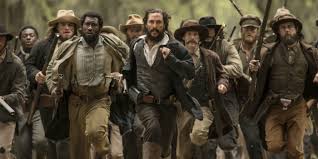
Newton Knight leading his strange new trust system.

The world is drowning in an ocean of mistrust—as usual. As we watched Free State of Jones the other day it was even more obvious that the disturbing storms that are stirring up the globe right now are not that unusual. Reflecting on Brexit, a British journalist says,

“When leaders choose the facts that suit them, ignore the facts that don’t and, in the absence of suitable facts, simply make things up, people don’t stop believing in facts—they stop believing in leaders. They do so not because they are over-emotional, under-educated, bigoted or hard-headed, but because trust has been eroded to such a point that the message has been so tainted by the messenger as to render it worthless.” — Gary Younge

Are we filled with that mistrust, too? In the 2016 Map we affirmed in Council on June 25, we included a proverb that says, “We are called to develop a trust system.” But do we mean that? Do we really think that is even possible? Do all of us even embrace the Map? Are we so mistrusting that we didn’t even participate or consider being part of the Council? Those seem to be relevant questions in a day like today, when the airwaves are filled with fear.

There was enough mistrust at the Council meeting to make some people start talking about trust. Some people did not think the meaning of the words were clear enough to be trusted or to show to others. We had to convince them that nothing we do is designed like law; it is designed to be personally delivered. But can the persons delivering it be trusted? It seems like there should be easy answers for those questions, but trust is not that easy. Nevertheless, we are still going for the atmosphere John teaches us to pursue: “We know and rely on the love God has for us. God is love. Whoever lives in love lives in God, and God in them.” — 1 John 4:16

Can we make a trust system? Even though we communicate a lot about our process and invite everyone into it, some people do not read the mail. Even though we work hard to listen, some people don’t care to speak. They are among us, but they can’t be with us; their trust is broken. Without trust we survive instead of create; we withdraw instead of include; we suspect instead of hope; we avoid instead of transform. We unlearn love. We demonstrate how we do not rely on God.

Our newest pastors have already experienced a few pinpricks of mistrust. Most people make their leaders prove they are trustworthy. We say the opposite, that it is our love that makes a leader. Our support can make a weak-kneed leader learn to walk confidently in the shoes of responsibility. Yet someone can still hold themselves off to the side and question the process. When I sent a report about the Council to the covenant members I “brazenly” included a list of the Leadership Team with all its new members. They might not like to have their names out there in an age of mistrust. Leaders are thought of as likely liars. But we have to build a trust system.

Building a trust system begins with trusting the Lord, of course. When we trust the Lord we have the confidence to trust others. They have to prove their untrustworthiness rather than the other way around. Our confidence embraces others and gives them a place to recover from the constant trauma of living in the world without God and his people.

But blessed is the one who trusts in the Lord,
whose confidence is in him.
They will be like a tree planted by the water
that sends out its roots by the stream.
It does not fear when heat comes;
its leaves are always green.
It has no worries in a year of drought
and never fails to bear fruit. — Jeremiah 17:7-8

Whenever the domination system lies (which is nothing new) we have somewhere to go.

When I am afraid, I put my trust in you.
In God, whose word I praise—
in God I trust and am not afraid.
What can mere mortals do to me? — Psalm 56:4

When my lack of trust is growing, I always end up back in 1 John, where John is struggling with churches threatened by liars and full of people who are not too adept at discerning among all the spirits wandering the world. Our trust system heeds his call: “We know and rely on the love God has for us. God is love. Whoever lives in love lives in God, and God in them” — 1 John 4:16.  A trust system is built from the ground up, not the top down. Jesus followers who live in love build it. The leaders can deter them, but not defeat them because God lives in them.

Build community in hard times — it is more than surviving.

I do a lot of talking so I went on retreat—not just to stop listening to myself all day, but to listen to God. Why talk if you’re not talking to God—and listening?

In the course of my retreat, I heard a lot from a book by Esther de Waal. It is a good one I picked up after one of our friends helped us explore it not long ago in Circle of Hope Daily Prayer :: WATER: Seeking God: The Way of St. Benedict. Benedict of Nursia is one of those spiritual ancestors we love. He is one of the most influential Christians you may have never heard of.

I am telling you about him today because we are had an About Making a Covenant meeting and twenty people considered entering our community in a more intentional way. Benedict caused a revolution by considering the same thing in the 600’s. Before Benedict wrote his new rule for the communities of monks he was founding, most radical Christianity was solitary; spiritual athletes were the people who entered it. Benedict was one of those atheletes, but he attracted a bunch of people who were not. He realized that following Jesus is mostly for ordinary people. What’s more, a group of individuals sitting at the feet of a “sage” is not very Biblical. His breakthrough was to emphasize the love among the members of the community as elemental to authentic spiritual life; multiplications of those communities are still shining the light of faith today.

His rule says: “The monks are to bear with patience the weaknesses of others, whether of body or behavior. Let them strive with each other in obedience to each other. Let them not follow their own good, but the good of others. Let them be charitable towards their brothers with pure affection.” (72.5-8).

His communities were all men, but women applied this rule in their houses, as well (thus, his language).

DeWaal says that within a hundred years of Benedict’s death, his rule had provided a collection of communities that wrapped Europe in a cloak of faith. “Whereas in the very earliest days monks had gone out into the desert leaving behind them a comparatively sophisticated life, now that pattern was reversed. In a world in which barbarian invasion, political uncertainty, and the power of the sword seemed the most immediate realities, [sound familiar?] and in a simple agrarian world where parishes were served by priests of humble peasant birth, [sound like many of our neighborhoods?] the monasteries came to stand out as centres of light and learning” (p. 20).

Who is that person sitting in the cell’s “second row?”

Radicals in covenant are important lights in deteriorating circumstances. They not only take care of one another, they provide opportunities for people to know God, learn love, and create sustainable community. Our cells are like Benedict’s little communities wrapping our region in a cloak of faith. We focus on God in prayer and worship, we study to deepen our faith and life, we work for one another and serve those we can touch. The Benedictines were known as change agents by Cruce, libro et atro—cross, book and plough. We have our surprisingly useful version of that.

It was and is all done in love by normal people. When some of those normal people make a covenant to be Circle of Hope at the end of the month they will deepen our capacity to make a difference in this upended world. I think they will reflect a story Pope Gregory I told in his biography of Benedict.

“A certain hermit named Martin had chained himself to the side of his solitary cave near Monte Cassino. When he heard of it St. Benedict sent him a message: ‘If you are indeed a servant of God, do not chain yourself with chains of iron. But rather, let Christ be the chain that binds you.’”

Like Benedict, we point to Christ. It is as simple as that: in the cell where Jesus is the agenda and in our covenant to live as the Body of Christ. That is where the transformation starts and where it continues to astound me.


The twentysomething church

Twenty years old! It does not seem possible, especially if you just showed up in Circle of Hope last week! What are we to you, you person who just showed up?

  • Are we like a well-aged wine you just opened?
  • A great old song that was just updated for your genre?
  • A miracle you experienced when you thought they didn’t happen anymore?
  • A new friend who feels like you’ve known them your whole life?

People say such things.

To me, we are like Nathanael. I see us like the guy Jesus saw under the fig tree in Bethsaida. I think he was a guy, about as old as our church, maybe, a twentysomething who was wondering what was going on with the world, the oppressive government, his out-of-touch parents, his no-future job, the weird guy from the desert, John the Baptist, and his own soul, which he was thinking about taking seriously. We are a twentysomething church and often act like all the twentysomethings we know: susceptible, nervous, energetic, risky, learning like crazy, sometimes a little out of control, unfinished, just getting started. I could go on.

Nathanael under the fig tree by my man, James Tissot.

But the way we are like Nat (name too long to type) is how we really like how Jesus SEES us. We love it when anyone sees us for who we really are, as ourselves, not someone’s kid or some school’s pupil. Nat’s friend Philip told him he’d found the Messiah and he should “Come and see.” When he got to Jesus, the Lord told him “I saw you under the fig tree before Philip called you.” Nat worshiped him. He was seen; he was known. This is a big deal for people who are bits of data to their leaders and fodder for the big institutions that run them.

Jesus responds to his worship with, “You haven’t seen anything yet!” (essentially). “If you liked the miracle of how I knew you, loved you, looked for you before you knew me, then you will really like the miracle of me revealed in all my glory, when the whole world discovers that God knows their every suffering, loves them with a self-giving love, and is looking for them to claim their rights as the children of God in the restored kingdom I’m giving to you!”

To me, we are like THAT Nat to whom Jesus is unfolding the secrets of eternity. We like how Jesus found us. And we are just getting started on what the Lord is going to reveal next. We haven’t exactly been hanging out under a fig tree for twenty years, but it is like we have been building toward this moment our whole lives.

Thinking back about the Grill and Chill last week I worship Jesus for how he found us and built us together into a splendid piece of alternativity. Jesus keeps finding people and they keep finding themselves in him.

But Jesus told me again after the party, “You haven’t seen anything yet!” In this wild era, this growing megalopolis, this diversifying city Circle of Hope has an important role to play that is worth our effort, our love and our resources. The Map we affirmed is kind of a taste of new wine, the first bars of a new song being written, the next example of the miracle that began us – and it didn’t even try to express all we have become! I’m with Nat, “You ARE the Son of God” Jesus!

Darkness cannot hide your face from us

(Above) Francisco de Goya — Disasters of War, Sad Foreboding of What Is to Come (1810)

The Comfort Retreat was full of revelations. One came into focus after I had been interrupted by two of my passionate, troubled friends who found me while I was otherwise occupied. Normally I would have been disappointed. A retreat should be a space free from other occupations. But as it turns out, the interruptions became a vital part of what the Lord was growing in me. Here’s my lesson (you probably already realized it): There is a big difference between anxiety interrupting my retreat and a retreat interrupting my anxiety. I need to live in Christ where people can meet me; I don’t need to take short trips from where I live to meet Jesus for a little while.

It was an unusual group that can gather on a June Saturday.  Many were anxious, some were grieving, I think all of us had questions. But looking to Jesus together quickly builds trust and vulnerability. Our dialogue at the end of our time was full of profound thoughts, deep feelings and satisfying empathy. We were not really there just to learn something (which we did). We were there to be someone: comforted, resting, loved, healed. We were the available cohort who could admit their distress or grief and dare to let the retreat open a channel for God’s grace. I think such disciplines have a nice ripple effect in the church as a whole.

You’ll probably see a variation on this retreat again. The small team that formed: Ellen Szczesniak, Angie Petersen, Branden Bauer and  I decided we liked working together. Plus, we realized that we and our friends need a spacious place to keep healing.

Our time was knit together with some of the songs Angie has written over the years. I’ll leave you with one set of lyrics that is staying with me. I hum it as I ride my bike through Philly chaos, anger and carelessness.

psalm 139, leaves, sun, healingDarkness cannot hide your face from us.
Darkness cannot hide your grace from us.
Darkness cannot hide your light from us

Because you shine, (you shine) over us.

Thank you for your love and peace for us.
Thank you for your care and love for us.
Thank you for the hope so bright for us

Because you shine (you shine) over us.

I live in that light. Should darkness visit me, I hope to invite it in to the light so Jesus can shine over it, too. Simple right? Let’s try it.