All posts by Rod White

Show up for your kids: Let go of your “helicopter God”

In a recent article for the NY Times Parenting section, Daniel Siegel, along with Tina Payne Bryson,  uncannily explored the gospel again. I’ve read Siegel’s books, seen him speak, and have often been surprised by how I resonate with his spiritual wavelength.

This time he is taking some loving swipes at how parents, especially people of means, are raising their children. The picture I lifted from the article shows the problem clearly, I think. He asks us to:

Take a moment and fast forward in your mind to a day in the future when your child, now an adult, looks back and talks about whether she felt truly seen and embraced by you. Maybe she’s talking to a spouse, a friend or a therapist — someone with whom she can be totally, brutally honest. Perhaps she’s saying, “My mom, she wasn’t perfect, but I always knew she loved me just as I was.” Or, “My dad really got me, and he was always in my corner, even when I did something wrong.” Would your child say something like that? Or would she end up talking about how her parents always wanted her to be something she wasn’t, or didn’t take the time to really understand her, or wanted her to act in ways that weren’t authentic in order to play a particular role in the family or come across a certain way?

Francesco Ciccolella, NY Times

The power of showing up

Of course, Siegel is going to say something brilliant that makes you wonder how you could have ever parented without him. For the most part, he thinks he can explain everything and make it all work reasonably well, even in territories as complex as the brain and your family system. But in this case, I think he is asking the right question,

Do our kids feel seen by us? Do they feel truly seen for who they are — not for who we’d like them to be, and not filtered through our own fears or desires?

I think the answer is probably, generally, “No.” And I doubt that when Siegel was thirty-two, and trucking kids to little league games and such, he was asking the right questions, either. Now that he is sixty-two, he has better questions than “How in the world are we going to get through this week?” Or “How are my children going to survive their next twenty years?”

He is trying to help us all with his new book, The Power of Showing Up. The main point is something you may already know:

Showing up means bringing your whole being — your attention and awareness — into this moment with your child. When we show up, we are mentally and emotionally present for our child right now….The idea is to approach parenting being present and aware in your interactions with your child — and to make repairs when that doesn’t happen.

As usual, I think he has a great idea. But, as usual, I think it would be even better if he had Jesus to make it happen.

Where does one get the power to show up?

The power of showing up is great if you have the power to show up. Doesn’t it seem a bit grandiose to suggest in a parenting section article that people should simply change their mind and show up? — they should bring their whole being — their attention and awareness — into this moment? Buddhists have suggested that philosophy for centuries and some great people have practiced it well. But most of us are having trouble with our “whole being,” not to mention “attention” and “awareness.”

His advice has a lot of merit, in my opinion. But he does not give a lot of help with where to find the power to follow his advice unless you happen to have it already. Helicopter parents may communicate a lot of their anxiety to their child because they feel powerless, not because they intend to exercise a lot of power. I think the reason most people hyper-parent is their fear of doing a bad job. Many people in the United States are driven by the fear of missing out or failing and they don’t want their kids to miss out or fail. They are hyper-responsible, since they believe whatever life is, it is up to them to get it and live it. Their world is a competition for scarce resources and everyone needs to be their best self to get what they need or want. Siegel has deeper things to say than that, but I think even he would say that is a realistic assessment of what drives people.

Those fears drive Christians too. A hyper-responsible worldview may drive you when you are parenting, even if you don’t admit it. You may want to believe that trusting God is a live option for your child, but, in fact, and in the schedule, life is all about preparing them to succeed in the world as it is, according to the stranglehold the “economy” has on most of us.

Our view of God matters when we parent

To be honest, most Christians have a “helicopter” God who is the main example for their helicopter parenting. For many, God is the hyper-parent who does not see them for who they are, but sees them for who they ought to be (and who they have never been). As a result, Siegel’s book will just add more pressure to “show up” properly. You may already know about this demand to “show up” and have not fulfilled it yet, either, just like all the other things you have not accomplished.

The power to show up will be a result of trusting God the Parent who showed up in Jesus and continues to show up Spirit to spirit. I’m not sure how much Siegel’s reparative idea will help unless parents are Parented by the God revealed in Jesus. We love because God first loved us, not just because we had a good idea and implemented it well.

Our view of God, our Parent: Father/Son/Holy Spirit in a loving family system, Jesus as our pioneering older brother, makes all the difference in the world when it comes to showing up. We show up for our children and have the spiritual and emotional depth they need because we experience God showing up for us in Jesus. If we show up as weak examples of God showing up, we still know that God will, personally, show up — and that is a lot better than whatever I might provide.

Image result for ron reagan atheist

Last week many of my friends were talking about Ron Reagan. The old atheist advertisements from the Freedom from Religion Foundation were rerunning during the Democratic Party debate. He notably signed off in them by saying he is not afraid of burning in hell.

His view of God is faulty. He got the message that God is the ultimate helicopter parent scrutinizing people and weighing how well they have matched up to the ideal set before them – an ideal of which they are well aware yet to which they are still not conforming. The people I talked to knew what he was talking about, since many of them have that God, or know people who do. I think Siegel has a similar “god” when he is giving his good advice.

It is hard to make sure your children feel safe, seen, soothed and secure, as Siegel advises, unless you feel safe, seen, soothed and secure. I, personally, see no hope for myself feeling or offering those vital experiences to anyone unless I have a constant relationship with God who saves me, sees me, soothes me, and makes me feel secure in a world which constantly demands more of me than I have. So that is where I am starting again today, giving over to trusting my trustworthy Savior, rather than mostly trying to get good enough so I can trust myself. Then I can hope to show up.

We’re an alternative to slaveholder religion

Image result for meghan and harry

Those attractive, young British Royals who had that great wedding, Harry and Meghan, are figuring out a way to do their duty but get their child out of racist England. Many people are appalled at their “cheek,” and ashamed of them for not “keeping a stiff upper lip” in the face of daily assaults on their “mixed” marriage. Systemic racism is a poison with a long half-life.

The English invented the slave trade, it is said, but it was left to their descendants, the Americans, to perfect its form. The “Founding Fathers” wrote it into their precious Constitution and the country’s original sin still permeates everything that goes on, no matter how often it is revealed and rebuked. The Founders may have had their problems with slavery, but their compromises sealed the sin into the future.

Slaveholder religion

Jonathan Wilson-Hartgrove (@wilsonhartgrove) tweeted on Jan 4: Trump didn’t preach Jesus at #EvangelicalsForTrump; he preached #SlaveholderReligion.

  1. God has given me power.
  2. Those who challenge my abuse of power are against God.
  3. When I have power, everyone benefits—& those who say they don’t are ungrateful.

I have not been able to get that well-phrased summary out of my mind. It is like a new memory verse for me. Only the Bible is the slaveholder’s Bible, which has as its goal protecting an economy that is based on slavery. “Slavery for the good of all” could be its motto.

Wilson-Hartgrove has been touring and teaching from his book, Reconstructing the Gospel: Finding Freedom from Slaveholder Religion. He was in Dallas at a Red Letter Revival doing a good job of challenging the racism at the heart of evangelicalism [report]. He says throughout American history, two versions of Christianity have competed for the loyalty of believers—slaveholder religion and the freedom church. He began to realize that dualism when he was appointed a Senate page by Strom Thurmond and discovered the Senator’s ardent opposition to all Civil Rights Acts.  At a key point in his life, Wilson-Hartgrove then encountered William Barber II, pastor of Greenleaf Christian Church in Goldsboro, N.C. “He began to teach me about a black-led, faith-rooted freedom struggle.”

He learned how slaveholders and their allies used the Bible to support their arguments in favor of slavery and of an economic system dependent upon slave labor. Some evangelicals might still use the Bible to justify the kind of capitalism people take as elemental to faith in the U.S. But most people don’t think it needs justifying, it just is. And they are thankful when the 1% exercise their power to create jobs.

Wilson-Hartgrove also learned about “the freedom church that was born on the edge of the plantations.” Meeting in brush arbors for worship, African-American slaves identified with biblical stories about how God delivered his people from slavery in Egypt and liberated them from exile in Babylon. “There has always been a struggle between slaveholder religion and the freedom church,” he said.

The freedom church was not invented in the United States, of course. It is a struggle repeated in every generation of the church. As we have often taught in Circle of Hope, after the Roman Emperor Constantine co-opted the church, the “freedom church” people had to constantly confront the domination system his successors and imitators determined to institute:

  1. God has given me power.
  2. Those who challenge my abuse of power are against God.
  3. When I have power, everyone benefits—& those who say they don’t are ungrateful.

Kissing the Pope’s ring or bowing before the God-anointed sovereign with absolute power were among the things they resisted. My heroes, Francis of Assisi and the Anabaptists heard the gospel just like the American slaves did. Many others took great risks to be their true selves in Christ.

Racism (and all the other oppressions that intersect with it) is a spiritual problem that requires “soul work” to solve, Wilson-Hartgrove said. “Deep healing is needed. To be segregated from our neighbors by racial divisions and economic inequities makes it harder to know God. But as we listen to one another, we draw closer to one another and closer to God.”

Free Bird by Christi B

Staying a freedom church

In a few days, Circle of Hope Daily Prayer :: WIND will begin our annual time to pray in light of one of our distinctives as a church: Fomenting diversity and reconciliation is at the prophetic heart of our gospel. In a profoundly angry and divided region we are attempting to be the next generation of the church who holds out the light as a freedom church.

“For freedom Christ has set us free. Stand firm, therefore, and do not submit again to a yoke of slavery” (Galatians 5:1).

When Paul wrote that he certainly had physical bondage in mind, as his letter to Philemon demonstrates. In that brief letter he tells a slaveholder it is incumbent on him to receive his slave as “no longer a slave” in Christ, which would certainly imply owning him no longer, since they had a common master. Likewise, we must all be, regardless of identity, vigilant on behalf of those who are most vulnerable to the evil instincts of the oppressors in the United States, who are backed by the world’s largest arsenal, the largest economy and a government devoted to the preservation of themselves as the heads of it all.

But, Like Wilson-Hartgrove would agree, Paul mostly had the spiritual problem in mind when he wrote the Galatians from prison under arrest by the great Empire of his time.  He knew that people are used to the slavery of sin and death and need a daily reminder to throw it off and not take it on again. Jesus the Christ has set us free. No matter if society imprisons us, it can’t take away that freedom. If it abuses us or even kills us we stand firm in the freedom of eternity. [I can’t get enough of this topic].

Paul’s teaching is bold because he also knows we are afraid. I am afraid to write this piece, since people who are desperate for freedom will critique my convictions, in some small or big way, and criticize my lack of appropriate action, or just use the power of the pen to condemn me for being who I am in the eyes of the evil world. I also fear the slaveholders who block my way to freedom every day with their controlling laws, oppressive capitalism for the rich, and immoral politics and policies. Among those slaveholders are the evangelical leaders who consign their flocks to follow Trump for political and economic power, both full of spurious promises, who have divided up the church and made people ashamed to be or become Christians.

Nevertheless, once again, at the beginning of the year, I am moved to hold on to my freedom and resist the yoke. This blog post is a small expression of my resistance. Community in Christ is possible. Forgiveness and reconciliation are possible. Faith, hope and love are not dead. Our little outpost is just part of the outpouring of the Spirit pushing against the barricades of the evil powers. We are not the only alternative to those forces, but we are certainly an amazing one. If we die trying to be that alternative, that will be a good death.

Have an Epiphany: God enters your weakness in Jesus

An armor-plated fig-leaf is still a fig leaf. And most of us just wish our fig leaves were armor plated, so we continue to hide behind tough-talking people who make vain promises of saving us from our weakness.

If you don’t get what “fig leaf” means, it refers to the story of Adam and Eve in Genesis 3 after they have eaten the forbidden fruit and feel ashamed of their broken relationship with God. They begin to vainly hide their naked shame by making clothes out of fig leaves.

Americans hide in a garden of power

Image result for adam fig leafIf you are a Jesus-follower who lives in the United States, you need to admit some things about your fig leaves. I think one of the main things we need to admit, just to get to square one of faith, is we think America is square one of the world. That sense of reality comes with some godless assumptions about power.
For instance, your reaction to Trump’s assassination of General Soleimani probably begins with power: 1) You’re glad God took out the evil general through his agents so lives would be saved and your children would be safe from Iranians. 2) You’re furious and are trying to find the lever that ejects Trump so lives will be saved and your children will be safe. Getting and exercising power is the go-to solution for Americans. We’re always declaring our independence in one way or another. We accept the violence that protects us. We crave power to protect our chosen lifestyle. The power to choose is super important to us.

I think democratic government is better than variations on totalitarianism. But I have no illusion that democracy equals godliness. And I know arguing about that all day is sewing fig leaves. The arguing is the illusion that someone knows like God knows. The arguing  reveals the assumption it is really important to get things right, since we run the world. Twitter and other social media is a daily example of this preoccupation.

As far as I can tell, the general Christian dream in America is power: miracle, organizing, argument, all loving and truthing done expertly and effectively. So we despise our weakness: no miracles, divided, voiceless. We look at our leaders and ourselves with unabashed criticism or resolute lack of criticism. We despise ourselves or we despise useless despising.

I think we should admit we are armor-plating our fig leaves. We live in an environment in which a deranged president has enablers who defend his right to order an assassination with a drone. We may argue or refuse to argue. But ultimately we generally swallow the reality and conform to it, fashioning our own defense system and thinking it makes similar sense to the giant defense system in which we live.

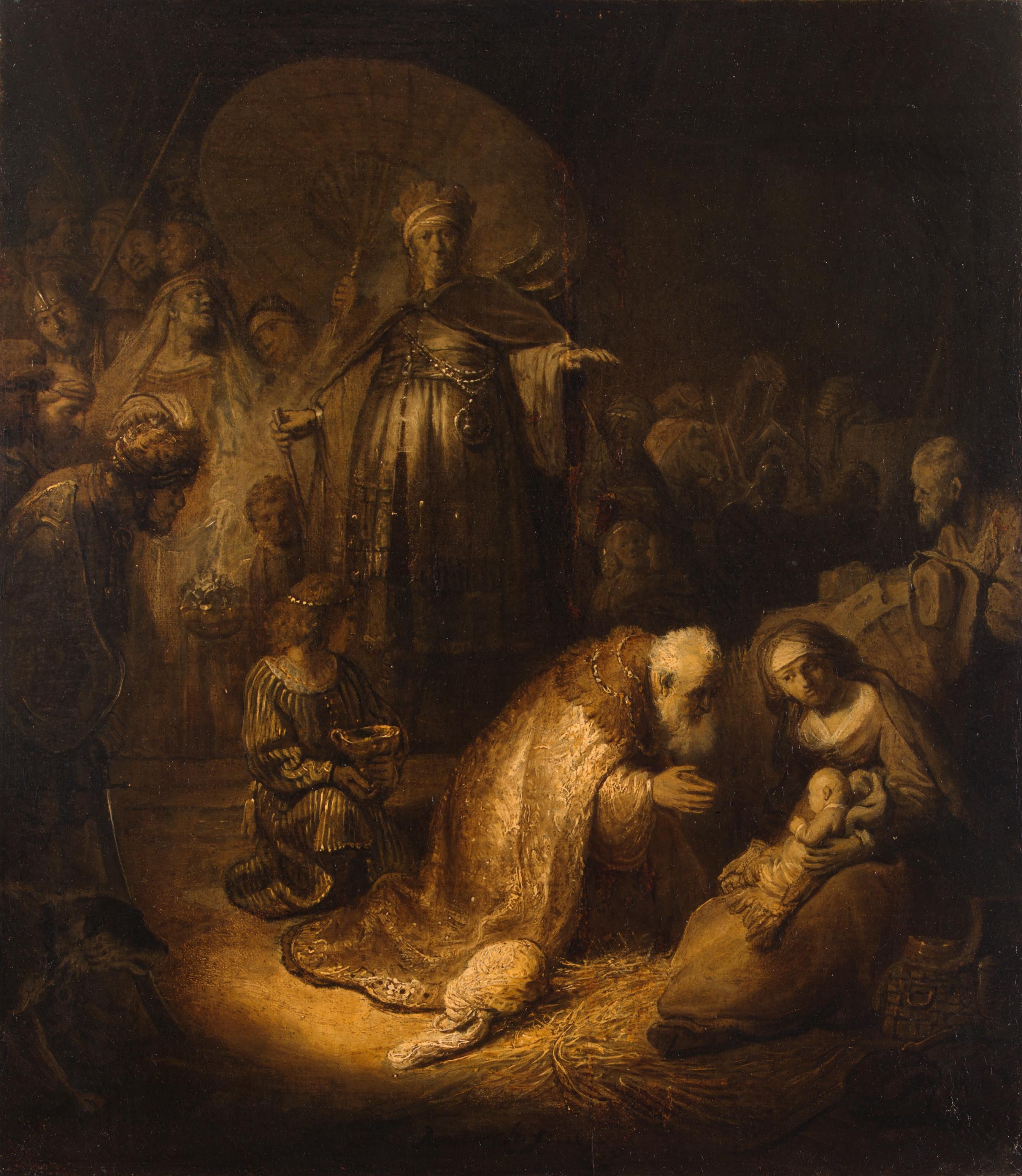
magi bowing in weakness
My pastor used this Rembrandt painting last night to help us see the powerful bending low to connect with truth and love.

Epiphany invites us back into weakness

Epiphany gives us a chance to get naked with God again. If you read the Genesis passage, it says, “They heard the sound of the Lord God walking in the garden at the time of the evening breeze.” If you are listening today, you can hear God in the garden again by looking through the Jesus lens. See God born in Jesus and see Jesus launched into His mission of redemption as he is revealed in his baptism. [More explanation of Epiphany, here].

In reaction to the most recent atrocity in Iraq we are tempted to swallow and emulate, people are coming out of the woodwork to try to say something else. For instance, one of Shane’s buddies, also a grad of Eastern, says on Twitter: “Having seen through Herod’s scheme to cling to power through lies, violence & false piety, the magi went home by another way. Like them we pray in this season for a better way home to wholeness, to justice, to peace.”Jonathan Wilson-Hartgrove

There is a better way home. God keeps trying to show us. We need to keep looking.

Here is the un-American way the teachers in the Bible keep trying to get on our screens with this better way: Our weakness is our strength. Epiphany is the celebration of this reality. The “manifestation” or “epiphany’ of God with us is a baby in the stable behind the inn on a side street in a village. The manifestation of God is the Messiah coming up from his baptism in a muddy, desert river in a territory on the outskirts of the Empire. The body of Christ being manifested in the world is our  struggling, underfunded congregations with their fragile idealism and sometimes inept leaders; it is the compilation of all our cells which have meetings their members struggle to attend; it is this  pathetic blog and many other wonderful things people have little time to read.

I think all that is wonderful. The epiphany of God is a wonder, again and again.

Jesus is baptized in the Jordan River by John by David Zelenka (2005)

We have another way home

The apostle Paul tried to teach the power-hungry Corinthians what he had learned about the wonder of God being a human and being manifest in Jesus-followers:

“[God] said to me, ‘My grace is sufficient for you, for power is made perfect in weakness.’ So, I will boast all the more gladly of my weaknesses, so that the power of Christ may dwell in me. Therefore I am content with weaknesses, insults, hardships, persecutions, and calamities for the sake of Christ; for whenever I am weak, then I am strong” (2 Corinthians 12:9-10).

Pretending we are not weak or pretentiously defending ourselves as if we can save ourselves or others from being weak is a human problem, and it is certainly an American one. Many American Christians have even fashioned a Christianity devoted to power in the image of the Declaration of Independence!

But, as Paul Tournier says in The Strong and the Weak,

“All people are, in fact, weak. All are weak because all are afraid. They are afraid of being trampled underfoot. They are all afraid of their inner weakness being discovered. They all have secret faults; they all have a bad conscience on account of certain acts which they would like to keep covered up. They are all afraid of other people and of God, of themselves, of life and of death.”

Into that weakness God came in Jesus. Not only was God born as a baby, Jesus entered into our sin and death, the main fears that keep us frantically reaching for the forbidden fruit and endlessly inventing ways to keep ourselves defended.

Epiphany celebrates the other way home Jesus has provided. It reminds us that the weak attempts at faith we criticize are actually wonders. I hope this holiday encourages you to look at your weakness (and ours) and see it as the canvas on which God is painting truth and love that is way beyond what our naked eye might see. I hope Epiphany allows you some space to admit that, contrary to most of what America teaches you, you are just like the rest of us: afraid and so weak, and so in need of the Savior who makes us strong like God is strong, not weak like assassins are strong in their armor-plated fig leaves.

Division is not new, reconciling always is: Turmoil can be good for the church

In October, Megan McArdle wrote in the Washington Post, “I used to think there were certain rules about U.S. politics. There were things you had to do, like be nice to veterans. And things you could not do, like stand by a Supreme Court nominee accused of sexual assault, invite foreign leaders to investigate the families of your political opponents or campaign for president as a socialist.

If those rules ever held, the past five years have gutted them. President Trump hammers daily on institutional norms, to cheers from his supporters; Democrats, meanwhile, are considering their own round of norm violations as soon as they get back in power.

Something major has obviously changed. It’s tempting to ask, ‘What has happened to America?’ but even that question doesn’t capture the scale of what’s going on. Waves of radicalism have swamped stable political orders all over the Western world. “

Merry Christmas, everyone.

Permafrost melting effects. Click pic for facts.

People divide and cause division

I often tell the story of sitting out on the front lawn of our bargain house in Riverside, CA (fondly called the “Flintstone house” due to its creative stucco job) and asking the same question: “How could the country elect Ronald Reagan? It must be the beginning of the end.” We were probably right about the end, at least the end of something, if only the fracturing of the Evangelicals and Catholics.

When I was complaining about Trump to my 73-year-old, genealogy-loving brother the other day, he quickly reminded me, “Trump is not new.” If you read history you can easily find hundreds of examples of numbskulls elevated into power who make quick work of what wiser leaders took decades to build. It is a lot easier to tear something apart than to build it. The work of Charlemagne’s grandsons might be a good example.

As many have said, Trump is given too much credit for stirring up trouble when he may just be riding the divisions caused by other factors. McArdle summarized four movements Reagan never dreamed of that might be more responsible than the old men in power for the radical rivalries splitting governments these days – not to mention friendships, families and churches!

  • There is a growing division between the mobile class that floats from successful city to successful city and the people left behind in declining rust belts and rural areas. These floaters are the cosmopolitans and the others are the rooted, or as David Goodhart put it in his 2017 book “The Road to Somewhere,” the “somewheres” and the “anywheres.” I have met these “anywheres” all over the world and many have passed through Circle of Hope. I have written a bit about how they hide their money.
  • George Shultz, the economist and secretary of state under Ronald Reagan, argues that the ever-increasing centralization of the federal government exacerbates division. It pushes power away from localities to remote authorities that are less accountable to individual voters, and less trusted. Schultz told McArdle, “Accountability is one basic principal of good government…The other basic principal is trust. You have to have a government you trust.” Federalizing everything also turns every political question into a life-or-death battle between two sides that are increasingly distant from each other, not just geographically, but culturally and economically. Lack of trust is the one “trickle-down” theory that seems to work. All authorities are subject to incredible suspicion, even one’s cell leader. So we keep talking about building a trust system.
  • Eric Kaufmann’s “Whiteshift” (2019) parses a great deal of data and comes up with a compelling story of division all over the world. As immigration rates rise and so-called “white” majorities feel their culture and demographic dominance at risk, they flock to candidates and platforms promising to control the flood. This is also true in China (Uighers), India (Muslims) and South Africa (Zimbabweans). I called the 2016 election a “whitelash” along with many others.
  • Former CIA analyst Martin Gurri argues in “The Revolt of the Public and the Crisis of Authority” (2018) that the 21st-century information explosion has fatally weakened the old hierarchies that maintained social, economic and political order. The Internet has eroded the monopolies over information and expertise — or the communications systems transmitting them — that shaped and reinforced those hierarchies. Now networked insurgents are making inroads everywhere. People were already skeptical about any notion of truth before the Internet weaponized that skepticism. Now people have to wonder if their mom is spreading fake news the Russians contributed to her pastor’s news stream.

All these theories are probably right. We are in a perfect storm of factors that tend toward backlash, illiberalism, and disruption. Maybe the powers will find a way through and maybe the revolutionaries will keep us distracted until the melting permafrost drowns us all. It is hard to predict what will happen but it is not hard to feel anxious about the uncertainty.

Image result for star of wonder

Jesus keeps bringing things together

As my brother might say, the newer things get the older they seem. Jesus was born the first time into an era of amazing innovation and astounding evil. What’s new? He is being born into the same situation now. Paul’s general criticism of humanity is as accurate now as when he first wrote it, “They exchanged the truth about God for a lie” (Romans 1:25). Last week, Christianity Today surprisingly called on the Evangelicals to admit the president has done the same thing: “His Twitter feed alone—with its habitual string of mischaracterizations, lies, and slanders—is a near perfect example of a human being who is morally lost and confused.”

Right now, in the middle of that, Jesus is raising up twenty and thirtysomethings, just like he raised up me and my friends. In many ways, they will change the world again. If they don’t reroute every Reagan and Trump, defeat every tyrant on the planet and reconcile every division, that won’t be surprising. But they will keep the truth about Jesus alive. And they will keep building a community in Christ where reconciliation is real.

So even though 2020 might be a political mess, I think it could be a glorious time for the church, especially Circle of Hope. We often feel tired and ineffectual, even while we are unusually strong and effective, but we still manage to look up and see the star moving over where Jesus is born. And we still manage to remember that God’s blessing is about peace on earth and grace to all. Our pastors and leadership team are helping us build a counterculture where we can live in reconciliation and from which we can demonstrate an alternative to whatever our truth-challenged society comes up with.

It is going to be a wonder-filled year.

Create an environment: “Caught not taught” is inevitable

Tested in their environment
Blunt and Corden in Into the Woods

OK, I admit it, I have Barbra Streisand on my ITunes playlist. Her The Way We Were album caught me and my college roommate when we were falling in love with our wives and she’s been around ever since.

One of my favorites is her rendition of “Children will Listen” from Into the Woods.

Careful the things you say
Children will listen
Careful the things you do
Children will see
And learn

Children catch wonderful things from being around their parents. They have an uncanny ability to strain out the best in us. But sometimes they miss what you wish they’d catch while they are acquiring all your bad traits. Sometimes they catch psychological diseases you caught from your parents. Yet, quite often, there is enough love and trust in the family for them to become someone much finer than who could have been predicted, given their environment.

Image result for children learn what they live poem

The environment matters

You may have seen the poster above  titled “Children Learn What They Live.” I admit I chose that particular rendition out of hundreds in the image search, for one main reason. I like the fish trying to get some attention. What’s more, there are chicks swimming around, which intrigued me, since their feathers get saturated and they drown quite easily, and if they survive their swim, they are likely to catch hypothermia.

Converse with fish, if you must, but do not throw your chicks in the water.

Careful the posters you put on you walls
Children will inspect them

Or at least their grandfather might.

The beginning reads If children live with criticism, they learn to condemn. If they live with hostility, they learn to fight. We know that is true, at some level. If we did not learn it at home, we were certainly taught it in school or at work. It would not be surprising if your well-schooled inner critic were at work right now. Whatever psychological machinery monitors your hostility is probably at work in the background, too. Maybe you scorned Barbra and hated the poster — you can tell I have gone through a bit if I imagined that!

You could sum up the rest of the poem with: If children live with kindness and consideration, they learn respect. If they live with friendliness, they learn the world is a nice place in which to live. Most of us also know this is true at some level, even if the feeling seems like it is a fish trying to get some attention, meaning kindness seems a bit imaginary, but somehow very important.  If we were making a poster, we’d want to include it. Our love relationships in the family and otherwise tap into our spiritual memory of creation as being a nice place to live.  Hopefully, such love softens our hearts so we can be saved from the world as it is, which might get even less kind in 2020.

As soon as the children leave our loving embrace, they will walk outside, or watch The Avengers, or listen to the President, or learn that they are just a data point on the spreadsheet of corporate stockholders. People are not picking up kindness and respect from the environment right now. To the contrary, people keep telling me they are running into the inner Trump-demon in people.

We create an alternative

The children of God also catch things from their environment. They live in a spiritual ecosystem called the church. Even though the church teaches all the time, I think most people are moving with what they catch. Like it or not, faith is more caught than taught. We wish everyone were listening to their pastors and other teachers (I’m writing a blog post, for Christ’s sake!), and that happens. But if any true reshaping is going on it is going to look a lot like the social system in which people are swimming.

Since we know faith is caught as much as taught, if not moreso, our church has always described how we develop Jesus followers like this: We create an environment where people can connect with God and act for redemption.

We are an alternative environment to the one where Donald Trump can move everyone with a Tweet barrage and where fear dominates most of the hours people aren’t sleeping. It is a lofty goal to think we can create an environment that images God like we do, but it is absolutely crucial to keep trying. God’s children also learn from from living with their spiritual parents and siblings in Christ. Who we are and what we do probably has more influence than what we say.

The Bible includes dialogue about “caught, not taught” in many places. In the following examples from the Old and New Testaments you can see parents wrestling with children who forsake their history and families, and see parents who are doing a terrible job at creating an environment of love.

  • Hear, my son, your father’s instruction and forsake not your mother’s  teaching  (Prov. 1:8).
  • Fathers, do not provoke your children to anger, but bring them up in the discipline and instruction of the Lord (Eph. 6:4).

Mother’s teaching should be about the mystery of God’s wisdom. The main instruction of the Lord is to “love one another as I have loved you.”

As the church, we are often the first place someone is invited into a love that holds them and a wisdom that launches them. Our environment is a place of living water into which people can dive or just get their toes wet as they navigate their spiritual journey. Just being dipped in it changes one’s view of destiny.

How do we respond to our deteriorating social system?

We need to create an alternative environment. Americans often begin and end with fighting over their democracy as if it will save them and the world. That delusion might be the main problem for Christians growing up in the U.S. Empire. We think and feel power, or the loss of it, all the time. Everyone needs to learn something else.

Especially during Advent, we should all try on the new clothes of our new lives in Christ:

“Our citizenship is in heaven, and it is from there that we are expecting a Savior, the Lord Jesus Christ” (Philippians 3:20).

We are citizens of the kingdom of God, right now, and the fullness of heaven will be ours before long; that is our hope. We are a circle of that hope, and you are probably part of a Jesus-environment where you are, too.

If we are products of our environment, then shouldn’t we do all we can to make that environment nourishing and not negative? Of course! Don’t give up. People need an alternative. We all learn what we live. And, in word and deed, we teach what we learn. The children we raise and the children of God Jesus has raised will mimic the model they are supplied. At the very least they should have the opportunity to catch some wisdom and love from someone bravely tending a garden (complete with demanding fish and endangered chicks, perhaps) in which to walk with Jesus and from which to bless creation.

8 ways to work with your limitations

Image result for michael phelps 2008"

In 2008 Michael Phelps published No Limits: The Will to Succeed. Here is a quote:

So many people along the way, whatever it is you aspire to do, will tell you it can’t be done. But all it takes is imagination. You dream. you plan, you reach. There will be obstacles. There will be doubters. There will be mistakes. But with hard work, with belief, with confidence and trust in yourself and those around you there are NO LIMITS.

That mentality certainly paid off! He is the most medaled Olympian of all time. Plus, he makes about $9 million a year, even today, at 34 years old.

But there was another side to the great athlete. After each Olympics he experienced a major episode of the general pattern of his life. After the 2004 Olympics he experienced a major depression for the first time, and that year he also got his first DUI. After 2008 he was photographed smoking marijuana.  He said about that much later, “It would be just me self-medicating myself, basically daily, to try to fix whatever it was I was trying to run from.” After he retired the first time after 2012 he considered killing himself. He finally sought treatment. Now, he says he has learned it is, “Ok to not be OK.” He agrees that while mental illness still “has a stigma around it,” things are beginning to improve.  “I think people actually finally understand it is real. People are talking about it and I think this is the only way that it can change.”

Americans are a “no limits” and “freedom” society. We all seem to want to grasp the first quotes from Phelps and ignore the realities of the second set. Many Christians are the worst examples of denying any kind of limitations, because they think it would deny God’s sovereignty and the power of the Holy Spirit to do so. The only limitations many Christians  acknowledge are due to their own poor faith.

I think many people have given up their faith altogether because it just wasn’t working out as perfectly as they were promised. Their loss is especially tragic during Advent when we see God purposely limiting herself to become Jesus to join us in the limitations of being human and then demonstrating the fullness of being resurrected humans.

Working within limitations

While we all dream of having ultimate freedom to be and do anything and everything we want, the hard truth of the matter is that we all face some limitations, large or small. Limitations may be things you’ve dealt with all your life, or they may come upon you suddenly through an accident or change of circumstances. The older one gets, the more real limitations become, as I well know.

Limitations are not the same as a jail sentence. Phelps obviously perfected his swimming within the limits of a regulation-sized pool and mastered various prescribed strokes. Even in art, where complete freedom can be glorious and expansive, sometimes the most innovative ideas come from solving a problem. Having boundaries forces us to use our resources in imaginative ways, and a limitation viewed as a challenge can inspire us to create something completely unexpected.

Limitations can take many different shapes. The most obvious are health or physical disabilities and limited financial means. Others are limited time or energy; lack of skills, knowledge or credentials; and reduced opportunities due to age, gender and/or racial bias or economic background. A change in status due to divorce or job loss can also be a limiting factor.

We also experience “perceived” limitations. Feelings such as fear, self-doubt, feeling you’re not good enough live in our minds, but can stop us just as effectively as physical limitations. No doubt we all had an experience in our childhood where someone told us we were a quitter or bad at math or would never amount to anything that imprinted itself on our psyche and kept us from achieving our potential, at least for awhile.

But limitations can be overcome, or at least stretched, and you can probably find numerous examples of people in your own life who have done so — maybe even yourself. Here are a couple of famous examples:

  • Irish painter Christy Brown, born with cerebral palsy, painted with the only limb over which he had control. His story is told in the film My Left Foot.
  • Oprah Winfrey, a woman of color who grew up with poverty and abuse, is one of the richest and most successful people in the world.
paul's limitations
Paul in prison

Gently push the boundaries

So, what can you do to push back your limitations? Paul told the Philippians, “I can do all things through him who strengthens me” (Philippians 4:13). One of the main things Paul thought he could do was face his present prison sentence and possible execution. He wrote one of the most encouraging and beloved books of the New Testament while under the extreme limitations of house arrest by the ruthless Romans! People from the U.S. empire often have expectations commensurate with their own ruthless society, so they might totally mistake Paul’s “I can do all things” for Michael Phelps’ “There are NO LIMITS.”

Contrary to a lot of American sensibilities, we all have boundaries to what we can do. I Believe I Can Fly is still kind of silly. If we can’t handle our limitations, we are Michael Phelps needing a hit.

But we can do all the things God calls us to accomplish with the strength we are given. Here are eight practical things to think and do if we want to gently explore the far reaches of our limitations with hope, not perfectionism, both as individuals and as the body of Christ.

  1. Be realistic about who you are and what you can do. You can accomplish more by accepting your limitations and starting from there, rather than depleting your energy wishing you were somewhere else. Self-pity and giving up are the biggest obstacles you’ll face.

As a church, we need to be realistic about who we are and what we can do. That’s why we map our future together and try to discern just how far we can go with what we have been given.

  1. When you feel limited by your circumstances, come up with as many alternatives or options as possible. Be imaginative. In the brainstorming process, you’ll open up new possibilities for yourself that you wouldn’t have thought of otherwise.

As a whole church, a team or a cell, we keep the dialogue about where we are and where we are going fresh, so we can imagine with God. We should always have a Plan B (and C,D, etc) when we are committing to a course of action.

  1. Challenge your limiters. If you were given only 3 colors to paint with, what would you do with them? Keep pushing the envelope. Make it a chance to play, not a reason to diminish yourself or your abilities. Boundaries give us something to push against. While those boundaries may sometimes be constricting, they can force us to be more focused and productive than we might be without them.

In the church, we need to be grateful for what we have, not listen to the critics (inside and out) who try to damn us for all we are not. We are saved, not flawless.

  1. Change your expectations, or let them go altogether. Sometimes, when you try something you don’t think you’re good at, you can release your expectations and just go for it.

As a church, I think we are pretty good at this, since we love it when people try things and honor people when they fail. We know we are a miracle; we live by grace. We are not merely the predictable outcome of our own efforts.

  1. Value the talents and abilities you do have, and leverage them. We all have different strengths and weaknesses. The gifts you have may not be the ones your family or friends value. Understand your own value, rather than restricting yourself  to other people’s expectations, and use your gifts fully.

I also think our church is pretty good at this. Even among the society of churches, we allow ourselves to be our alternative selves, without worrying too much about how others look at us.

  1. Use your limitations to help you focus and use your resources efficiently. If you have $20 to pay for groceries for the week, you’ll think more carefully about what to buy than if you had an unlimited amount. Alternatively, you might starve yourself for fear of scarcity. Efficiency is about determination to meet a goal (like surviving, in this example!); it should not be about being a well-oiled cog in the machine of someone else’s unrevealed goal.

 As a church we are always walking this balance, too! We seem to err on the side of risk and it often pays dividends. When we bought 2007 Frankford Ave, it seemed like a huge investment, but it has paid off repeatedly in saved lives and social action.

  1. Do what you can when you can. Modify or adjust your dreams to suit your own parameters, not according to how it’s “supposed” to be done. Every path to fullness is unique. That doesn’t mean we can’t learn from each other, but we’ll have to apply what we learn uniquely.

As a church we are into this mentality. I think we are mostly committed to not really knowing how everything is supposed to be done. That way, we have freedom to trust God to use what we express. No small seed of faith is planted fruitlessly.

  1. If your limitation comes upon you suddenly, through accident, trauma or loss, be sure to deal with the grief and all the other feelings, so that you can move on.

As a church we do so much for each other as cells, we often provide a safe place for people to experience calamity. We welcomed Circle Counseling as a partner from the very beginning of our mission to help us face what has come upon us.

Challenging our limitations can be scary. We’ll feel discouraged at times. But if you feel drawn to doing something despite the challenges, your successes will be that much sweeter. Giving up can lead to boredom or depression or that great denial of our true selves Phelps described.

I don’t know anyone who’s ever regretted trying. Paul also wrote this to the Philippians: I press on toward the goal to win the prize for which God has called me heavenward in Christ Jesus. He thought pressing on was his re-birthright, not some pressure-filled obligation. He pressed on because he was saved, not because he needed to succeed at being saved. He could press on even if he was in jail!

We always have a choice because we are chosen. God reached into our limitations in Jesus so they would not stop us. The Lord is such an inspiration that billions of people now follow Jesus all over the world. Jesus handled his limitations with love and demonstrated achievement so deep and high that we are all inspired to believe we can follow him with our own variation of his example.

Turning: The basic skill of spiritual survival and growth

Turning is the essential soul-behavior we are all learning if we are still growing in faith and spiritual capacity.

Image result for shaker dance"
Shaker round dance

I’ve come to believe the Shakers were teaching the lesson of turning and dancing it out when they used the song that became their famous contribution to American folk music.

’Tis the gift to be simple, ’tis the gift to be free
’Tis the gift to come down where we ought to be,
And when we find ourselves in the place just right,
’Twill be in the valley of love and delight.
When true simplicity is gained,
To bow and to bend we shan’t be ashamed,
To turn, turn will be our delight,
Till by turning, turning we come ’round right. — Shaker song written and composed in 1848, generally attributed to Elder Joseph Brackett from Alfred Shaker Village.

[Judy Collins sings it] [Aaron Copeland dramatizes it]

It is hard to say exactly what Elder Joseph had in mind as he wrote the song. But it was probably the Bible. In the Darby version, Luke 11:34 says:

“The lamp of the body is thine eye: when thine eye is simple, thy whole body also is light; but when it is wicked, thy body also is dark.”

The goal is to be “simple,” to “turn ’round right.” So in Proverbs 20:27 the NRSV translates: “The human spirit is the lamp of the Lord, searching every inmost part.” Call that spirit “conscience,” or our “moral sense,” or the “person,” it is the part of us which discerns spiritual realities, distinguishes right from wrong, and perceives the light of God by which we find our way. If we have an eye for that light, if we can see it, if our perception is not bent, then wholeness is our destiny, then we are a healthy human. Otherwise, we are divided within and consumed by our own complexity as well as the myriad neon lights of the world’s attractions. To live in the light of the God-lit lamp of our spirit, we need to turn from the dark and into the light.

It is hard to “turn ’round right”

I am honored to explore many souls with people who are turning into the light. They all have a lamp and many of them want it to be lit by God. All of them are having a difficult time turning. Like me, they have a demanding voice nattering in the ear of their souls which can preoccupy them with lessons from the dark. They don’t like it, but the narrative seems very familiar. And much of the teaching bombarding them tells them the dark is just who they are, it is where they belong and there is no one but them to “lighten up.” That is discouraging.

But the Bible encourages us to see things through the unalloyed lens of our love relationships with God. At the very beginning of John’s mysterious revelation, the subject is turning: “Then I turned to see the voice that was speaking with me. And having turned I saw seven golden lampstands…” (Revelation 1:12).

And even though Jesus had to tell his right-hand man he was going to go through a dark time, the Lord was sure he could turn,

“Simon, Simon, listen! Satan has obtained permission to sift all of you like wheat,  but I have prayed for you that your own faith may not fail; and you, when once you have turned back, strengthen your brothers.”  And he said to him, “Lord, I am ready to go with you to prison and to death!” Jesus said, “I tell you, Peter, the cock will not crow this day, until you have denied three times that you know me.” (Luke 22:31-4)

In the famous story of the prodigal son, the younger son comes to see his situation and turns home. The longing of the father causes him to turn his eyes toward the road. The older son turns his head to see what the music is all about and his father pleads with him to turn toward a new perspective. I think one of the basic skills of opening to grace and truth is turning until we “turn ’round right.” Turning is cooperating with our true selves on the dancefloor of love.

Image result for two screen method"

The two-screen method of turning

Last spring I enjoyed a CAPS workshop with Dr. Scott Symington. He taught a metaphor he has been teaching his clients about turning. He calls it his “two screen method.” His idea is right there in the Bible, but his metaphor is well-tuned for people who relate to screens all day. See if it helps you to turn.

Imagine your internal world as a media room with two screens. All possible thoughts, feelings, and physical sensations show up in this room on one of two screens. Your chair is facing the primary or front screen. This is where positive and life-giving thoughts, feelings, and images show up. It’s the home of joy, contentment, and connection. It’s looking into the face of a loved one, attending to the present moment, being in the flow at work, laughing with a friend, feeling spiritually connected, and expressing the best parts of who you are. It’s all the inner activity that gives you a sense of well-being. When you say to yourself, “Today is a good day,” it’s a sign you’ve been connected to the front screen. Consciously or unconsciously, we’re all trying to stay connected to the front screen.

The challenge is, off to the side is another screen competing for your attention. This is the place where the threats, fears, anxieties, unhealthy temptations, and potentially destructive thoughts and feelings show up. You will be in a conversation, on the way to work, or trying to sleep when suddenly the side screen lights up and your internal eyes reflexively swivel over to take a look. Scrolling across the screen, there’s an anxious thought or unsettling image.

If you sit there and watch the side screen for too long, you risk locking into it like a kid with a video game. It doesn’t take much exposure before you get caught up in the worries or seduced by the destructive urge or mood. This happens because the side screen uses your preoccupied attention and reactivity as an energy source. Under the spotlight of attention, the destructive mood or anxious feeling intensifies. The images become more colorful and pronounced. The sound gets louder. Before long the side screen is an IMAX with Dolby surround sound, and you don’t feel you can or want to turn back to the front screen.

Image result for home dog squirrel gif"Let’s be clear. We can’t control what shows up on the side screen. Nor can we control the reflexive swivel of our attention when the unwanted thoughts and feelings first come into awareness. You will suddenly find yourself gazing at an anxious idea or depressive image scrolling across the screen. It’s what you do next that’s important.

You’ll be tempted to watch, analyze, debate, fight, or run from the thoughts, feelings, and physical sensations announcing themselves on the side screen. All these responses may be natural, but they keep the side screen shining brightly. The more you try to avoid or resist an anxious feeling, the stronger it becomes. The longer you study the worry or entertain memories of past failures, the more anxious and down you’ll feel—and so on.

Turning from the side screen

To be free—to get the relief you’re seeking—you need to relate to the side screen in a new way that deprives it of your attention and reactivity. If you remove the spotlight of attention and purge the system of reactivity (efforts at resisting the unwanted experience), you pull the plug on the side screen’s energy source, causing it to fade into the background.

The Two-Screen Method shows you how to put these ideas into practice in two steps: striking a new relationship with the side screen, and staying anchored to the front screen.

Ideally, you want to cultivate a relationship with the side screen that is defined by acceptance and nonresistance. When an anxious thought or feeling announces itself—like, “I’m going to make a fool of myself”—your internal eyes will automatically dart over to the side screen, where the image of yourself being horribly embarrassed might be playing. As soon as you realize you’re on the side screen, with your new awareness you are guided by the motto “accept and turn.” You accept the hard feelings or unanswered questions, while gently turning your attention back to the front screen.

As you plant your attention on the front screen, you allow the side screen to run its tape in your peripheral vision. You accept the distracting stream of thoughts and images, as well as the emotional heat emanating from the side screen. You accept the experience of being heckled or taunted from the sidelines — “You’re going to fail. You’ll be a laughingstock. You suck.  You never get it right. You can’t get love.” Acceptance doesn’t mean you like or agree with the content of the side screen. The thoughts and feelings displayed there may be bad for you or contrary to what you believe or what you want to have happen. Acceptance is about letting go internally, focusing on what you can control, and responding to the unwanted thoughts and feelings with wisdom. You move into acceptance and nonresistance, even though it goes against your instincts, because that kind of action unravels your reactivity. It’s the turning that cuts off the side screen’s energy source, ultimately foiling the anxious feeling or destructive mood.

In short,

1) First step: Reshape your relationship with the side screen; de-energize the problematic thoughts and feelings by meditation. When we turn our eye to our inner parts we present our lamp to be lit as we experience our thoughts and feelings with God. Meditation increases our ability to be in the present moment, while accepting and not resisting the thoughts, feelings, and physical sensations coming into awareness—especially the debilitating or unwanted ones.

2) Second step: Learn how to stay connected to the front screen, using one or more of the main anchors that can hold your attention as you’re turning away from the side screen: meditation, healthy distractions (like going to your cell or finishing a book—the Shakers used dancing), and loving action (call a friend and be one, or serve the cause).

The side screen will frequently exert a strong pull on your mind. During these times, it’s often not realistic to say, “Don’t watch!” unless you have another home for your attention with some sticking power. That’s where the front screen anchors come in. These anchors give you a safe place to secure your attention while the side screen storm is passing through. But this is not all they do. The front screen “anchors” are all those great gifts caring people have given you to make you healthy and loosen up the joy you long for. They help you take the energy that is normally consumed by the side screen and redirect it to activities that cultivate a sense of aliveness and well-being.

‘Tis a gift to be simple

These are great suggestions, but as the Shakers and everyone who wrote the Bible knew, “’Tis a gift to be simple.” We can turn into grace, but grace was there before we turned. We don’t manufacture our own health by practicing the two-screen method! But turning will always be the crucial test of the maturity we need to live into our fullness and not sink into sin and death.

In the middle of dire times, John heard a voice and turned to see lampstands burning. On the eve of his worst moment of turning away from his salvation, Peter was assured he would turn back and strengthen others who were facing their own sifting. When we are eating with the pigs or sulking in self-righteousness, our loving, patient Parent comes to us in a vision or with a personal plea and lights our way to return home.

Staying anchored to the main screen will take some determination and time. But hopefully this simple metaphor will be something to remember and something to do when the side screen lures you into thinking you are looking into the mirror and all is lost or hopeless. Jesus still came to find you just as you are and is leading you into who you will be.

If you get Ta-Nehisi Coates, get more.

I tend to brake when the name Ta-Nehisi Coates flashes on the page. So I got to listen to him get into the “cancel culture” dialogue that President Obama entered a couple of weeks ago. You can read Coates’ thoughts in the NYTimes. He is thinking about how Colin Kaepernick got cancelled. Coates says,

“’Cancel culture’ has always existed — for the powerful, at least. Now, social media has democratized it.”

I have friends who are MUCH more into the Kaepernick drama than I am. And I am certain there are few who could tell me a lot I don’t know about Coates. So that’s just to say I am not writing to add to the drama or to fan the fan club.

Coates just resonated so eloquently with much of what we were revisiting last Saturday during our Thirtysomething Retreat! As if the spiritual stage of development that often occurs in the thirties was not hard enough, Coates lays out the challenges of our time that compound all the natural problems of gaining adult faith. He says,

The new cancel culture is the product of a generation born into a world without obscuring myth, where the great abuses, once only hinted at, suspected or uttered on street corners, are now tweeted out in full color. Nothing is sacred anymore, and, more important, nothing is legitimate — least of all those institutions charged with dispensing justice. And so, justice is seized by the crowd.

I think part of the anxiety we were talking about last Saturday has to do with the threat of our lives being “tweeted out in full color.” I think people, and I am primarily thinking of thirtysomethings — but they are not alone, feel like they aren’t sacred, either. And if we church people want to explore what is sacred, it takes a while for many people to recover the real story about Jesus and his people, a story that isn’t soiled by that debunked, “obscuring myth” that satisfied so many people before it got ripped away.

Coates says the new normal is

Suboptimal. The choice now would seem to be between building egalitarian institutions capable of withstanding public scrutiny, or further retreat into a dissembling fog.

We’ll see what everyone ends up doing. No one has any idea, right now, do they? And everyone feels the “dissembling fog.”

The Bible on Prime. Jesus and his thirtysomething followers

We actually discussed the thirtysomething challenge as including a choice whether to dissemble or assemble last Saturday.  It is easier to dissemble things in the fog than to build with eternal materials. Trump may just naturally cause fog. His pal Putin does it on purpose. But all of us are finding our way through it.

For the Jesus follower, the fog of the world might be frustrating enough to push us into the proverbial “cloud of unknowing” where we give up our lust for power, control and god-like knowledge and surrender to the fact that God can be held fast by love, but never by thought. God has withered under “public scrutiny” for generations. Today’s thirtysomethings are so good at scrutiny they can’t marry someone imperfect and need hours of therapy to consider accepting themselves.

Coates ends with sympathy for Kaepernick (age 32) that most of my thirtysomething friends could use, especially those who follow Jesus in a world where the opposition feels strong, often inside, but certainly out:

Mr. Kaepernick is not fighting for a job. He is fighting against cancellation….This isn’t a fight for employment at any cost. It is a fight for a world where we are not shot, or shunned, because the masters of capital, or their agents, do not like our comportment, our attire or what we have to say.

Once again a black person, the most likely to feel the heel of the master’s boot, is angry enough, brave enough, and sensitive to the truth enough to tell it. I’m listening.

Purposely or not, Coates inspires American Jesus followers to take off the master’s boot, in fact or in their imagination,  and feel it themselves. The fog of lies and the fall of the “obscuring myth” Christianity became is very clarifying for a thirtysomething seriously considering whether they want to end the decade with faith. The unmasking of the masters of capital should encourage us all to stop begging at their table or clawing for our rightful seat — at least allowed an accepted identity! That’s all beneath the dignity of freed people.

I am inspired by Kaepernick and Coates to never be shut up. But I am more inspired by them to open up to Jesus, to wait, worship and listen. I don’t need to join the oppressors or fight them in order to get a life, I have one. As I watched my thirtysomething friends struggling and succeeding to get an adult faith, I was encouraged once again to see Jesus leading people into their fullness, right through the fog.

What to expect if your loved one is in the media

The first thing we’ll probably do if our loved one is in the media is have a big emotion, right? — like when the cameraperson in the stadium puts you on the jumbotron.

Most of us will be excited. I was VERY excited when NPR discovered our Debt Annihilation Team and talked about them on two different podcasts, recently.  I hope you saw the notice on the Covenant List:

My loved ones sounded like their brilliant selves and our vision for following Jesus looked pretty great, too.

But sometimes you might feel puzzled, at best, and horrified, at worst, at how your loved ones gets twisted by inaccurate or unscrupulous reporting that will probably be on the internet forever.  The first time I ever got my picture in the newspaper they said my name was “Tod.” They got both the dogs’ names correct, however.

Our most recent relationship with the powerful media was pretty great.  NPR treated us generously. But I also feel disappointed with how the producer of “This is Uncomfortable” summed up  our radicality in a way none of his subjects implied.

Here are two things to expect if your loved one is in the media.

It is going to be depersonalized while looking personal

The segment of Marketplace I heard was the 23rd in a series about “Life and how money messes with it.” “Life” is a thing” and “money” is a force.  You’ve entered the media machine and it has a worldview. The show has a topic and you are being fit into it.

I kind of like the show’s point of view. We need to know that the average amount for people with credit card debt is over $6000. They said our team was “turning to a very ancient text, the Bible, to solve a very modern problem.” That’s all great.

Caroline Butcher sounded like a very charming, sincere person. The story of her troubles, joys, problems, and hopes was inspiring. They said saving, and living within one’s means is a social act.  They showed how sincere the group was about not compromising their Integrity. Caroline said the money helped her finances, but maybe even more profound, the group helped her change her view from “me” to “us.” When the reporter outed her in the Sunday meeting she owned her place on the usually-anonymous DAT — that made her shame lose some power, which might be the most profound experience of all. So that was all good.

I was impressed how love and hope kept leaking through the carefully-flat presentation of the format.

The producer will have a way of inserting their agenda which does not match what you said

There was really only one line in the segment that made me sigh with disappointment and a little bit of irritation. It was this:

“What’s so radical about that church’s system to pay off debt is that God doesn’t actually have to be a part of it. It’s really just a community helping each other out.”

Nobody said anything like that. God was a main player in all of it. It is hard to come to his conclusion from what he presented himself!

On the one hand, it’s true. We would like to help people who don’t trust Jesus and his people. Being mutual with them would be great. Community is powerful. But I don’t think the producer meant to say just that. He was interested in the radicality of having community, not knowing God. He pointedly took God out of the question, for some reason.

So on the other hand what he said wasn’t true and was just plain poor reporting. He tweaked the whole thing on the sign off, after Caroline was up front about her faith journey, after people had allowed him to record them praying, and after Joshua gave a dandy explanation of the Debt Annihilation Team’s biblical foundation in a few sentences. All the people in the piece were open and vulnerable with their faith and the author summed it up with “Faith doesn’t matter anyway; this is all about people getting together, not God.”

Peter Balonon-Rosen | WBUR
The producer

Most of us wake up every day with some indecision about what matters or whether we even matter. So I can give the producer, Peter Balonon-Rosen, a pass on his conclusion. Most listeners probably listened to his summary and wondered what people he had listened to, anyway, like I did. But he would probably be a fine dinner guest.

When you get involved with the media, don’t be surprised if the producers produce what they want with the raw material of your story. They’re running a big machine looking for stuff to process and the machine has  some big assumptions to organize our thinking — on purpose or unwittingly.

The three things that changed my mind about those “other” people

In August, Ken Cuccinelli, the acting director of U.S. Citizenship and Immigration Services, said immigrants legally in the U.S. may no longer be eligible for green cards if they use food stamps, Medicaid and other public benefits. To justify this direction, he cited an 1882 rule intended to undo the words on the Statue of Liberty about welcoming the poor through the golden door by restricting immigration to wealthier people.

Cuccinelli’s intentions are just one of many ways the government is inventing to keep people, especially poor people and people of color, out of the United States. The  administration of Donald Trump (the Nativist in Chief) is so full of enmity and strife they can’t implement most of their threats, but that certainly doesn’t ease the fears of families who are left in limbo and too often separated from each other.

I grew up in a lower middle class family in the 1950s and 60s. My parents bravely clawed their way out of their parents’ poverty. Along the way, they cultured every “white” fear of the “other” possible. As a child, I swam in the nation’s original sin of racism. The family carried a careful disdain for every outsider who somehow managed to get into the white man’s country. This was my father’s creed, even though his grandmother was so poor she tried to get onto the Choctaw rolls in order to receive Native American benefits. As a result of all this training, even now I have a small, inbred instinct that resonates with people who think Ken Cuccinelli makes sense as he protects the nation from “freeloaders” flooding in to steal the fruits of “our” hard labor. I thought “otherizing “ people was just the way things worked until I was in Jr. High.

Friendship

Long about Jr. High I began to wake up to what all this hatred really meant. My mind began to change due to my friendships. I played sports with people who spoke Spanish at home and many were dear friends my whole childhood. I also learned my town’s name was Spanish and the first colonizers of California were from Spain. I had Japanese girlfriends, which really did not go over well, since my dad had fought them in World War 2. California was a major melting pot and I melted in.

The Bible

More important, I began to read the Bible for myself when I was a young man. My parents were not Christians, so they did not have any authority to recast the Bible for me; therefore, I got it straight.  When it came to “other” people, the Bible is clear. Jesus was an “other” and allied himself with poor people and outcasts, all the fancy buildings dedicated to him, notwithstanding. Israel was a nation of freed slaves who were commanded to treat outsiders like guests. Jesus made it clear that if his followers did not go to the ultimate degree with this element of Jewish morality, they were not his followers. “Love as I have loved you” and “love your enemies” are not hard truths to understand. I understood them.

Travel

What sealed my change of mind and helped create new instincts was experiencing other cultures and people first hand. The TV and our many screens makes the world seem small until you are travelling all over it. I’ve been all over. I have five abiding images that continue to stoke my love and reinforce the truth I gained in rebellion from my parents’ manifestly bad example as I followed Jesus.

  • While in Indonesia as a seventeen-year-old exchange student, a legless blind woman appeared in our train car after a stop, a car dominated by our merry band of rich kids en route to Bali. She scared us as she begged. She refused our food, since she was sent for money. Our conductor entered the car and was appalled. He actually had the train stop and they threw her out in a rice field in the middle of nowhere. We cried. I have never forgotten her.
Related image
Homes for the “other”
  • Gwen and I lived in San Diego for a little while before we had children. Whenever we crossed back over the border from Mexico, it amazed us how the air felt different — San Diego was irrigated with water that flowed through California’s expensive water projects and it sweetened the air. When we delivered help to people on the steep, dirt streets of Tijuana, it was our first experience of people all over the world who live on the hillsides without any utility services.
  • My first immersion trip with MCC was to El Salvador and Honduras. It was at the end of the civil war the U.S. financed. More than once our van was stopped by eighteen-year olds with automatic weapons making sure we were doing nothing subversive. We later learned many of them were probably kidnapped and forced to do their duty. In El Salvador we visited some of the “marginalized” people MCC was housing in one-room corrugated homes, for which they were very grateful. We learned the “marginalized,” although they lived in a category, did not officially exist. The territory on which they squatted had no government jurisdiction and they had no citizen rights. They were “others” who lived someone else’s lie.
  • While in South Africa learning mediation from the experts, our group of visibly-Western, wealthy people spent a brief time in downtown Johannesburg enjoying coffee in a sidewalk café. Our handlers began to note the young men who were beginning to circle us. They had warned us that desperate people were on the prowl for unsuspecting marks. It was a bit terrifying to be otherized by the otherized.
“Fumigation” in Colombia
  • In Colombia, again with MCC, we survived a ride through one section of the mountains — where vans had been stopped by kidnappers rappelling down cliffs, to arrive in beautiful Cali. There we met displaced “others” who had been driven off their land by the war on drugs. The helicopters spayed Round-up indiscriminately, so people growing corn to feed their families were punished along with the coca farmers. One of them made sure to tell us to speak to our government about such cruelty. I did.

Jesus makes us safe enough to love the “other”

The government is as cruel now as it has ever been. And a good 40% of the voting population is convinced, as my father was, that there is not a problem a wall could not solve. Purported, Bible-loving Christians are some of the staunchest defenders of people like Ken Cuccinelli.

It is a blessing that I read the Bible, since it has little hope for any kingdom God does not rule and has little hope for any situation that is not seen through the lens of Jesus. Ultimately, being rooted in Jesus allowed me to cherish my cross-cultural encounters with the “others” I have met over the years. Jesus gives me the courage to put my opinions, identity and way of life at risk. Because of Jesus I am ready to be changed by my encounters with others just like God risks to relate to me and you. The process of love is unsettling unless one is settled in love.

David Brooks rightly noted last Friday that millions of Americans are being asked

“to accept high immigration while they are already living with maximum insecurity. Their wages are declining, their families and communities are fragmenting, their churches are shrinking, government services are being cut, their values and national identity feel unstable. Of course they are going to react with suspicion if suddenly on top of all this they begin to feel like strangers in their own place.”

I see what he is saying; I grew up in a house full of those fears. But when have regular people ever felt anything but that? My Dad was just trying to survive, too. He thought it was dangerous to be connected to others and illogical to care about their needs if his own family suffered.

Without that Jesus lens, the points Cuccinelli, Brooks, and Trump make along with their supporters and detractors will be endlessly made, just as the same points have been made my whole life. A friendship may show you another way. The Bible will surely teach us something different. Travel may open one’s eyes. At least I feel I have learned some life-changing things as I have listened to all those things. The big one is: no one is really safe and others are not safe from us unless we are safe in Jesus.